Coal Is Back: What the Fossil Fuel’s Stubborn Revival Means for India’s Energy Transition — and for the CCUS Bet
A sequel to “Carbon Capture, Utilisation and Storage in India: Reality or Mirage?”
1. The fuel that refused to die
For about a decade now, coal kept getting written off. Climate summits scheduled its funeral. Banks pronounced it uninvestable, modellers drew the demand curve bending politely toward zero, and ministers in rich countries practised the phrase “consigning coal to history” until it sounded like a done deal. The awkward thing is that coal kept not dying.
In 2025 the world burned more of it than ever: somewhere around 8.85 billion tonnes, on the International Energy Agency’s count, and a second straight record after 2024 had already set one. This is the same agency that called the peak in 2023. It has since quietly changed the subject to “plateau,” with a frank admission that its earlier forecasts of decline simply did not survive contact with the data.
None of this is a fluke, and none of it is going to reverse on cue. Electricity demand is climbing almost everywhere — data centres, air conditioners multiplying across a hotter planet, factories and cars going electric, a few billion people wanting more of the comforts that run on power. The IEA reckons global electricity demand could be 40% higher by 2035. Renewables are doing real work against that: in 2025, solar covered more of the year’s demand growth than any other single source, which had never happened before. But covering the largest slice of the growth is not the same as covering the growth, and the shortfall gets filled by whatever an operator can switch on at will. Lately that has meant coal.
America supplied the year’s biggest twist. After fifteen straight years of decline, US coal consumption jumped roughly 10%, pushed up by pricier natural gas, a White House that slowed plant retirements and talked up coal as dependable baseload, and the bottomless electricity hunger of data centres. Europe, which had sworn off the stuff, found itself postponing phase-outs as prices spiked and supplies tightened. And when fighting in the Middle East threatened oil and gas through the Strait of Hormuz in early 2026, coal imports surged again across South Korea, Japan and the EU — buyers reaching for a fuel you can pile up in a yard and burn without praying that a single pipeline or chokepoint stays open.
There’s the lesson of the past two years, and it isn’t subtle: when energy security and decarbonisation come into conflict, security wins. Every time. Nobody is buying coal out of affection. They are buying it because it is cheap, plentiful, easy to store, and available on demand, and because the cleaner options still can’t promise the lights stay on through a heatwave or a tanker crisis.
That one fact bends every other conversation about the transition out of shape, and it sets up the question this piece is here to answer. If coal were genuinely on the way out, carbon capture would be a footnote. Because it isn’t — and in India it is expanding — capture quietly turns into the assumption holding the whole net-zero structure up. The earlier companion article asked whether that assumption was reality or mirage. Coal’s comeback is what makes the question impossible to wave away. Let it sit for a moment; the evidence has to come first.
2. India’s heatwave was a confession
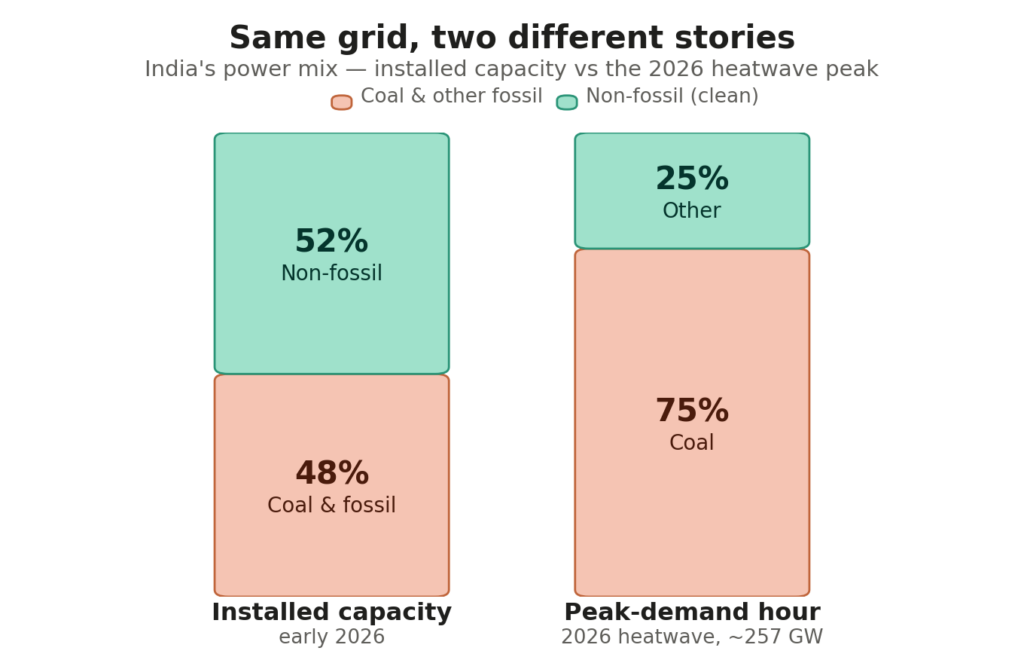
India is where the argument stops being abstract. The country has built one of the most aggressive clean-power programmes anywhere. Non-fossil sources passed half of total installed capacity in 2025; by early 2026, renewables were around 40% of the installed fleet, with record solar and wind going up year after year. A unit of solar electricity now costs about half what a new coal plant charges. Read off the capacity sheet, India looks like a transition that is working.
Then summer came. During a brutal 2026 heatwave, with the mercury past 45°C across much of the country, peak demand hit an all-time high near 270 GW. When the grid groaned under that load, solar panels and wind farms were not what kept it upright. Coal did, supplying upward of three-quarters of demand at the peak. The government ordered imported-coal plants to run flat out and told idle gas units to fire back up alongside them, for no grander reason than keeping the system from falling over.
Installed capacity is a flattering number. It tells you what could run, not what actually runs when everything is stretched. Solar gives you nothing at nine in the evening while the air conditioners are still going; wind comes and goes; India’s batteries and pumped hydro are real but nowhere near big enough to carry a subcontinent through the after-dark peak. So the firm capacity, the kind you can order to produce at any hour, is still mostly coal. A grid can read 40% renewable on the nameplate and run 75% on coal in the one hour that counts. That gap between the brochure and the load curve is the whole story, and the heatwave laid it bare: India’s transition is real where you add supply and largely unbuilt where you need reliability.
Delhi has read that lesson and drawn the opposite conclusion to the one the climate crowd hoped for. As of August 2025 the country had roughly 217 GW of coal and 6.6 GW of lignite installed, with about 35 GW of new supercritical and ultra-supercritical plants under construction across some 25 projects. The stated target is another 100 GW of coal over roughly seven years, and the Ministry of Power has reportedly floated a figure as high as 420 GW of coal capacity by 2047. Khurja, Buxar, Ghatampur, Patratu, Yadadri — through 2025 and 2026 the units kept inching toward commissioning, with more blocks queued out to 2030.
The supply side is just as committed. India set a production target of 1.31 billion tonnes for FY 2026-27, with Coal India Limited alone meant to deliver around a billion of that, which would be a record. Captive and commercial mines turned out 210.46 million tonnes in FY 2025-26, more than 10% up on the year before, and the Coal Ministry has dressed the whole expansion in the language of Aatmanirbhar Bharat — self-reliance, fewer imports. There is even ₹3,500 crore in the budget for coal and lignite gasification, which tells you the state is hunting for new things to do with coal, not fewer.
Officials have stopped pretending. At an industry summit, a NITI Aayog energy adviser said the plain part out loud: the country can’t afford to be “subjective” about coal, and the only live question is how sustainably it gets used. That single remark is more honest about Indian energy policy than any pledge in a glossy report. Coal is not the past. It is the plan.
3. Why coal’s new job breaks the capture math
There is a wrinkle buried inside the coal boom that quietly decides whether carbon capture can ever earn its keep, and it deserves a paragraph of its own.
Plenty of people doubt India needs all the coal it is pouring concrete for. Analysts at Ember and Climate Risk Horizons have warned for years about “zombie plants” — units neither properly used nor honestly retired, idling or running at uneconomic rates because the system already has more firm capacity than it can sell. Their work suggested India could cover its projected 2030 peak with no new coal beyond what’s already under construction, as long as it married its vast planned solar to enough battery storage to ride out the evening. On that reading, much of the new build is insurance against storage failing to show up in time, and ratepayers are the ones holding the premium.
The sharper point, though, is about how coal runs now, not how much of it there is. With solar beating it on price during daylight, coal is increasingly relegated to balancing duty: ramping up for the evening, covering the spikes, sitting back the rest of the time. Plant load factors, the measure of how hard the fleet actually works, have been drifting down for a decade. A coal plant that cycles part-time is a completely different animal from one that runs hard around the clock.
And that is poison for capture economics. The capture kit is brutally capital-heavy, and it only repays you if it runs constantly, pulling in a steady stream of CO₂ to smear those fixed costs across as many tonnes as possible. Hang it on a plant that fires up two evenings out of three and the numbers fall apart. You’ve bought a Ferrari to do the weekly grocery run. So India is, in effect, building two futures that contradict each other: a coal fleet drifting toward flexible, part-time work, and a capture plan that needs those same plants chained to the wall and running flat out. Something has to give.
4. CCUS gets a budget line — and a reality check
A quick word on the alphabet soup, because people muddle it constantly. CCUS — capture, utilisation and storage — means grabbing CO₂ where it’s made, then either putting it to use (oil recovery, chemicals, building materials) or burying it underground for good. It is not the same as pulling CO₂ that’s already loose in the open air, which is what carbon removal does. Capture cleans up the chimney it’s bolted to and nothing else. That last bit matters more than it sounds.
When the earlier article asked whether CCUS in India was reality or mirage, the fair answer at the time was: an aspiration with a policy paper stapled to it. NITI Aayog’s 2022 framework set the lodestar — 750 million tonnes a year of capture capacity by 2050 — and proposed the usual machinery of viability-gap funding and industrial hubs to get there. But a target without cash and working projects behind it is a slideshow.
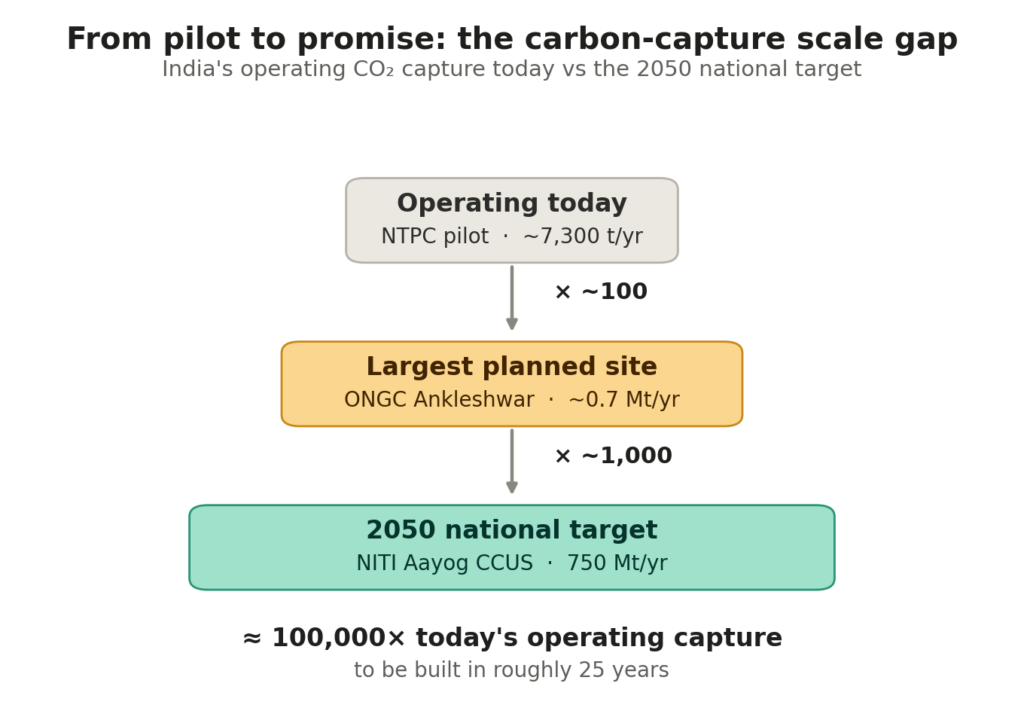
Two things have shifted since, and both deserve credit before the scepticism resumes. The money turned up, or at least the promise of it: the 2026-27 Union Budget put ₹20,000 crore over five years behind CCUS across power, steel, cement, refineries and chemicals, with NITI Aayog officials talking about covering anywhere from half to all of select project costs, and saying out loud that the point is to bolt capture onto coal-based energy. (There’s the security framing again, not the climate one.) And the scaffolding got sturdier. On 2 December 2025 the Department of Science and Technology launched the country’s first dedicated CCUS R&D roadmap, with a phased run from pilots in 2025–30 toward commercial scale later. On the ground, the pilots arrived: NTPC’s small unit at Vindhyachal, capturing about 20 tonnes a day; ONGC injecting CO₂ into spent wells at the Gandhar field in Gujarat while squeezing out more oil; NTPC’s first geological storage borewell in Jharkhand; capture pilots at Tata Steel in Jamshedpur and JSW Steel at Dolvi.
So the mirage has acquired some hard edges. There’s a budget line, a roadmap, an R&D push, real steel in the ground. Set against where things stood two years ago, that’s progress, and pretending otherwise would be dishonest.
Still, a scaffold is not a building. The pilots are minute. Call NTPC’s 20-tonnes-a-day rig a step and you flatter it; leading projects abroad already run in the millions of tonnes a year, and ONGC’s Ankleshwar site tops out at a potential 0.7 million tonnes. To reach the 2050 number, India would have to scale its real-world capture roughly ten-thousand-fold in twenty-five years while conjuring an entire CO₂ plumbing industry from nothing: pipelines, injection sites, monitoring, the legal question of who’s liable if it leaks in 2095. The pilots and the promise are not in the same postal code.
5. The arithmetic that keeps CCUS honest
Three numbers explain why the doubters haven’t gone quiet.
Cost
Stripping CO₂ out of a coal plant’s flue gas is dear — international experience lands somewhere around USD 28–40 a tonne, with a hope, demonstrated nowhere near India’s intended scale, of getting it down to USD 10–20. Wood Mackenzie has pencilled in about USD 4.3 billion of government support to make CCUS work here at scale. The ₹20,000 crore on the table, roughly USD 2.4 billion, is real money, but it’s plausibly half of what that estimate calls for, and it’s spread thin across five hungry industries. And capture is only the opening move; the gas then has to be compressed, piped and stored, every leg adding to the bill.
The energy penalty (and the water that goes with it)
Running the capture gear eats a fat slice of the plant’s own output — energy you get by burning still more coal. The studies say CCUS can knock 63–82% off a plant’s warming impact, which sounds great until you sit with the other side of it: a real chunk of what the plant makes now goes to cleaning up the rest of what the plant makes. You burn more coal to bury the carbon from the coal you already burned. There’s a thirstier problem lurking too. Conventional amine capture drinks water, and so does coal generation, in a coal belt where water is already scarce and getting scarcer. No subsidy makes either penalty disappear.
Opportunity cost
Here the independent voices have been bluntest. The Institute for Energy Economics and Financial Analysis, going through the 2026 budget, flagged the capture and coal-gasification money as “capital-intensive and technologically uncertain,” the sort of thing that “would benefit from careful assessment against cost-effectiveness and deployment timelines” — pointed language, given how cheap and proven renewables, storage and electrification have become. The buried question is the uncomfortable one. Every rupee that goes toward making coal cheaper to keep burning is a rupee not spent on the storage and grid that would let India burn less of it. Capture doesn’t just compete with emissions. It competes for money with the very things that could retire the need for it.
6. What the rest of the world has learned
India isn’t deciding this blind. The global record on carbon capture is exactly the evidence a careful reader would want, and it points two ways at once.
The good news lives in dedicated storage. Gas operations in Norway and elsewhere have been pushing CO₂ underground for decades with no great drama and no significant leaks, which settles the basic question of whether the stuff stays put: it does. Permanent storage is an engineering job, not a fairy tale.
The bad news lives in the power sector specifically. The marquee attempts to strap capture onto coal-fired electricity have an unhappy track record — late, over budget, capturing less than advertised, running fitfully, sometimes mothballed when the sums stopped working. The United States ended up propping the whole effort on a fat production-style tax credit (the 45Q scheme, lifted to around USD 85 a tonne for stored carbon), which is itself a confession that capture can’t stand on its own commercial legs. Twenty-odd years of this point the same way India’s own arithmetic does: capture is most believable where the CO₂ is concentrated and the plant runs steady, least believable strapped to power generation that’s going part-time. (Which flagship is up or mothballed shifts year to year; it’s the pattern that holds, not any one plant.)
7. The cost coal won’t show on a meter
There’s a reason coal is back that no spreadsheet of cost-per-tonne will surface, and any honest account of Indian energy has to say it plainly: people.
Coal in India is not just a fuel. It’s an economy, and a vote bank. Industry estimates put the livelihoods hanging off it — mining, the railways that haul it, the plants that burn it, the steel and cement downstream — at something like 13 million. Whole districts across Jharkhand, Chhattisgarh, Odisha and Bengal are organised around a pit and a power station. Royalties and levies prop up state budgets; the District Mineral Foundation money that comes out of mining pays for the local school and the local clinic. When a politician contemplates shutting a coal plant, the maths in their head isn’t kilowatt-hours. It’s jobs, and seats, and the tax base of an entire region.
Which is why coal’s stubbornness isn’t simply bad planning, and why an analysis that treats it as a dispatch decision will read as naïve to anyone who’s spent time in those districts. A just transition — retraining, new work, some believable economic future for places that have only ever known coal — isn’t a nice-to-have bolted onto the energy story. In India it’s the thing that sets the speed limit on all of it.
The financial system holds the other end of the risk. A lot of the new coal is bankrolled by public-sector banks and leans on distribution companies whose books are already shaky. If the insurance plants end up running at thin capacity factors — the zombie scenario, exactly — the country is left paying down loans on assets it barely uses, and the cost lands on ratepayers and taxpayers rather than on any meter you’d notice. Build coal as a hedge if you must. But a hedge nobody ends up calling still has to be paid for.
8. Where CCUS is reality, and where it is mirage
Now the verdict has earned its keep. The error in both the cheerleading and the dismissals is to treat capture as one thing you’re either for or against. The reading that actually survives the 2026 evidence is messier: CCUS is real in some places and a mirage in others, and telling them apart is the whole game.
Reality: the cement kiln and the blast furnace
Capture comes closest to real in the hard-to-abate industries, which is where NITI Aayog pointed from the start. Steel and cement don’t just burn fuel for heat you could in principle electrify away; their basic chemistry coughs up CO₂ no matter what. You can’t bake the clinker for cement without driving carbon dioxide out of limestone, and you can’t make virgin steel in a blast furnace without carbon doing the work. There’s no renewable waiting in the wings for either. Capture is one of the only honest routes to deep cuts. The Council on Energy, Environment and Water reckons CCUS may be needed to take out as much as 56% of steel’s emissions, and that steel and cement between them could need an extra ₹47 lakh crore of capital by 2050 to get to net zero.
What’s changed is that there’s now a market reason to do it, not just a moral one. Steelmakers selling abroad are running into carbon border levies — the EU’s CBAM, mainly — that tax the carbon baked into the product. India’s new Green Steel Taxonomy answers that by letting steel made below 2.2 tonnes of CO₂ per tonne of crude steel wear an official “green” label. Once a cleaner tonne fetches a better price, or dodges a tax at someone’s border, capture stops being a favour to the planet and starts being a commercial play. The Tata and JSW pilots sit squarely in this hopeful camp.
Mirage: the coal power station
Capture slides toward mirage in precisely the place India wants it most — fixed to the coal power fleet so the 100 GW splurge can claim a path to net zero. This is where the economics are thinnest, the energy penalty bites hardest, the cycling fleet breaks the math, and the cheaper alternative is sitting right there. It’s also where capture quietly turns from an engineering question into a political one. Believe that coal plants can be cleaned up later and you’ve handed yourself a licence to keep building them now; the promised future fix shaves the apparent cost of the present spree. The risk was never really that the kit won’t work. It’s that the expectation of it works far too well — well enough to wave through gigawatts of unabated coal that nobody quite gets around to retrofitting, because by the time the bill arrives, solar and a battery will be cheaper than the retrofit anyway.
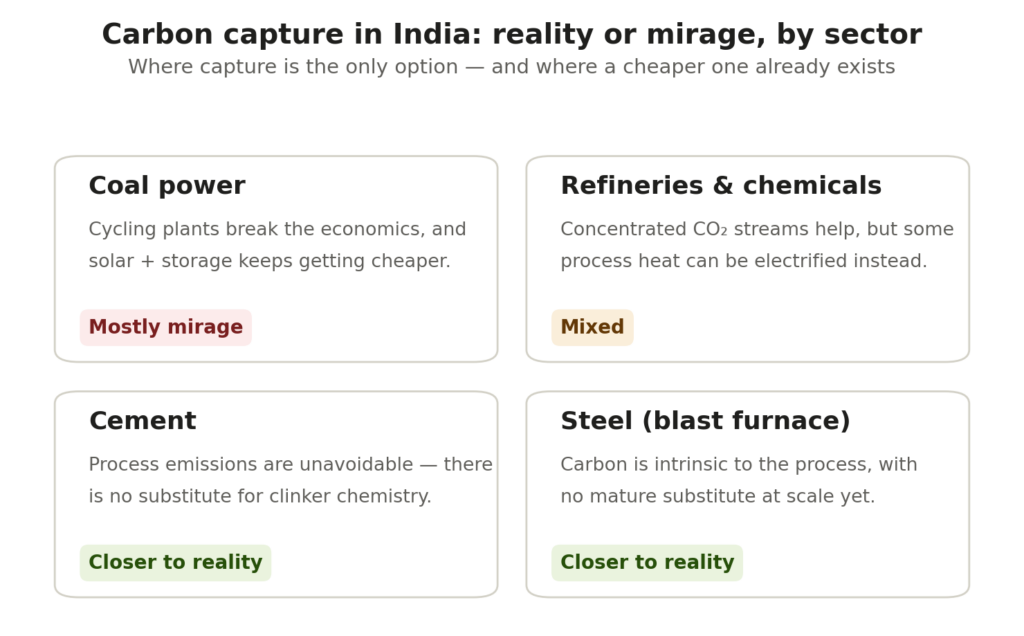
The verdict, in one table
| Sector | Is capture feasible? | Cheaper clean alternative? | Verdict |
| Coal power | Technically yes, but cycling plants break the economics | Yes — solar + storage, improving yearly | Mostly mirage |
| Refineries / chemicals | Yes; concentrated CO₂ streams help | Partial; some process heat electrifiable | Mixed |
| Cement | Yes; process emissions unavoidable | No substitute for clinker chemistry | Closer to reality |
| Steel (blast furnace) | Yes; carbon intrinsic to the process | No mature substitute at scale | Closer to reality |
This is the seam that joins the two articles. “Coal is back” is the demand-side fact: India will burn enormous, possibly rising, quantities of it for decades. “Reality or mirage” is the question of whether that coal can be reconciled with a 2070 net-zero pledge. The worry is that the second is being quietly conscripted to excuse the first.
9. Four things honest policy would do
If India genuinely means to keep the lights on and hit net zero, the move isn’t to pick coal over capture or to pretend either is going anywhere. It’s to be merciless about what each can actually do.
1. Spend the capture money where capture is the only game in town. Aim the scarce ₹20,000 crore at cement, steel, and the refinery and chemical processes with no renewable substitute, rather than thinning it across a power-sector retrofit dream that’s competing with cheaper storage. Pointed at hard-to-abate industry, that money could anchor something real. Sprinkled over coal-power capture, it mostly buys expensive demos that never scale.
2. Treat the storage gap as temporary, and out-build it. The alternative to coal isn’t mysterious. India’s daytime solar surplus is already so large that solar routinely undercuts coal; the bind is the evening, those few hours after sundown when the ACs are still humming and the panels have clocked off. Four-hour batteries and pumped hydro exist precisely for that window, and analysts have argued the evening peak can be met more cheaply with storage than with new coal. The fair caveat is that this capacity hasn’t been built at the scale a 257 GW peak demands — which is exactly why coal came roaring back in 2026. The choice is whether that gap becomes a permanent excuse to build coal or a temporary problem you out-build with storage, transmission and a bit of demand flexibility.
3. Be straight about retrofit timelines, or price them in. If a plant going up in 2027 is supposed to get capture in the 2040s, say so, fund the eventual retrofit for real, and build the thing retrofit-ready. Otherwise admit the retrofit is a story you’re telling, and price the plant’s full lifetime emissions accordingly. What India shouldn’t do is keep building unabated coal on the unspoken faith that capture will tidy it up someday.
4. Put a real price on carbon. No amount of viability-gap funding does the work a carbon price would. India’s carbon market is still thin, trading well below the level that would make capture pay for itself. A modest coal cess — proposals have floated around USD 5 a tonne, which could raise USD 6–7 billion a year by 2030 — would fund the transition infrastructure coal’s comeback has made urgent while nudging investment off the dirtiest options. One price does in a stroke what a dozen subsidies fumble at piecemeal.
10. What to watch in 2026–27
A few concrete tells will show whether capture is graduating from slideshow to system:
- Scale. Does any Indian pilot jump from tonnes-a-day to a commercial plant measured in millions of tonnes a year? Until one does, the chasm stands.
- A first real investment decision. Watch for the first final go-ahead on a full-scale capture project, and where it lands — cement or steel (a good sign) or propped on a coal power plant (a warning).
- The carbon price. Is India’s carbon market crawling toward the level, well above today’s, where capture starts paying its own way?
- The coal pipeline, as built. Announced gigawatts are cheap. Watch how much of the 100 GW actually gets built, and how hard it runs once it’s online.
- Storage. The single number that matters most: how fast batteries and pumped hydro go up against that evening gap.
11. The plateau, not the cliff
The defining energy fact of the mid-2020s is that the transition isn’t a cliff coal tumbles off. It’s a long, contested plateau coal sits on top of while the alternatives get built underneath it. Globally, demand has levelled off at record highs instead of cratering. In India, coal isn’t merely hanging on; it’s growing, right alongside the renewables, the two of them climbing together rather than one shoving the other aside. The clean build is real. So is the coal build. Both are true at the same time, and the strain of holding both in your head is exactly what makes any honest version of this so hard to say.
Capture sits on the fault line between them. In theory it’s the thing that lets the two coexist. That’s a tremendous load to hang on a technology that, after decades of promising, still runs in India at tens of tonnes a day when the plan calls for hundreds of millions of tonnes a year.
So, the verdict, sharpened: CCUS in India is neither all real nor all mirage. It’s real for the cement kiln and the blast furnace, where nothing better exists. It’s mostly mirage for the coal power station, where something cheaper exists and keeps getting cheaper, and where the main use of the capture promise may simply be to justify a coal expansion the promise itself can’t honestly carry.
Coal is back. That much is settled, here and everywhere. What isn’t settled is whether India spends the next decade building the firm, clean capacity that would let coal actually fade, or leans on the anticipation of carbon capture to keep building the very fuel it claims to be quitting. The second path doesn’t ask anyone to lie. It only asks everyone to keep believing, plausibly and indefinitely, that the cleanup is on its way. The sweating grid of summer 2026 already hints at which way the bet is going down — one plant, one budget line, one fiscal year at a time.
This article extends the analysis in “Carbon Capture, Utilisation and Storage in India: Reality or Mirage?” Figures and policy details draw on the International Energy Agency (Coal 2025 and Global Energy Review 2026), NITI Aayog’s CCUS Policy Framework (2022), the Union Budget 2026-27, the Department of Science & Technology’s CCUS R&D Roadmap (December 2025), and analyses by IEEFA, Ember, CEEW and Wood Mackenzie, alongside Ministry of Coal and Ministry of Power data. Employment, cost and emissions figures reflect ranges reported in government, peer-reviewed and industry sources and are indicative rather than precise; the status of individual international capture projects, carbon-price levels and tax-credit values should be checked against current reporting before publication.
Amulya Charan writes on energy systems, infrastructure economics, and development policy at amulyacharan.com. This analysis draws on reporting from Business Standard, ThePrint, Business Today, and the Press Information Bureau, and on policy research from the Takshashila Institution and the Observer Research Foundation.