Geothermal Energy in India: The Overlooked Firm-Power Opportunity
India has spent half a century studying heat beneath its surface. The question now is not whether geothermal exists, but whether a small, difficult resource can become useful exactly where India’s power system needs it most.
| 10.6 GW Theoretical potential | 42 Promising manifestations | July 2026 Two Puga wells commissioned |
India has known about this heat for decades
There is something faintly comic about calling geothermal a new opportunity for India. The country has been studying its hot springs since the early 1970s. Puga Valley in Ladakh has appeared in reports, project proposals and hopeful announcements for so long that scepticism is entirely reasonable.
This time, though, there is at least something concrete to point to. In July 2026, the ONGC Energy Centre commissioned two geothermal wells at Puga, each about 1,000 metres deep and drilled at an altitude above 14,000 feet. The wells are meant to evaluate the reservoir and support a proposed 1 MW demonstration plant. One megawatt is barely a rounding error in India’s electricity system. As a test of whether Puga can finally move from geology to generation, it matters a great deal more.
The policy backdrop has changed too. India notified its first National Policy on Geothermal Energy in September 2025. Binary-cycle technology has made moderate-temperature resources more usable. Oil and gas companies are looking at depleted and abandoned wells with a different question: could some of them produce heat after they stop producing hydrocarbons?
None of this guarantees a geothermal industry. It does, however, make the old question more interesting. India already knows the heat is there. Can it turn any of it into dependable, economic energy?
The real prize is not cheap energy. It is energy at the right hour.
India’s renewable build-out has changed the terms of the electricity debate. Solar has become enormous. Wind continues to expand. By mid-2026, more than half of India’s installed electricity capacity was non-fossil. That is a genuine achievement.
But the next part is harder. A power system cannot run on annual energy totals. It has to balance supply and demand every minute. Solar fades after sunset. Wind may be blowing, or it may not. Batteries can shift electricity from one hour to another; pumped hydro can do the same over longer stretches; nuclear, hydro, gas and coal each bring their own form of dependable capacity.
So the question is changing. The cheapest daytime kilowatt-hour is no longer the only prize. What matters increasingly is electricity that can be counted on when the grid actually needs it.
The market is beginning to put a price on that. In August 2026, a Solar Energy Corporation of India tender for 1 GW of firm and dispatchable renewable energy on a round-the-clock basis discovered a lowest tariff of ₹5.25 per kWh. It would be wrong to compare that mechanically with a plain solar tariff; they are different products. But the gap tells us something useful. Firmness has value.
That is the narrow opening for geothermal. Where the geology works, a geothermal plant can run through the night, through cloudy weeks and through a still evening. It needs no fuel shipment and no daily recharge. Geothermal does not replace batteries or pumped hydro. It simply brings a different kind of reliability to the table.
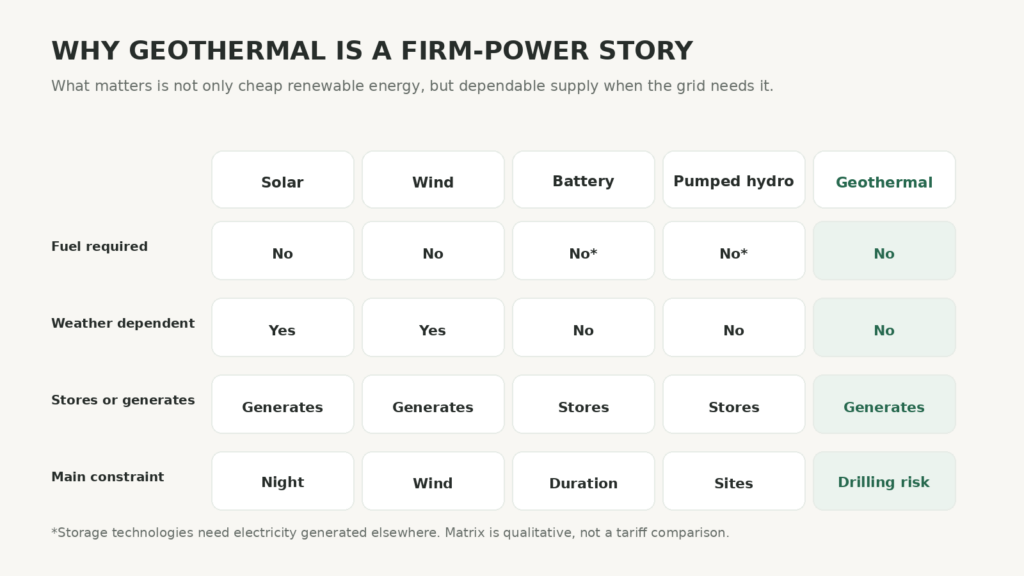
Figure 2. Geothermal is best understood as one option in the firm-power portfolio, not as a substitute for solar or wind.
India’s resource is modest – and that is not the same as irrelevant
The Geological Survey of India has mapped 381 hot springs across 10 geothermal provinces. The current estimate of conventional theoretical potential is about 10.6 GW, with 42 geothermal manifestations identified as promising for further exploration or direct-heat use.
Put beside an electricity system approaching 550 GW, 10.6 GW does not look revolutionary. It is not. Anyone selling geothermal as India’s next solar is setting it up to disappoint.
Nameplate capacity, however, is a poor way to compare technologies that behave differently. Solar produces when the sun is available. Geothermal, once a reservoir is proven and managed properly, can operate for most hours of the year. A smaller fleet can therefore deliver more annual energy per installed megawatt and, more importantly, deliver some of it at hours when solar cannot.
There is also a technological caveat. The 10.6 GW figure reflects India’s conventionally assessed resource. Deeper drilling and enhanced geothermal systems could eventually widen the usable resource base. The International Energy Agency sees next-generation geothermal as a potentially much larger global resource if drilling and reservoir technologies continue to improve.
That is a future possibility, not a bankable Indian number. India has enough work to do proving the conventional resource it already knows about.
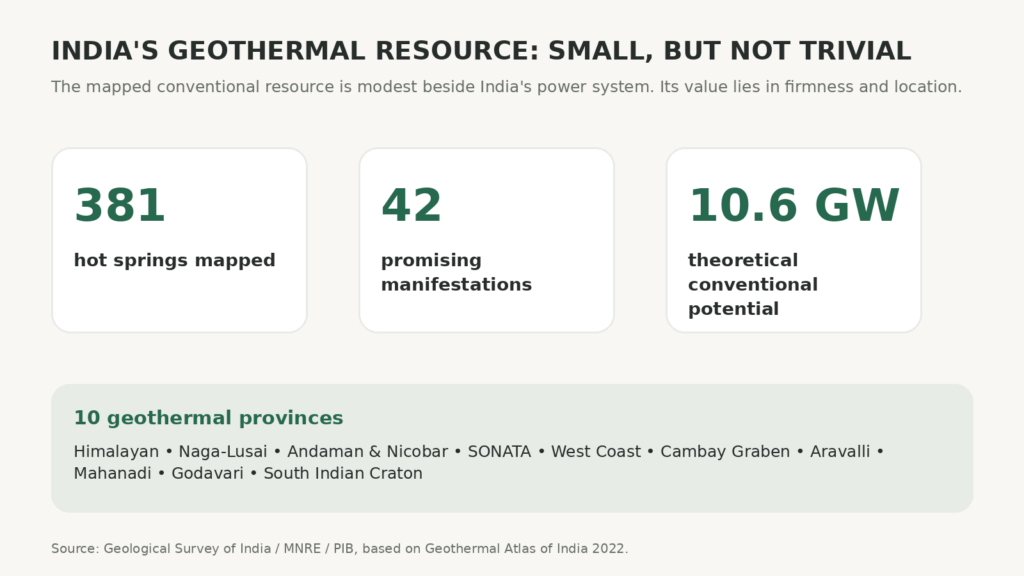
Figure 1. India’s mapped geothermal resource: enough to matter, not enough to dominate.
The machines improved. The rocks did not.
India’s geology has not suddenly become hotter. What changed is the equipment used to extract value from moderate heat.
Traditional geothermal power was easiest where temperatures were high enough to produce steam efficiently. A large part of India’s known resource sits at more moderate temperatures. Binary-cycle systems, including Organic Rankine Cycle plants, make some of those resources more useful by transferring geothermal heat to a secondary fluid with a lower boiling point.
That sounds like a technical detail. For India it is central. A resource that once looked too cool for power can now at least be tested seriously.
But temperature alone does not make a project. Flow rate matters. So do permeability, well depth, fluid chemistry, reinjection performance and the power consumed by pumps. A hot hole in the ground can still be an expensive failure.
Which leads to geothermal’s least glamorous feature: you often have to spend serious money before you know whether you have a business.
The first well is where finance gets nervous
Solar and wind developers can measure much of their resource before committing the bulk of construction capital. Geothermal developers eventually have to drill into the uncertainty.
An IFC and ESMAP study covering more than 2,600 geothermal wells across 57 fields found that drilling success generally improves as a field becomes better understood. The first wells carry the greatest uncertainty. Later wells benefit from what the earlier ones – successful or not – have taught the developer.
This gives geothermal an awkward financial shape. Early exploration looks a little like oil and gas: expensive, geological and uncertain. A proven field looks much more like infrastructure: high upfront capital, no fuel bill and a long operating life.
Commercial lenders naturally prefer the second half of that story. The difficult question is who pays for the first half.
That is why countries with serious geothermal industries have often used public or concessional finance to absorb part of the exploration risk. The World Bank’s geothermal programmes have focused heavily on exactly this bottleneck. India’s 2025 policy recognises the need for risk-sharing and financing support, but the country still lacks a mature mechanism that makes the first wells comfortably financeable.
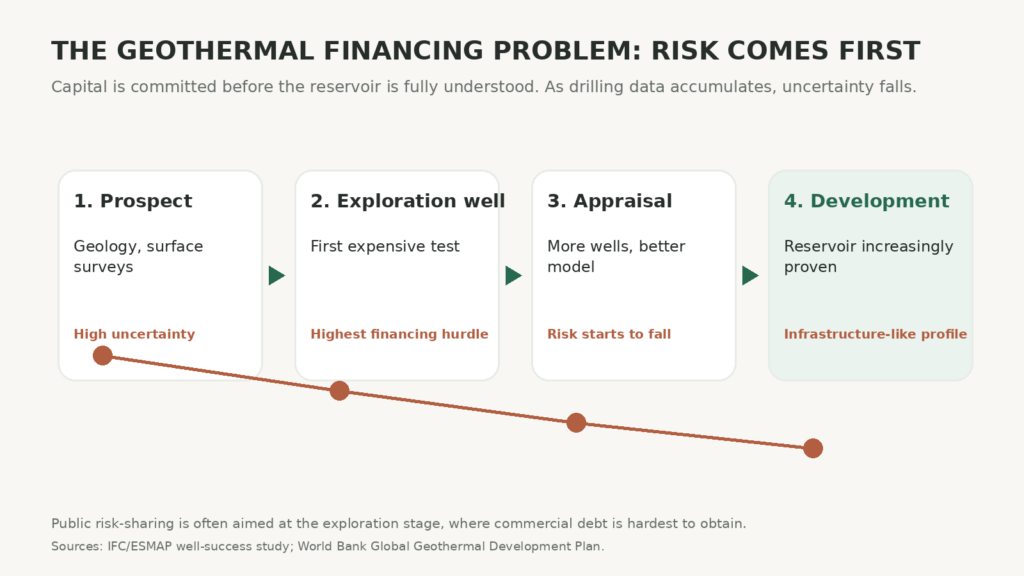
Figure 3. Geothermal finance is hardest before the reservoir is proven.
The 2025 policy matters because there was no framework before it
The National Policy on Geothermal Energy is easy to either oversell or dismiss. It deserves neither treatment.
It is not a giant subsidy scheme. It does not make difficult geology easy. What it does is give a neglected sector a national framework: a nodal ministry, an exploration-and-development structure, an emphasis on state-level facilitation, a push for better geothermal data, and recognition of direct heat as well as electricity.
The data piece could be particularly important. India’s public-sector oil and gas industry has accumulated decades of well logs, temperature records and subsurface information. Some of that may be useful for geothermal exploration. Every old data point that helps rule a site in or out is cheaper than drilling a new hole to learn the same lesson.
The policy also explicitly recognises the possibility of repurposing abandoned oil and gas wells. That is a sensible bridge between an established Indian capability and a sector that has barely begun.
Still, the distinction between a framework and an incentive package matters. India allows 100% foreign direct investment in renewable energy, while the geothermal policy discusses possible fiscal support, concessional finance and risk-sharing. Many of those measures need further implementation. The rulebook now exists. The commercial machinery around it is still being assembled.
The most practical experiment may be sitting in an old oilfield
Puga will get the photographs. The more repeatable idea may turn out to be much less dramatic: using old oil and gas wells.
ONGC offered an early proof point in April 2026 when it inaugurated a 450 kW geothermal pilot at Gandhar Field under the “Wells to Watts” initiative, working with IIT Madras and with MNRE support. The project repurposes an abandoned well rather than starting with a fresh geothermal borehole.
The appeal is obvious. The hole has already been drilled. There is subsurface data. Roads and industrial infrastructure may already exist. In some cases there is a nearby captive load. Those advantages do not make the heat free, but they remove several of the costs that hurt greenfield geothermal.
This is also where India’s oil and gas sector becomes an asset rather than a legacy problem. The IEA estimates that up to 80% of the investment in geothermal can involve skills and capabilities familiar to oil and gas companies: drilling, subsurface modelling, reservoir management, project execution and surface operations.
There are limits. Old casing may need work. Flow may be poor. Temperature can be disappointing. Pumping can eat into net output. A few hundred kilowatts from one well will not excite a national grid planner.
It may still make perfect sense behind the meter. A converted well that reliably supplies captive electricity or process heat to an oilfield can be commercially useful without ever becoming a headline power station.
Figure 4. “Wells to Watts” reduces some greenfield costs by reusing existing oilfield infrastructure.
Do not forget the heat while chasing the megawatts
Electricity gets most of the attention because megawatts are easy to count. Geothermal’s first viable Indian markets may lie in heat instead.
Food processing, crop drying, greenhouses, aquaculture and some industrial processes can use low- or medium-temperature heat directly. Ground-source heat pumps use the relatively stable temperature of the ground to improve heating and cooling efficiency. The 2025 policy deliberately includes these applications.
Direct use avoids an obvious inefficiency. If a factory needs heat, there is little virtue in turning geothermal heat into electricity only to convert that electricity back into heat. Where a suitable resource sits near a suitable user, the economics can look quite different from those of a grid-connected power project.
This is one reason India should resist judging geothermal by a single electricity tariff. Some resources that never justify a turbine may still displace coal, gas or biomass in an industrial heat application.
The environmental case is good, not spotless
Geothermal is low-carbon. It is not consequence-free.
Puga sits in a fragile high-altitude landscape. Drilling brings machinery, roads, water management and the need to handle geothermal fluids carefully. A 2022 incident, when fluid was released into a local stream after pressures exceeded expectations, prompted criticism from environmental groups and was a reminder that geothermal wells are industrial wells, not harmless hot springs with turbines attached.
Scale matters too. A 1 MW demonstration plant has one footprint. A commercial field with multiple production and reinjection wells, pipelines, roads and surface equipment has another.
Enhanced geothermal systems add a different risk: induced seismicity. Projects at Basel and Pohang showed that stimulation can, in some settings, trigger damaging earthquakes. That does not mean every geothermal project carries the same risk; conventional hydrothermal systems and engineered reservoirs are different propositions. But if India eventually moves towards EGS in tectonically active regions, seismic monitoring and operational shutdown protocols cannot be an afterthought.
The sensible approach is not to use environmental risk as an argument against geothermal. It is to write the rules while the industry is still small enough to learn cheaply.
Why the world is looking at geothermal again
For years, geothermal seemed destined to remain a specialist technology for countries blessed with obvious high-temperature resources. The revival is being driven partly by techniques borrowed from oil and gas: directional drilling, horizontal wells, better subsurface imaging and more sophisticated reservoir engineering.
The IEA thinks the upside could be large if those techniques drive costs down. In a strong cost-reduction scenario, it sees cumulative geothermal investment reaching about $1 trillion by 2035 and $2.5 trillion by 2050, with next-generation costs potentially falling by as much as 80% by 2035. Those are conditional scenarios, not promises.
The enthusiasm around Fervo Energy in the United States shows how much capital is willing to bet on the learning curve. Fervo’s May 2026 IPO raised about $2.2 billion in gross proceeds. By June it reported 658 MW under binding power-purchase agreements and other arrangements, representing about $7.2 billion in potential revenue backlog. It also disclosed that it had not yet begun large-scale commercial operations.
That combination is worth dwelling on. Investors are paying for what geothermal might become if drilling gets cheaper and more repeatable, not simply for what it costs today.
India does not need to imitate that wager. But it should understand what is changing underneath it.
What India should learn before it announces another target
Geothermal does not need a heroic national capacity target yet. It needs evidence.
The next few years should be used to answer mundane questions that will matter far more than slogans. What does an Indian geothermal well actually cost? How often does drilling succeed? What output can a reservoir sustain? How quickly does it decline? What does reinjection do to performance and cost? Which abandoned wells have enough heat and flow to justify conversion?
A carefully designed exploration-risk mechanism would help produce those answers. So would a serious national effort to organise subsurface data held by GSI, DGH, ONGC, Oil India and research institutions. Abandoned wells should be screened as a portfolio rather than discovered one pilot at a time.
Regulators will eventually need a way to value geothermal fairly. A high-capital, no-fuel plant that can run around the clock should not be compared lazily with the tariff of a solar plant that sells a different product. Nor should geothermal be protected from competition. It should have to show what its firmness, location and fuel independence are worth.
And direct-use projects deserve equal attention. The first bankable Indian geothermal project may turn out to be a heat project that barely troubles the electricity statistics. That would still count as success.
A small option can still be a valuable one
India’s energy transition has become so large that every technology is asked the same question: can it deliver tens or hundreds of gigawatts? Geothermal probably cannot, at least on the resource base India has demonstrated so far.
That is not a reason to ignore it.
A power system with vast amounts of solar and wind will increasingly value things that a simple daytime tariff does not capture: availability after sunset, fuel security, land use, local reliability and the ability to serve demand when weather-dependent generation is weak.
Geothermal offers some of those qualities. It is domestic. It needs no continuing fuel imports. It can provide electricity and useful heat. And much of the industrial skill needed to test it already exists in India’s oil and gas companies.
The drawbacks are just as real. The mapped resource is modest. Exploration is expensive. Commercial performance in India is barely proven. Environmentally sensitive sites demand care, and engineered geothermal would bring additional seismic questions. The 2025 policy is a beginning, not an industry.
Which is why Puga should not be judged by whether one megawatt changes the grid. It should be judged by whether India learns enough from those wells to make the next project easier to finance, quicker to permit and less uncertain to drill.
For fifty years, Indian geothermal has lived mostly in the future tense. The interesting change is that a few wells, a policy and some new technology have finally pulled part of it into the present.
Major references
Primary and near-primary sources are listed first wherever possible so readers can verify the article’s principal factual claims.
1. Ministry of New and Renewable Energy (MNRE). National Policy on Geothermal Energy, notified 15 September 2025. Source link
2. Press Information Bureau, Government of India. Geothermal Energy: A New Chapter in India’s Clean Energy Journey, 4 September 2026. Puga wells, 1 MW demonstration project and current programme overview. Source link
3. Press Information Bureau / MNRE. MNRE Steps Up Global Collaboration for Advancing Geothermal Energy in India, 8 December 2025. GSI resource estimate: 381 hot springs, 42 promising manifestations, about 10.6 GW theoretical potential. Source link
4. Press Information Bureau / MNRE. Geothermal Energy (RDD&D) Projects, 24 July 2024. GSI Geothermal Atlas 2022 and Manuguru pilot. Source link
5. International Energy Agency. The Future of Geothermal Energy (2024). Global market potential, cost-reduction scenarios and overlap with oil-and-gas skills. Source link
6. IFC / ESMAP. Success of Geothermal Wells: A Global Study. Evidence on drilling success, learning and exploration risk across geothermal fields. Source link
7. World Bank / ESMAP. The Global Geothermal Development Plan: Mitigating Upstream Cost and Risk. Exploration-risk finance and concessional mechanisms. Source link
8. ONGC. Wells to Watts: Gandhar Field geothermal pilot, 24 April 2026; 450 kW using a repurposed abandoned well, with IIT Madras and MNRE support. Source link
9. pv magazine India. SECI’s 1 GW FDRE-RTC power tender discovers INR 5.25/kWh tariff, 7 August 2026. Source link
10. Zhou et al., Reviews of Geophysics. Managing Induced Seismicity Risks From Enhanced Geothermal Systems: A Good Practice Guideline (2024). Source link
11. Fervo Energy / U.S. Securities and Exchange Commission. Form 10-Q for quarter ended 30 June 2026. IPO proceeds, binding PPAs and potential revenue backlog. Source link
Editorial note: Figures describing India’s geothermal resource are theoretical or exploratory estimates unless stated otherwise. Demonstration projects should not be read as evidence of commercial-scale economics.