Global Warming and Heat Waves: The Impact on India and What Must Change
Amulya Charan April 2026
(Updated Blog of June 2024)
This article first appeared on my blog in June 2024, when Delhi had just crossed 50°C and the country was in the grip of one of its most severe heat wave seasons. Two years on, the pattern has not only persisted but intensified. I felt it was important to revisit this piece — to update the data, sharpen the analysis, and hold it up against what India has actually done (and not done) in the intervening period. What follows is a substantially rewritten version of the original.
In May 2024, parts of Delhi and Rajasthan crossed 50°C. Hospitals across northern India reported surges in heatstroke cases. Power grids buckled under the load of millions of air conditioners and coolers running simultaneously. This was not a freak event — it was the latest chapter in a pattern that has been intensifying for decades.
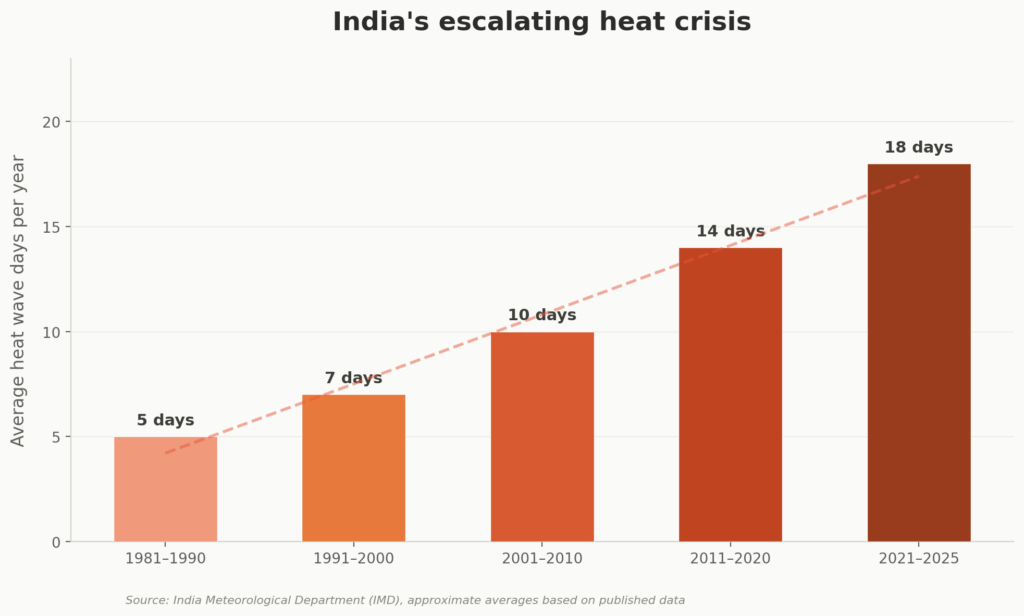
India is on the front lines of a global crisis. The India Meteorological Department (IMD) has documented a sharp increase in the frequency and duration of heat waves since the 1980s. What was once a two-week ordeal in a handful of states now stretches across months and across the country. The consequences ripple outward — from glaciers to groundwater, from crop yields to city streets.
This article examines how heat waves and rising temperatures are reshaping India’s environment, economy, and daily life, and outlines what must change at the policy, technology, and community levels.
India’s Escalating Heat Crisis: The Numbers
India’s geography makes it especially vulnerable to heat extremes. The 2023 and 2024 summers shattered records across multiple states: Delhi saw sustained temperatures above 45°C for days at a stretch, while Rajasthan’s desert regions repeatedly crossed 50°C.
The trend is clear and accelerating. IMD data shows that heat wave events have roughly doubled in frequency over the past three decades. The 2015 heat wave in Andhra Pradesh and Telangana killed over 2,000 people — a stark reminder that these are not weather statistics but life-and-death events.
The economic toll is equally severe. The International Labour Organization has estimated that India could lose the equivalent of 34 million full-time jobs by 2030 due to heat stress alone, with outdoor sectors like construction, agriculture, and street vending bearing the brunt. For a country where a significant share of the workforce operates outdoors, this is not a distant projection — it is an unfolding reality.
Glaciers, Monsoons, and Cyclones: A Shifting Climate System
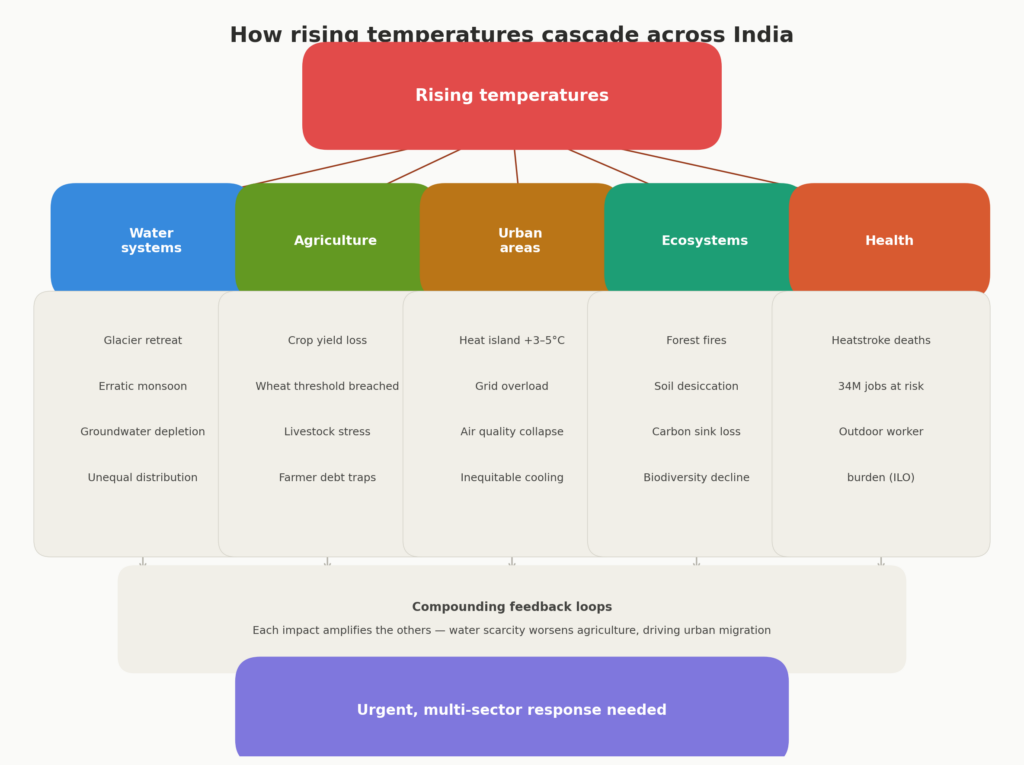
Rising temperatures are destabilising the large-scale systems that India’s water, food, and energy security depend on.
Himalayan Glaciers. The glaciers that feed the Ganges, Brahmaputra, and Indus river systems are receding at an accelerating rate. In the near term, increased meltwater raises flood risk in mountain and foothill regions. Over the longer term, shrinking glaciers mean reduced dry-season river flows — a slow-moving crisis for the hundreds of millions of people who depend on these rivers.
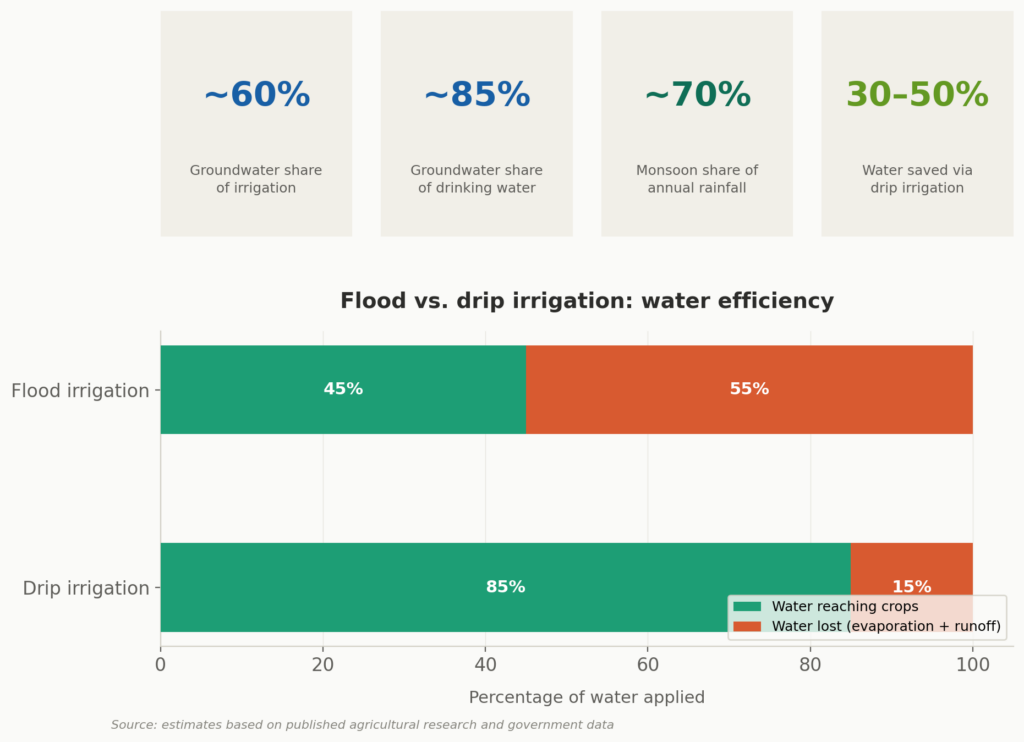
Monsoon Disruption. India’s monsoon, which delivers roughly 70% of the country’s annual rainfall, is becoming more erratic — fewer rainy days but with more intense bursts. This means both drought and flood risk can increase in the same year, sometimes in the same state. For a nation that stakes its agricultural calendar on the monsoon’s arrival, this growing unpredictability is deeply consequential.
Tropical Cyclones. Warmer sea surface temperatures are increasing the intensity of cyclones in the Arabian Sea and Bay of Bengal, threatening coastal communities and infrastructure. The rapid intensification of recent cyclones — where storms escalate from moderate to severe in a matter of hours — has made preparation and evacuation timelines dangerously short.
Air Quality. Heat waves also worsen air pollution. Higher temperatures accelerate the formation of ground-level ozone, compounding India’s existing particulate pollution crisis. During heat wave periods, cities like Delhi and Lucknow often see simultaneous spikes in temperature and air quality index readings — a double burden on public health.
Forests and Ecosystems Under Heat Stress
India’s ecosystems — from the Western Ghats’ tropical forests to the Thar Desert’s scrublands — are under mounting pressure. Prolonged heat desiccates soil, reduces plant growth, and increases the risk of forest fires. India has recorded a significant rise in forest fire incidents in recent years, with satellite data showing increased fire hotspots across Uttarakhand, Odisha, and the northeast.
Forests serve as carbon sinks; their degradation feeds back into the warming cycle. Wetlands, mangroves, and grasslands — all of which provide critical ecosystem services including flood buffering, water filtration, and biodiversity support — are similarly under threat. The loss of these natural buffers amplifies the very climate impacts they once helped absorb.
Urban Heat Islands: Why Cities Are Boiling
India’s cities are heating faster than the country as a whole. The urban heat island effect — caused by dense concrete, asphalt, and a lack of green cover — means cities like Delhi, Mumbai, Chennai, and Kolkata can be 3–5°C warmer than surrounding rural areas.
The consequences cascade: higher electricity demand (and more frequent blackouts), worsened air quality from increased cooling loads, and direct health impacts including heatstroke, dehydration, and cardiovascular stress. The burden falls hardest on outdoor workers, slum dwellers, the elderly, and children — populations with the least access to cooling and healthcare.
The inequity is stark. In a city like Delhi, a resident in a well-insulated, air-conditioned apartment and a construction worker labouring on an open site may be separated by just a few kilometres but experience fundamentally different climates. India’s urban heat crisis is, at its core, an equity crisis.
Ahmedabad’s Heat Action Plan, launched in 2013 as the first of its kind in South Asia, offers a model worth emulating. The plan includes early warning systems, public cooling shelters, and targeted outreach to vulnerable communities. It has been credited with a measurable reduction in heat-related deaths and has since been adopted by over a dozen Indian cities. Scaling this approach is both feasible and urgent.
Agriculture at the Breaking Point
Agriculture employs nearly half of India’s workforce and is acutely sensitive to heat. Wheat, India’s second most important cereal, suffers yield losses when temperatures during the grain-filling stage exceed 35°C — a threshold increasingly breached across the Indo-Gangetic plains. Rice, pulses, and oilseeds face analogous vulnerabilities at different stages of their growth cycles.
Livestock productivity also declines sharply under heat stress: reduced milk yields, lower fertility rates, and increased mortality in cattle and poultry. For the millions of rural households that depend on dairy as a primary or supplementary income source, this is a direct hit on livelihoods.
The erratic monsoon compounds the problem. Delayed onset, uneven spatial distribution, or excess rainfall in short bursts can destroy standing crops and disrupt sowing schedules. The combination of heat damage and water unpredictability is pushing many smallholder farmers toward economic distress — and, in the worst cases, toward debt traps from which there is no easy exit.
India’s Water Crisis: Depleting Sources, Rising Demand
India is already classified as “water-stressed” by global benchmarks, and climate change is tightening the squeeze from multiple directions.
Surface water is affected by glacial retreat (reduced long-term river flows), higher evaporation from lakes and reservoirs, and unpredictable rainfall that makes storage planning difficult. Rivers that once maintained reliable dry-season flows are becoming more seasonal in character.
Groundwater, which supplies roughly 60% of India’s irrigation and 85% of its drinking water, is being extracted far faster than it is recharged. The Central Ground Water Board has flagged hundreds of districts as “over-exploited” or “critical.” Rising temperatures increase crop water demand, accelerating the drawdown. In states like Punjab, Haryana, and Rajasthan, the water table has dropped dramatically over the past two decades.
Distribution remains deeply unequal. Some regions face perennial scarcity while others experience seasonal flooding. The gap between water-surplus and water-deficit areas is widening, and the infrastructure to transfer or store water efficiently remains inadequate. India does not have a water scarcity problem alone — it has a water management problem.
What Needs to Change
Climate-Resilient Infrastructure and Urban Planning
Indian cities need to plan for heat as a design parameter, not an afterthought. This means expanding urban green cover, protecting and restoring urban water bodies, mandating cool-roof and reflective-surface standards for new construction, and incorporating natural ventilation into building codes.
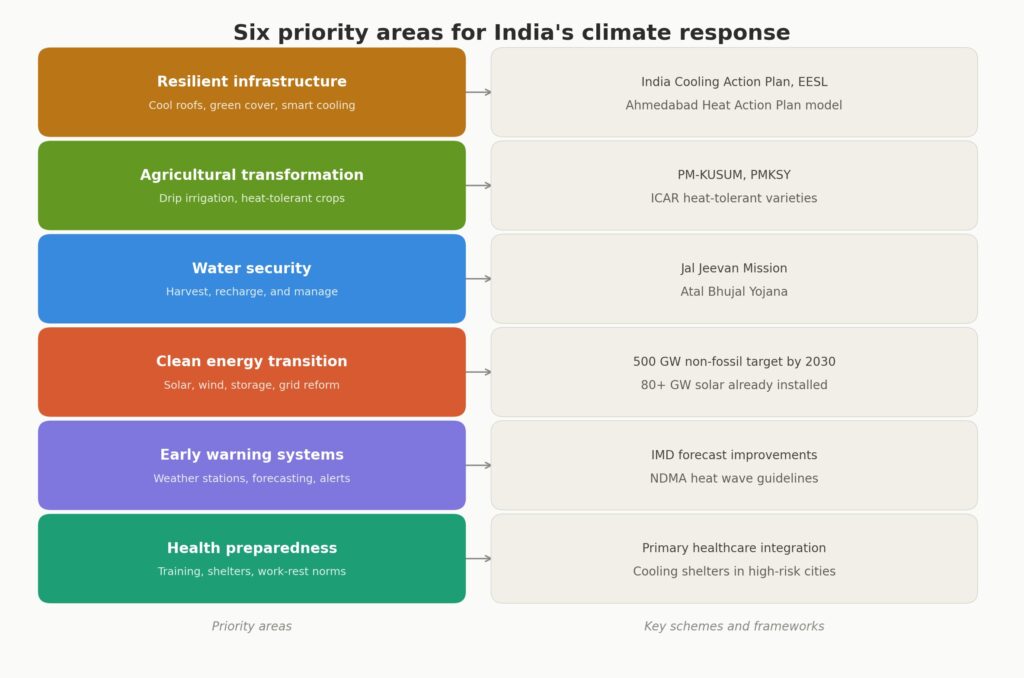
The India Cooling Action Plan (2019) sets out a useful framework, but implementation has been slow. Programmes like EESL’s super-efficient air conditioner initiative need to be scaled up, alongside investment in passive cooling strategies — green roofs, shaded walkways, permeable pavements — that reduce dependence on electricity-intensive solutions. The goal should not just be more cooling, but smarter cooling.
Transforming Agricultural Water Use
The shift from flood irrigation to drip and sprinkler systems is one of the highest-impact interventions available. Flood irrigation wastes an estimated 50–60% of water through evaporation and runoff. Drip systems deliver water directly to roots, cutting water use by 30–50% while often improving yields.
The PM-KUSUM scheme, which supports solar-powered irrigation, and the Pradhan Mantri Krishi Sinchayee Yojana (PMKSY), which promotes micro-irrigation, provide existing policy vehicles — but adoption remains well below target, particularly among smallholders who lack upfront capital. Bridging this last-mile gap — through subsidies, farmer producer organisations, and demonstration farms — is critical.
Complementary measures include promoting heat-tolerant crop varieties (ICAR has developed several for wheat, rice, and pulses), crop diversification away from water-intensive monocultures, and agroforestry systems that provide shade, additional income, and carbon sequestration.
Water Security: Harvest, Recharge, and Manage
Addressing India’s water crisis requires action on three fronts: increasing supply through rainwater harvesting and managed aquifer recharge; reducing demand through efficient irrigation and industrial water recycling; and improving governance through real-time monitoring and enforceable groundwater regulation.
The Jal Jeevan Mission (piped water to every rural household) and the Atal Bhujal Yojana (community-led groundwater management) are significant government commitments. Their success, however, depends on sustained funding, genuine community participation, and institutional capacity at the district and block level — areas where India’s track record has been uneven.
Accelerating the Clean Energy Transition
India has made impressive strides in renewable energy — solar capacity alone has grown from under 3 GW in 2014 to over 80 GW. But the pace needs to increase further to meet the target of 500 GW of non-fossil-fuel capacity by 2030.
Beyond generation, energy storage (batteries, pumped hydro) and grid modernisation are critical to managing intermittency. Distributed solar — rooftop installations and solar microgrids in rural areas — can simultaneously reduce emissions, improve energy access, and reduce the strain on centralised grids during peak heat-wave demand.
Strengthening Early Warning and Monitoring Systems
Effective adaptation depends on granular, real-time data. India needs a denser network of automated weather stations, improved forecasting models, and robust early warning systems that reach the last mile — including non-smartphone users in rural areas.
The IMD has improved its heat wave forecasting significantly, but dissemination to vulnerable communities remains patchy. The chain from forecast to action — through local governments, community health workers, and media — needs to be strengthened at every link. Investment in remote sensing, soil moisture monitoring, and integrated climate data platforms can sharpen both short-term warnings and long-term planning.
Health System Preparedness
Heat-related illness is preventable if health systems are prepared. This means training primary healthcare workers to recognise and treat heatstroke early, pre-positioning oral rehydration supplies in vulnerable areas, establishing public cooling shelters in high-risk cities, and adjusting outdoor work norms — such as mandating midday rest breaks for construction and agricultural workers during heat alerts.
India’s public health infrastructure is already stretched thin. Heat preparedness cannot be treated as a stand-alone programme; it must be integrated into the existing primary healthcare framework, with dedicated protocols activated each summer.
Policy, Finance, and Governance
National Framework
India’s National Action Plan on Climate Change (NAPCC) and its eight missions provide a policy scaffold, but several missions are underfunded and inconsistently monitored. India’s 2070 net-zero pledge and updated Nationally Determined Contributions (NDCs) under the Paris Agreement set the long-term direction. The challenge lies in closing the gap between ambition and execution — translating national targets into state-level plans, district-level budgets, and ground-level action.
Financing the Transition
The scale of investment required is enormous. Estimates from government and multilateral sources suggest India needs hundreds of billions of dollars in cumulative climate investment over the next two decades. Key funding channels include Union and State budgets, the Green Climate Fund, multilateral development bank lending, and private capital mobilised through green bonds and blended finance mechanisms.
India’s existing climate-relevant budget allocations — across agriculture, water, energy, and disaster management — need to be significantly scaled up, better coordinated across ministries, and rigorously tracked for outcomes. Climate budgeting, where every relevant ministry tags and reports its climate-related expenditure, is an important governance reform that several states have begun to pilot.
State and Local Action
States and municipalities are where policy meets reality. Localised heat action plans, city-level climate budgets, and district-level water security plans are essential. The success of Ahmedabad’s Heat Action Plan — and its subsequent adoption by cities like Nagpur, Bhubaneswar, and Hyderabad — shows what is possible when local government takes ownership.
Community and Individual Action
Top-down policy alone is insufficient. Community-led watershed management — as demonstrated by the transformation of villages like Ralegan Siddhi and Hiware Bazar in Maharashtra — shows what organised local action can achieve. Local renewable energy cooperatives, farmer producer organisations focused on sustainable practices, and women-led water user groups are all models that work when given institutional support.
At the individual level, action matters too: adopting energy-efficient appliances, conserving water, choosing public transport, reducing food waste, and supporting local environmental initiatives. Climate action is not only the government’s responsibility — it is a shared one.
The Road Ahead
India’s challenge is not a lack of awareness — the heat is impossible to ignore. The challenge is the gap between knowing what needs to be done and doing it at the speed and scale the crisis demands. The policy frameworks exist. Many of the technologies are proven and increasingly affordable. The financing mechanisms are available, if imperfect.
What is needed now is execution: faster adoption of climate-smart agriculture, accelerated urban resilience planning, ruthless water-use efficiency, and a clean energy transition that reaches the last village. International cooperation and climate finance can help, but the core work is domestic — in state capitals, district offices, municipal corporations, and farm fields.
The cost of inaction is not abstract. It is measured in lives lost to heatstroke, crops destroyed by drought, groundwater tables that will not recover, and cities that become unliveable for all but the wealthy. India has the institutional capacity and the human ingenuity to bend this curve — but not if it waits.
References
- India Meteorological Department (IMD). Statement on Climate of India (annual series). Available at: mausam.imd.gov.in
- IPCC. Climate Change 2022: Impacts, Adaptation and Vulnerability — Working Group II, Chapter on Asia.
- World Bank. South Asia’s Hotspots: The Impact of Temperature and Precipitation Changes on Living Standards(2018).
- International Labour Organization. Working on a Warmer Planet: The Impact of Heat Stress on Labour Productivity and Decent Work (2019).
- Government of India. India Cooling Action Plan (2019).
- Government of India. National Action Plan on Climate Change (NAPCC) — updated mission documents.
- Central Ground Water Board. Dynamic Ground Water Resources of India (latest assessment).
- National Disaster Management Authority (NDMA). Guidelines for Preparation of Action Plan — Prevention and Management of Heat Wave (2019).
Amulya Charan writes on energy systems, infrastructure economics, and development policy at amulyacharan.com. This analysis draws on reporting from Business Standard, ThePrint, Business Today, and the Press Information Bureau, and on policy research from the Takshashila Institution and the Observer Research Foundation.
————————————————————————————————————————