From Hormuz to Haldia: Mapping India’s Uneven Energy Vulnerability
1.0 Introduction
A disruption at the world’s most important oil chokepoint does not affect every part of India in the same way. Its consequences depend on what a state manufactures, how its households cook, where its workers earn and which forms of energy it can produce or substitute locally.
A tanker slows in the Strait of Hormuz. The consequences may surface thousands of kilometres away: a ceramic kiln in Morbi suspends production, a restaurant receives fewer commercial LPG cylinders, a household waits longer before making its next gas booking, or a family in Kerala begins to worry about employment conditions in the Gulf.
The originating event is the same. The economic and social consequences are not.
India’s energy vulnerability is usually presented through national statistics: crude-oil import dependence, the petroleum import bill, inflation or the effect of higher oil prices on economic growth. These measures matter, but they provide an incomplete picture. A national average cannot show whether a disruption is being transmitted through household cooking fuel, industrial process heat, agricultural diesel, international remittances or transport costs.
The West Asia conflict and disruption around the Strait of Hormuz in early 2026 illustrated this distinction. The episode did not produce a uniform national energy failure. India’s refineries continued operating, petrol and diesel supplies were maintained and alternative crude and gas cargoes were arranged. At the same time, particular industries and commercial consumers experienced substantially greater pressure than the national indicators suggested.
The lesson is not that India is uniformly fragile. It is that national resilience can coexist with concentrated local vulnerability.
2.0 The chokepoint—and the fuels that behave differently
The Strait of Hormuz lies between Iran and Oman. It is about 33 kilometres wide at its narrowest point, although commercial vessels travel through much narrower designated shipping lanes. A substantial share of the world’s internationally traded oil and LNG normally passes through it.
India’s exposure to the strait cannot be reduced to one number because crude oil, natural gas and LPG have different supply chains, storage systems and substitution possibilities.
2.1 Crude oil: diversified routes, continuing price exposure
India has significantly diversified its crude-oil suppliers. During the March 2026 disruption, the government reported that the share of crude imports arriving by routes outside Hormuz had increased to about 70%, compared with approximately 55% earlier. Refineries were reported to be operating at high capacity with adequate inventories.
This diversification reduced the immediate risk of physical crude shortages. It did not make India immune to a Hormuz crisis. Even crude purchased from Russia, the Americas or Africa is priced in an internationally connected market. A sustained disruption can therefore raise the cost of oil, shipping, insurance and working capital even when the physical cargo does not pass through Hormuz.
Crude oil is consequently the fuel for which India has developed the greatest sourcing flexibility—but not complete protection.
2.2 Natural gas and LNG: less flexible than crude
Natural gas presented a different problem. On March 11, 2026, the government said that India was consuming approximately 189 million metric standard cubic metres a day of natural gas, of which around 97.5 million was domestically produced. Approximately 47.4 million cubic metres a day of supply had been affected by force-majeure conditions.
LNG cargoes can be redirected, swapped or replaced through spot-market purchases, but substitution is normally more difficult and expensive than changing crude suppliers. Availability depends on liquefaction facilities, suitable cargoes, shipping capacity, regasification-terminal schedules, pipeline access and contractual provisions.
The government responded by obtaining cargoes from alternative suppliers and issuing a Natural Gas Control Order under the Essential Commodities Act. Domestic piped gas and CNG were protected, while industrial and commercial consumers were initially limited to around 80% of their recent average consumption. Fertiliser, refining and petrochemical users were also placed within a formal priority structure.
This mattered because an energy crisis can occur even while households continue receiving fuel: the shortage may instead be absorbed by factories, commercial establishments and other lower-priority users.
2.3 LPG: the sharpest household and commercial vulnerability
LPG was the most concentrated near-term exposure. India normally imports about 60% of the LPG it consumes, and the government stated that approximately 90% of those imports came through Hormuz. That was equivalent to roughly 54% of total national LPG consumption being linked to the route.
The distinction between imports and total consumption is important. India was not dependent on Hormuz for 90% of all its LPG, but more than half of total consumption was nevertheless directly exposed.

Figure 1. India’s exposure to the Strait of Hormuz varies by fuel. Emergency route diversification reduced the share of crude imports passing through Hormuz, but LPG remained substantially more concentrated.
Source: Government of India, PIB inter-ministerial briefing, 11 March 2026. LPG exposure is calculated as 60% import dependence multiplied by 90% of imports normally routed through Hormuz.
The government increased refinery production of LPG, redirected refinery streams towards domestic cooking gas and sought cargoes from the United States, Norway, Canada, Algeria, Russia and other available suppliers. Refinery LPG production was initially reported to have risen by about 28%; by March 20, the increase was reported at about 40% over pre-crisis levels.
Domestic LPG remained protected, while commercial allocation was prioritised for hospitals, educational institutions and selected essential industries. Booking intervals were lengthened to 25 days in urban areas and up to 45 days in rural areas as a demand-management measure. Additional kerosene was released to states, and coal was made available for some commercial users to reduce pressure on LPG.
These measures maintained household supply, but they also revealed the difficulty of rapidly replacing LPG. A cooking cylinder, a restaurant burner and a propane-fired industrial kiln cannot all be protected in the same manner.
3.0 India’s strategic reserves: important, but easily misunderstood
India’s first phase of strategic petroleum reserves has a total capacity of 5.33 million tonnes at Visakhapatnam, Mangaluru and Padur. Based on the country’s 2019–20 consumption pattern, the government estimated that this capacity represented about 9.5 days of crude-oil requirement.
That does not mean India possesses only nine or ten days of petroleum security. Refiners and oil-marketing companies also hold commercial crude and product inventories. A 2021 government estimate put commercial storage capacity at about 64.5 days and total nominal storage capacity, including the strategic caverns, at approximately 74 days. Actual stocks available at any particular moment may be lower than installed capacity, however, and commercial inventories cannot automatically be treated as fully accessible strategic stocks.
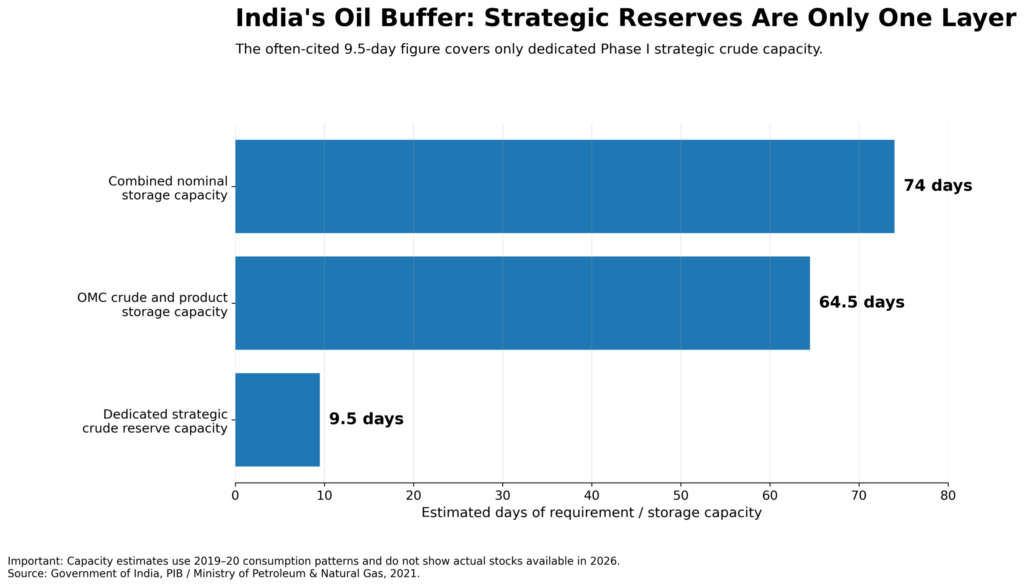
Figure 2. India’s petroleum buffer consists of more than its strategic caverns. The frequently quoted 9.5-day figure covers only the dedicated Phase I strategic crude reserve.
Source: Government of India, PIB / Ministry of Petroleum and Natural Gas, 2021. Figures represent nominal storage capacity based on 2019–20 consumption patterns, not actual stocks available in 2026.
Comparisons with the International Energy Agency’s 90-day stockholding requirement also require care. That obligation applies to IEA member countries and is based on net oil imports. India is an association country rather than a member subject to the same legal obligation.
More importantly, crude reserves are not interchangeable with LPG or LNG storage. Releasing crude from a strategic cavern may support refinery operations, but it cannot immediately replace a missing LNG cargo, propane shipment or filled LPG cylinder.
India therefore needs to think about energy reserves by fuel and function—not simply as a single number of days.
4.0 A better way to read the state map
The state comparisons that follow are not a statistical ranking. They identify four broad channels through which an international energy disruption can reach particular regions:
- Industrial process-fuel exposure: dependence on natural gas, propane or other molecules for kilns, furnaces, chemicals and continuous manufacturing.
- Household and distribution exposure: reliance on LPG combined with long transport distances, limited storage, difficult terrain or thin last-mile networks.
- Transport and agricultural exposure: sensitivity to diesel, freight, tractors, harvesters and road movement.
- External-income exposure: dependence on employment and remittances from Gulf economies.
Running beneath these channels is a fifth question: what substitutes are actually available? Coal, hydro, solar and wind can strengthen electricity supply. They do not automatically replace LPG in a kitchen or high-temperature process heat in a factory.
A state may therefore be well buffered in electricity but highly exposed in manufacturing or household fuel.
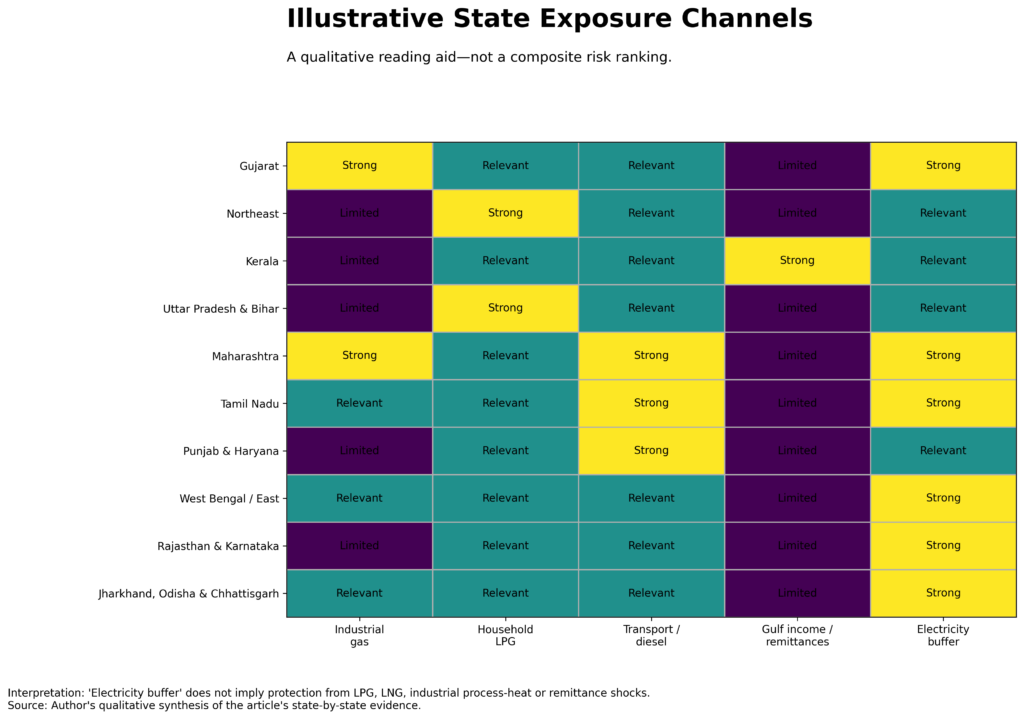
Figure 3. Illustrative state exposure channels. States face different combinations of industrial-gas, household-LPG, transport-fuel and external-income exposure.
Source: Author’s qualitative synthesis of the evidence discussed in this article. The matrix is a reading aid, not a composite risk ranking.
5.0 Gujarat: an energy gateway with concentrated industrial exposure
Morbi provides one of the clearest examples of industrial process-fuel vulnerability. The Gujarat cluster produces more than four-fifths—and by some industry estimates close to 90%—of India’s ceramic tiles. Its kilns depend heavily on propane and piped natural gas.
The number of affected units changed as the crisis developed. In early March, reporting indicated that about a quarter of the cluster’s units had stopped production. By March 17, industry representatives said that approximately 450 of 650 major units had suspended operations, principally because propane supplies had been exhausted and natural-gas availability had been restricted.
Abruptly closing a ceramic kiln can spoil material already in production and can damage refractory systems if cooling is not properly managed. Even a planned shutdown is expensive because restarting and stabilising the kiln requires fuel, time and technical control.
Morbi also demonstrates why installed renewable-electricity capacity is not an adequate measure of total energy resilience. Gujarat is one of India’s leading renewable-power states and has extensive refineries, pipelines, ports and LNG infrastructure. These assets strengthen its overall energy position, but solar and wind generation cannot directly supply the molecular fuel required to fire a conventional ceramic kiln.
Some Morbi plants subsequently began moving from propane to more expensive piped natural gas. By mid-April, Gujarat Gas reported that 142 units were operating and that it had obtained additional gas from non-Middle Eastern spot markets. The substitution helped production resume, but at materially higher fuel costs.
The Gujarat lesson is therefore not that the state lacks energy infrastructure. It is that a globally important manufacturing cluster had concentrated its process heat around fuels vulnerable to one international supply corridor.
6.0 The Northeast: where logistics can magnify a national disruption
The Northeast’s exposure is less about a single factory cluster and more about geography. LPG supplied to remote areas must travel long distances through relatively thin transport and distribution networks. Difficult terrain, weather disruptions and limited local storage can turn a manageable national constraint into a more serious local delivery problem.
The 2026 episode, however, should not be described as a generalised regional collapse. Government advisories lengthened booking intervals as part of national demand management, but official statements continued to report protected domestic LPG supply. A 25-day interval did not necessarily mean a consumer waited 25 days after ordering; in many places it meant that the next booking could not be made until the prescribed interval had elapsed.
The structural concern remains valid. Several northeastern states possess natural gas and significant hydroelectric potential, yet many households remain outside piped-gas networks. Local gas reserves do not provide household energy security unless gathering, processing, pipelines, city-gas systems and last-mile connections are in place.
Electric cooking can provide an alternative where electricity service and household wiring are reliable. But it should be treated as part of a resilient multi-fuel system rather than an assumed universal substitute. A household dependent on one LPG cylinder and one fragile electricity connection may still have little practical redundancy.
7.0 Kerala: exposure through the Gulf economy
Kerala’s principal vulnerability is not necessarily its power grid or industrial fuel system. It is the state’s exceptionally deep relationship with international migration.
The Kerala Migration Survey 2023 estimated approximately 2.2 million emigrants from the state, with about four-fifths located in Gulf Cooperation Council countries. Kerala’s migration destinations are gradually diversifying, but the Gulf remains central to employment, household consumption, savings and investment.
This creates a different kind of energy exposure. Higher oil revenues can support government spending, construction and services in oil-exporting Gulf states, which may in turn sustain migrant employment. The relationship is not automatic: inflation, fiscal policy, localisation of employment, geopolitical risk and changing economic models also influence labour demand.
The greater threat to Kerala is therefore not simply a higher oil price. It is a prolonged conflict that damages Gulf economic activity, interrupts projects, restricts transport or forces a large number of workers to return before Kerala’s labour market can absorb them.
This transmission channel moves more slowly than an LPG shortage, but its effects may last longer. A factory can restart when fuel returns. A migrant household that loses its income may reduce consumption, postpone construction, draw down savings or seek new employment for months or years.
Kerala has developed migrant-welfare and returnee-support institutions through NORKA and related programmes. The policy question is not whether nothing has been done, but whether the scale, skills and financing of these programmes are sufficient for a large external-employment shock.
8.0 Uttar Pradesh and Bihar: the refill-continuity challenge
The Pradhan Mantri Ujjwala Yojana substantially expanded access to LPG among lower-income households. By July 2024, the programme had delivered about 10.35 crore connections. Uttar Pradesh and Bihar account for a large share of beneficiaries.
This is a major clean-cooking achievement, but possession of a connection is not the same as exclusive or uninterrupted LPG use. Affordability, refill frequency, household income, delivery continuity and the availability of electricity all influence how often a family uses LPG.
The vulnerability in these states is therefore not an “Ujjwala trap.” It is a refill-continuity challenge. Millions of households have moved towards a cleaner fuel and consequently depend on cylinders remaining physically available and financially accessible.
When LPG becomes expensive or difficult to obtain, poorer households may reduce consumption or return temporarily to wood, crop residue, dung, coal or kerosene. This practice, often described as fuel stacking, weakens the health benefits of clean cooking.
The World Health Organization warns that inefficient use of biomass, coal and kerosene generates dangerous household air pollution associated with respiratory and cardiovascular disease, stroke, lung cancer and childhood pneumonia. It specifically discourages household use of unprocessed coal and kerosene because of pollution, burn and poisoning risks. Women and children generally bear the greatest exposure.
Emergency fuel policy must therefore protect not only the number of cylinders distributed, but also the public-health gains created by regular use of clean cooking energy.
9.0 Maharashtra and Tamil Nadu: diversified industrial exposure
Maharashtra and Tamil Nadu face broad rather than single-cluster exposure.
Maharashtra combines refining, petrochemicals, engineering, transport, hospitality and a large commercial LPG market. Its economic diversity reduces the likelihood that one fuel constraint will switch off the entire state economy. At the same time, a disruption can appear across many channels: industrial gas prices, restaurant fuel allocations, freight, aviation, chemicals and consumer inflation.
Tamil Nadu’s large automotive and manufacturing base is similarly exposed to freight and input costs. Its substantial wind and solar capacity provides a degree of insulation in electricity generation, but installed renewable capacity should not be confused with guaranteed round-the-clock supply. Actual resilience also depends on seasonal generation, storage, transmission, balancing power and access to the national grid.
For both states, the central risk is less likely to be a complete loss of electricity than an accumulation of higher fuel, transport and input costs across complex supply chains.
10.0 Punjab, Haryana and western Uttar Pradesh: the diesel channel
In the agricultural belt, a crude-price shock is transmitted through tractors, harvesters, some irrigation pumps, road freight and the movement of produce. The effect depends on the timing of sowing and harvesting, the degree of mechanisation and the mix of diesel and subsidised electricity used for irrigation.
The pass-through from international crude to retail diesel is not automatic. Central excise duty, state value-added tax, oil-company pricing and government intervention can delay or reduce the change. During the 2026 crisis, the government altered fuel taxes and imposed export levies to support domestic availability.
The agricultural risk is therefore usually a tightening of margins and an increase in food-distribution costs rather than an immediate physical shutdown. But when higher diesel prices coincide with a critical farming operation, even a moderate national shock can impose substantial local costs.
11.0 Haldia and eastern India: a qualified buffer
Haldia is an important refinery, port and distribution centre for eastern India. The surrounding region also benefits from proximity to the coalfields of Jharkhand, Odisha and Chhattisgarh, which reduces the direct dependence of much coal-fired electricity generation on imported oil.
These advantages should not be overstated. A refinery processes crude; it does not necessarily make the crude domestic. Coal mining and rail transport use diesel, some power stations consume imported coal, and households remain dependent on LPG and transport fuels. Ports and coastal infrastructure are also exposed to cyclones and other logistics risks.
Eastern India is therefore relatively better insulated in one part of the energy system—coal-based electricity—but not immune to an international oil and gas shock.
The government has approved a proposed second-phase strategic petroleum reserve at Chandikhol in Odisha, with a planned capacity of four million tonnes. It should be described as an approved or proposed facility until construction and commissioning are completed, not as existing storage.
12.0 Where India’s buffers really lie
India’s renewable transformation is strengthening the electricity system. As of June 30, 2026, the country had approximately 162.2 GW of installed solar capacity, 57.4 GW of wind capacity and total renewable capacity—including large hydro—of about 288.6 GW.
States such as Rajasthan and Gujarat have very large solar fleets. Tamil Nadu and Gujarat are major wind producers. Karnataka combines solar, wind and hydro, while Himalayan states derive an important share of their electricity from domestic hydropower. Coal-producing eastern and central states possess a different kind of electricity buffer.
But installed megawatts do not provide a complete measure of security. Resilience depends on actual generation, time of day, weather, storage, transmission, fuel availability, grid interconnection and the ability of the end user to switch technologies.
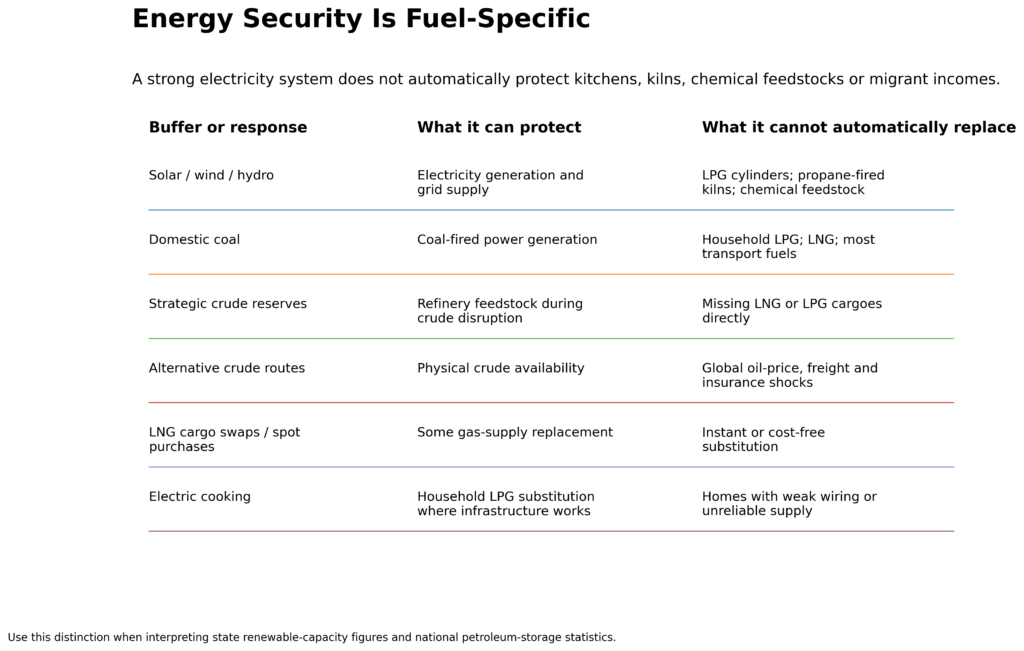
Figure 4. Energy security is fuel-specific. Renewable electricity, domestic coal, crude reserves and alternative shipping routes each protect different parts of the energy system.
Source: Author’s synthesis. No single buffer automatically substitutes for LPG, LNG, industrial process heat or migrant income.
Solar, wind, hydro and coal can help keep electricity flowing. They do not directly replace:
- LPG in a household without suitable electric cooking equipment;
- propane or gas in an existing high-temperature industrial kiln;
- natural gas used as a chemical feedstock;
- diesel in machinery that has not been electrified; or
- income lost when employment in the Gulf contracts.
India’s energy-security challenge is therefore increasingly one of matching each vulnerability with the correct buffer.
13.0 An illustrative state exposure guide
| State or region | Principal exposure channel | Important buffer | Indicators to monitor |
| Gujarat | Industrial propane and gas; refining and petrochemicals | Ports, refineries, pipelines and renewable electricity | Morbi operating rates, industrial gas prices and LNG availability |
| Northeast | LPG logistics and last-mile distribution | Local gas resources, hydro and potential electric cooking | Booking backlogs, distributor stocks and road connectivity |
| Kerala | Gulf employment and remittance income | Services economy, diaspora institutions and destination diversification | Gulf employment, return migration and household remittances |
| Uttar Pradesh and Bihar | Household LPG affordability and refill continuity | PMUY support, electricity and targeted subsidy | Refill frequency, effective cylinder cost and fuel stacking |
| Maharashtra | Industrial gas, commercial LPG, transport and petrochemicals | Large and diversified economy; refining and renewable capacity | Commercial allocations, gas prices and freight costs |
| Tamil Nadu | Industrial inputs, automotive supply chains and logistics | Wind, solar, diversified manufacturing and grid connectivity | Industrial electricity cost, freight and input-price pass-through |
| Punjab, Haryana and western Uttar Pradesh | Agricultural diesel and freight | Grid-powered irrigation and policy intervention | Retail diesel price during sowing and harvesting |
| West Bengal and eastern India | Household LPG, transport and imported crude | Haldia infrastructure and proximity to domestic coal | Refinery throughput, rail logistics and LPG distribution |
| Rajasthan and Karnataka | Transport and household fuels rather than electricity alone | Large renewable portfolios | Peak availability, storage and grid-balancing requirements |
| Jharkhand, Odisha and Chhattisgarh | Household LPG and transport | Domestic coal-based generation | Coal logistics, diesel costs and household clean-fuel access |
Note: This table identifies dominant exposure channels. It is not a composite risk ranking.
14.0 What policymakers should watch next
The 2026 episode suggests that industrial clusters may provide the earliest warning of a serious molecular-fuel shortage. Morbi’s operating rate, industrial-gas allocation and spot-LNG costs are more informative for this purpose than a national electricity statistic.
For household stress, policymakers should monitor refill frequency, distributor backlogs and the effective cost paid by consumers—not merely the number of LPG connections. In remote areas, transport reliability and local storage matter as much as national inventory.
For Kerala, the most relevant indicators are Gulf employment, project activity, return migration and remittance flows. For the farm belt, the timing of diesel-price movements relative to sowing and harvesting is critical.
India also needs fuel-specific emergency planning. Crude reserves, refinery inventories, LPG storage, LNG contracting, pipeline redundancy and demand-management arrangements should not be grouped together as though they were interchangeable.
Industrial policy has a role as well. Where technically and economically feasible, clusters should be encouraged to develop dual-fuel capability, electric process technologies, biomethane, green hydrogen or other alternatives. Such transitions require careful engineering: an emergency order cannot instantly convert a kiln, furnace or chemical plant to another energy source.
15.0 From national resilience to local resilience
India managed the 2026 Hormuz disruption without a nationwide collapse of petroleum supply. Refineries operated, petrol and diesel remained available, alternative LPG and LNG cargoes were arranged, and household cooking gas was prioritised. These were meaningful demonstrations of national resilience.
Yet the same episode interrupted ceramic production, constrained commercial fuel use, required legally enforced gas allocation and led to the temporary activation of more polluting substitute fuels. It showed that the country can remain secure at the aggregate level while particular industries, regions and households experience severe pressure.
The next stage of Indian energy security must therefore move beyond asking how many barrels the country imports or how many days of crude it can store.
It must ask which fuel is needed, for what purpose, in which location, by which consumer—and what can genuinely replace it.
That is the map that matters: from Hormuz to Haldia, and state by state in between.
16.0 References
1. Government of India, Press Information Bureau. Inter-ministerial briefing on energy supplies and the Strait of Hormuz, 11 March 2026. https://www.pib.gov.in/PressReleasePage.aspx?PRID=2238525&lang=2®=48
2. Government of India, Press Information Bureau. Statement to Parliament on petroleum products, natural gas and LPG, March 2026. https://www.pib.gov.in/PressReleasePage.aspx?PRID=2239021&lang=1®=3
3. Government of India, Press Information Bureau. Update on refinery operations, PNG, CNG and industrial gas allocation, March 2026. https://www.pib.gov.in/PressReleasePage.aspx?PRID=2239794&lang=1®=3
4. Government of India, Press Information Bureau. LPG supply update and refinery-production measures, March 2026. https://www.pib.gov.in/PressReleasePage.aspx?PRID=2239172&lang=1®=6
5. Government of India, Press Information Bureau. Energy-supply briefing, 20 March 2026. https://www.pib.gov.in/PressReleasePage.aspx?PRID=2243020&lang=1®=20
6. Government of India, Press Information Bureau. LPG booking intervals and demand-management measures, March 2026. https://www.pib.gov.in/PressReleasePage.aspx?PRID=2240360
7. Government of India, Press Information Bureau. Strategic petroleum reserve capacity and estimated days of coverage, December 2021. https://www.pib.gov.in/PressReleasePage.aspx?PRID=1780898&lang=2®=48
8. Government of India, Press Information Bureau. Strategic crude-oil reserves and Phase II proposals at Chandikhol and Padur, February 2021. https://www.pib.gov.in/Pressreleaseshare.aspx?PRID=1694712&lang=2®=3
9. Ministry of New and Renewable Energy. Physical progress and installed renewable-energy capacity as of 30 June 2026. https://mnre.gov.in/en/physical-progress/
10. Ministry of New and Renewable Energy. Year-wise renewable-capacity achievements. https://mnre.gov.in/en/year-wise-achievement/
11. The Indian Express. Reporting on shutdowns in Gujarat’s Morbi ceramic cluster, March 2026. https://indianexpress.com/article/cities/ahmedabad/as-iran-conflict-enters-10th-day-a-fourth-of-ceramic-units-in-gujarats-morbi-shut-down-amid-fuel-shortage-10573726/
12. The Indian Express. Morbi ceramics industry shutdown reporting, 17 March 2026. https://indianexpress.com/article/cities/ahmedabad/morbi-ceramics-industry-shutdown-april-west-asia-turmoil-10587409/
13. The Indian Express. Reporting on Morbi’s switch from propane to higher-priced PNG, April 2026. https://indianexpress.com/article/cities/ahmedabad/west-asia-conflict-morbi-tile-makers-want-to-switch-to-png-but-higher-prices-remain-a-hurdle-10621107/lite/
14. The Indian Express. Reporting on the resumption of Morbi units and gas costs, April 2026. https://indianexpress.com/article/cities/ahmedabad/morbi-ceramic-industry-png-price-hike-tiles-cost-increase-10638710/
15. World Health Organization. Household air pollution and health, updated 16 December 2025. https://www.who.int/news-room/fact-sheets/detail/household-air-pollution-and-health
16. World Health Organization. Guidelines for Indoor Air Quality: Household Fuel Combustion. https://www.who.int/publications/i/item/WHO-FWC-IHE-14-01
17. Pradhan Mantri Ujjwala Yojana. Official programme overview and connection data. https://www.pmuy.gov.in/about.html
18. The Indian Express. Kerala Migration Survey 2023 findings. https://indianexpress.com/article/explained/kerala-mirgation-survey-findings-gulf-9398005/
Editorial note: Figures and policy measures in this article reflect reporting and official releases available up to July 2026. Before final publication, the editor should recheck any fast-moving market price, operational-status or capacity figure against the latest primary source.
————————————————————————————————————————————
Amulya Charan writes on energy systems, infrastructure economics, and development policy at amulyacharan.com.From Hormuz to Haldia: Mapping India’s Uneven Energy Vulnerability
Congratulations sir, for yet another highly detailed and comprehensive paper. You have vividly explained the macro situation, divided the fuel categories, analysed the Strait of Hormuz contribution to LPG, versus crude versus LNG, differentiated strategies for each geographical region and State. Absolutely great.