The Factory Floor India Never Built at Scale
Why India Missed East Asia’s Export-Manufacturing Boom—and Why the Story Is Not Over
EXECUTIVE SUMMARY
India did not fail to develop manufacturing. It built important capabilities in automobiles, pharmaceuticals, steel, chemicals, engineering goods and, more recently, electronics. What it failed to create at sufficient scale was the labour-intensive, export-oriented manufacturing system that transformed China and, later, countries such as Vietnam and Bangladesh. India therefore missed the opportunity to move millions of workers from low-productivity employment into regular factory jobs.
This was not the result of one policy or one government. For several decades, industrial licensing, import controls, restrictions on large firms, small-scale industry reservations and complex labour regulations made it difficult for efficient businesses to expand. These policies were introduced for understandable reasons—self-reliance, employment protection and prevention of excessive economic concentration—but they also encouraged fragmentation, protected inefficient production and prevented firms in sectors such as garments, footwear, toys and leather goods from achieving global scale.
The economic reforms of 1991 removed many restrictions and encouraged investment. However, liberalisation did not automatically provide serviced industrial land, reliable electricity, efficient logistics, affordable finance, skilled workers or predictable administration. India’s information-technology and business-services industries became globally successful, but the country did not build an equally broad manufacturing economy capable of creating productive employment for workers without advanced education.
China’s advantage was not simply cheap labour. It combined ports, roads, power, industrial zones, export access, investment facilitation and dense supplier networks. Vietnam and Bangladesh later captured parts of the labour-intensive manufacturing opportunity, although their experiences also reveal risks such as dependence on foreign investors, limited domestic value addition, unsafe working conditions and excessive reliance on a few export industries.
India’s recent progress is nevertheless significant. Make in India and the Production-Linked Incentive schemes have attracted investment and helped expand electronics and mobile-phone production. But assembly alone is not enough. The real test is whether India can increase domestic value addition, develop local suppliers, create regular employment, improve productivity and sustain investment after incentives end.
The manufacturing opportunity has changed, but it has not disappeared. India can become a major production centre in a more diversified global supply chain by helping productive firms grow, improving implementation at the state and local levels, connecting training with actual factory jobs, enabling more women to enter industrial employment, reducing the cost of imported inputs used in exports, and maintaining strong labour, safety and environmental protections.
India cannot reproduce China’s historical journey exactly. It must build its own model—one in which firms can achieve scale without becoming lawless, workers can become more productive without becoming disposable, and industrial policy creates lasting capability rather than permanent dependence.
| India did not fail to manufacture. It failed to build, at sufficient scale, the labour-intensive, export-oriented factory system that moved millions of workers into more productive employment across East Asia. That distinction matters, because the causes—and the remedies—are more complicated than a story about one bad law, one missed trade agreement or one government programme. |
In the last quarter of the twentieth century, the geography of global production changed dramatically. Labour-intensive assembly shifted first, followed by more complex manufacturing and increasingly fragmented supply chains. Some existing production moved out of high-wage economies; much of the transformation came through new investment in export platforms built across Asia.
China became the most spectacular beneficiary, turning itself within a generation into the principal workshop of the world. Later, Vietnam, Bangladesh and other Asian economies captured important parts of labour-intensive manufacturing. India, despite its continental scale, large workforce and industrial ambitions, followed a different path.
That does not mean India failed to manufacture anything. It developed substantial capabilities in automobiles, pharmaceuticals, steel, chemicals, engineering goods and, more recently, electronics. What it did not develop at comparable scale was a dense, export-oriented system of large factories, specialised suppliers, reliable logistics, trained workers and trade connections capable of handling enormous global orders at predictable cost.
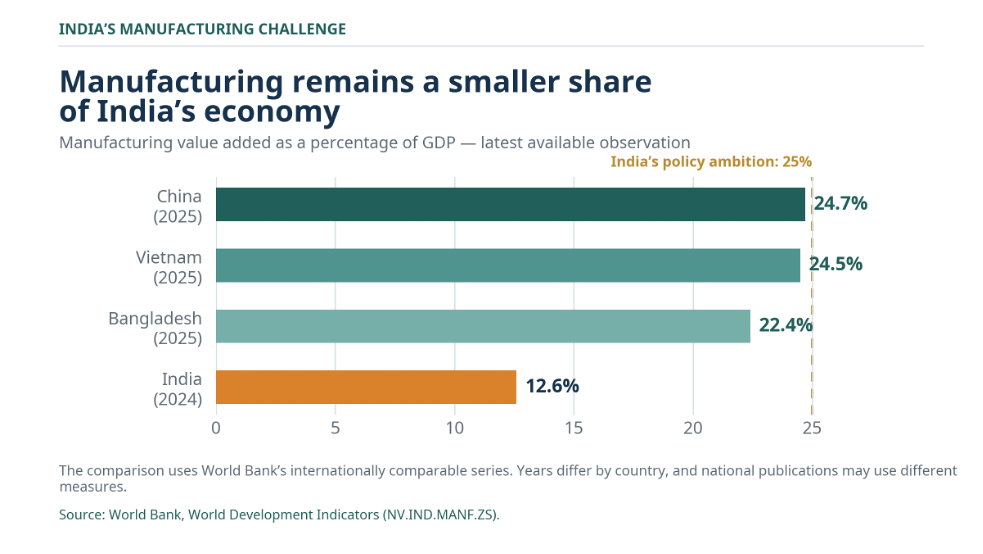
The difference remains visible in the composition of the four economies. [1]
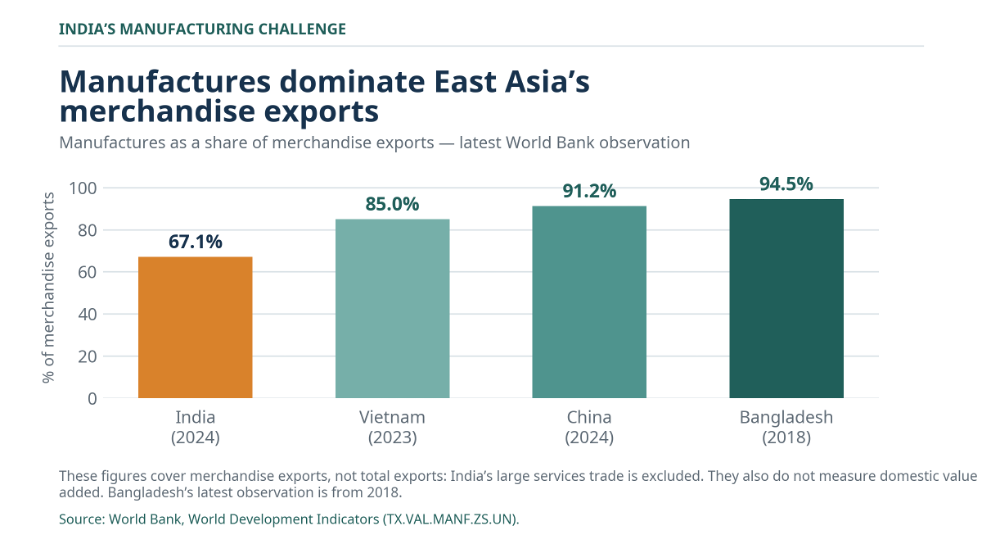
Trade data tell a similar, though not identical, story. Manufactures accounted for approximately 67% of India’s merchandise exports in 2024, compared with 91% for China in 2024 and 85% for Vietnam in 2023. Bangladesh’s latest World Bank observation—94%—dates from 2018 and should not be presented as though it were a current, like-for-like comparison. These figures also cover merchandise exports, not total exports, and therefore exclude India’s unusually important services trade. Nor do they reveal how much domestic value has been added to an exported product. [2]
India’s ambition to raise manufacturing to 25% of GDP did not originate with Make in India. It was formally articulated in the National Manufacturing Policy of 2011 and was subsequently carried into the Make in India era. More than a decade later, that transformation has not occurred. [3, 4]
How did India reach this position? There is no single villain and no single decision that can now be reversed to recover the lost years. The outcome reflects an accumulation of policies, institutions and social conditions—many adopted for understandable reasons—that repeatedly made productive scale more difficult than it needed to be.
PART ONE — HOW THE OPPORTUNITY NARROWED
Built to Distrust Scale
India’s early industrial model emerged from genuine historical anxieties. The country had inherited deep poverty, weak infrastructure, limited domestic capital and an economy shaped by colonial dependence. Self-reliance, balanced regional development, protection of employment and prevention of excessive economic concentration were not irrational objectives.
The difficulty lay in the instruments chosen to pursue them.
Under the industrial-licensing system created after independence, firms in many regulated industries needed government approval to establish plants, expand capacity or alter their product mix. Separate import and foreign-exchange controls restricted access to machinery and intermediate inputs. The Monopolies and Restrictive Trade Practices framework treated the expansion of large domestic business groups with suspicion, while the Foreign Exchange Regulation Act of 1973 generally restricted foreign equity in joint ventures to 40%, subject to exemptions and official approvals. Some multinational companies diluted their holdings; some reorganised; and some left. [5, 6, 7]
Perhaps the most consequential constraint was the small-scale industry reservation policy. Beginning in the late 1960s, hundreds of products were reserved for production by small enterprises. The policy was intended to decentralise ownership and protect employment, but it also restricted larger firms from entering many labour-intensive sectors in which scale, consistency and rapid delivery were becoming essential to export success.
Garments, footwear, leather goods, toys and other light manufactures were precisely the products through which several East Asian economies entered global markets. India protected small producers in these sectors, but often at the cost of preventing them—or larger firms around them—from building the production systems required by international buyers.
Research on the later dismantling of these reservations supports the view that the policy constrained growth: districts more exposed to dereservation subsequently recorded higher employment and output growth. That does not mean every small firm should have been displaced by a large one. It means that policy should have helped productive firms grow rather than making smallness itself the objective. [8]
Import substitution also produced a mixed legacy. It helped India establish capabilities in heavy industry, scientific research and strategic sectors. But long-term protection from external competition weakened export discipline, limited access to the best inputs and allowed inefficient production structures to persist. By the time global supply chains began reorganising at speed, much of Indian industry was oriented towards a protected domestic market rather than towards competing for the world’s largest orders.
Reform Opened the Economy—but Left the Factory Half-Finished
The 1991 reforms were genuinely transformative. Industrial licensing was removed from most sectors, trade barriers were reduced, competition increased and foreign investment became easier. It would be misleading to suggest that these reforms benefited only services. Research finds that delicensing had a statistically and economically significant positive effect on manufacturing investment, with smaller firms in states possessing better credit conditions benefiting particularly strongly. [9, 10, 11]
But liberalisation removed some constraints faster than it created the complementary conditions required for mass manufacturing. The ease of acquiring serviced industrial land, the reliability and cost of power, the quality of transport connections, access to long-term finance, worker training and the efficiency of state and municipal administration continued to vary enormously.
Services, meanwhile, took off. Telecommunications, information technology, finance and business-process exports became symbols of a new India. This was not a policy error or a consolation prize. India built globally competitive capabilities and generated substantial income, exports and professional employment.
The limitation was that high-skill services could not, on their own, provide productive jobs for the much larger population with modest formal education. India’s success in services may also have reduced the political urgency of confronting the more contentious foundations of industrialisation. The country did not choose services instead of manufacturing in one deliberate moment. It allowed a successful services economy to develop without building a sufficiently broad manufacturing economy beside it.
Factories and services are, in any case, not opposites. Modern manufacturing depends on software, design, finance, logistics, telecommunications, testing and professional services. India’s missed opportunity was not that it became good at services. It was that it did not convert those strengths into a wider industrial ecosystem. [12]
The Hundred-Worker Wall—and What Has Changed
For years, the most frequently cited example of India’s labour-market rigidity was Chapter V-B of the Industrial Disputes Act. Under the earlier national framework, covered industrial establishments employing at least 100 workers generally needed prior government permission for specified lay-offs, retrenchment or closure, although amendments by individual states created important variations.
Such thresholds could encourage some employers to remain below the coverage limit, outsource parts of their workforce or divide production among multiple units. But it is too simple to claim that every entrepreneur stayed small solely because of one labour law. Technology, access to finance, managerial ability, market demand, taxation, land, infrastructure and access to large buyers all influence firm size.
More importantly, the legal position has now changed. The four Labour Codes were brought into force on 21 November 2025, and central rules followed in 2026. Under the Industrial Relations Code, the central threshold for prior government permission in specified cases of lay-off, retrenchment and closure is 300 workers rather than 100. One month’s notice, retrenchment compensation and other protections continue to apply, including below that threshold. It is therefore no longer accurate to describe India’s current national framework as an unchanged “hundred-worker wall.” [13, 14, 15]
The underlying problem of undersized firms nevertheless remains. The Economic Survey 2018–19 described a large group of long-established enterprises in organised manufacturing as “dwarfs”—firms more than ten years old that still employed fewer than 100 workers. Such firms accounted for about half of organised manufacturing enterprises by number, but only 14.1% of employment and 7.6% of net value added. [16]
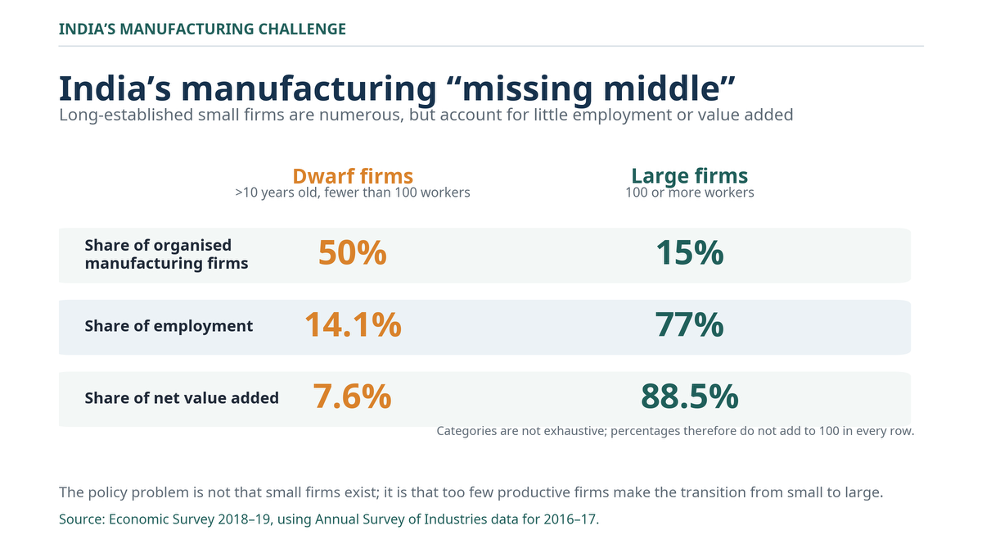
India’s “missing middle” was therefore shaped partly by regulatory thresholds, but not by regulation alone. Firms may also fail to grow because they cannot secure credit, adopt technology, obtain reliable inputs, meet quality standards, find trained supervisors or connect with large domestic and international buyers.
The question now is not whether India has formally changed its labour laws. It has. The question is whether the new framework will be implemented predictably across states while preserving effective worker protection, collective representation, social security and fair compensation. Labour flexibility without trust will not create durable industrialisation; nor will worker protection that makes legitimate expansion needlessly uncertain.
Death by a Thousand Frictions
Even a firm willing to expand can encounter a cumulative series of physical and administrative obstacles. Land assembly may be slow or contested. Electricity quality and industrial tariffs differ sharply across states. Local approvals can involve several authorities. Transport may work reasonably well on a main corridor but break down at the first or last mile.
The often-repeated claim that logistics costs India 13–14% of GDP should now be retired as a current statistic. A DPIIT–NCAER assessment estimated India’s total logistics cost in 2023–24 at 7.97% of GDP and 9.09% of non-services output. The study considers the non-services measure more useful because agriculture, mining and manufacturing—not most services—generate the physical goods that must be transported. It also cautions, in effect, against casual comparisons of GDP ratios derived from different economic structures and methodologies. [17]
That correction does not mean India’s logistics problems have disappeared. The same study identifies railway bottlenecks, gaps in service availability, congestion and inadequate first- and last-mile connectivity. A national average cannot capture the cost of an unpredictable shipment, a missed vessel, an unreliable feeder road or a factory forced to hold excessive inventory as protection against delay.
In global manufacturing, reliability can matter as much as the headline cost. A buyer placing a large seasonal apparel order or sourcing components for a tightly coordinated production line needs assurance that quantity, quality and delivery dates will be met. A factory may be competitive on average and still lose business because the variation around that average is too great.
Software can often route around the physical economy. Manufactured goods cannot. Every interruption in power, every avoidable day at a border and every uncertain permission adds cost to a product competing in markets where margins may be measured in cents.
The Workers India Underused
A manufacturing strategy is ultimately a strategy about people. Here, India’s experience has been more complicated than the older claim that only one quarter of Indian women participate in the labour force.
The Periodic Labour Force Survey for 2025 reports an all-India female labour-force-participation rate of 40% for people aged 15 and above under the usual-status measure. This is above the levels reported in earlier PLFS releases, but the 2025 survey redesign means the estimate is not strictly comparable with previous annual reports. The rural female rate was 45.9%, while the urban rate was 27.7%. Among female workers, 64.2% were self-employed and 18.2% were in regular wage or salaried employment. The rising headline rate should therefore not be confused with a mass movement of women into regular urban or factory jobs. [18]
This matters because labour-intensive export manufacturing in much of Asia has drawn heavily on women workers. Bringing more women into Indian manufacturing will require more than announcing vacancies. It requires safe and affordable transport, secure accommodation where migration is involved, suitable sanitation, childcare, predictable shifts, protection against harassment and workplaces in which families are confident that women will be treated safely and fairly.
Skills present a second constraint. PLFS 2025 reports that only 4.2% of Indians aged 15–59 had received or were receiving formal vocational or technical training. The precise figure should not be compared casually with other countries because training systems and statistical definitions differ, but it plainly shows the limited reach of formal vocational preparation within India. [18]
Training cannot be separated from employment. Workers learn most effectively when curricula are designed with employers, apprenticeships lead to real jobs and factories invest in continuous training. India does not merely need more certificates. It needs a much stronger bridge connecting technical institutes, industrial clusters and production lines.
What China Understood About Scale
China’s rise is sometimes reduced to a simple formula: cheap labour plus authoritarian government. That explanation is inadequate.
Beginning in 1980, China established Special Economic Zones, including Shenzhen, in which new policies and market-oriented institutions could be tested. These zones were combined with ports, roads, power, housing, investment facilitation and links to increasingly dense industrial clusters. China’s accession to the World Trade Organization on 11 December 2001 then strengthened its integration into global markets at a critical stage in the expansion of international supply chains. [19, 20]
The decisive advantage was not merely the presence of individual factories. It was the ecosystem surrounding them. Component producers, toolmakers, packaging companies, testing facilities, freight operators, engineers, financiers and large pools of workers increasingly operated within the same industrial regions. Each additional factory could therefore draw on capabilities already built by the factories that came before it.
Nor did China achieve this without incentives. It used preferential policies, public infrastructure, directed finance, procurement, subsidies and strong administrative coordination. The lesson is not that incentives are unnecessary. It is that incentives work best when they reinforce supplier depth, technical capability, infrastructure and access to markets rather than compensating indefinitely for their absence.
The accumulated result is visible in newer industries. The International Energy Agency estimates that China’s share exceeds 80% across the principal stages of solar-panel manufacturing. It also accounted for nearly 75% of global electric-car production in 2025. Such dominance cannot be created by one subsidy programme or one industrial park; it reflects decades of investment, learning, competition and supply-chain development. [21, 22]
China’s model is not one India should copy wholesale. It has also produced environmental damage, economic imbalances and serious questions about labour rights and the allocation of capital. India’s lesson lies not in reproducing China’s political system, but in recognising the economic value of coordinated infrastructure, export discipline, supplier clusters and sustained execution.
China Plus One—and the Countries That Captured the Opening
During the 2010s, rising costs in China and growing concern about supply-chain concentration led multinational firms to explore “China Plus One” strategies. This did not mean that companies abandoned China. More commonly, they added capacity elsewhere to diversify risk while retaining major Chinese operations.
On paper, India appeared well placed to benefit: a large workforce, a growing domestic market, established corporate capabilities and an English-speaking professional class. Yet in several labour-intensive and assembly-based industries, Vietnam and Bangladesh captured a larger share of the opportunity.
Vietnam combined export-oriented industrialisation, foreign investment and participation in global value chains. Its model has been highly successful in generating exports, but it also illustrates an important limitation: the foreign-invested sector accounts for more than 70% of Vietnamese exports, and the participation of domestic firms in major value chains remains comparatively limited. Vietnam’s success is real, but it too must now deepen domestic capabilities and move beyond lower-value assembly. [23]
Bangladesh built an extraordinarily focused garment industry. The sector employs around four million workers, and an estimated 60.5% of garment workers were women in 2018. It has provided large-scale employment and transformed the country’s export structure. But that concentration also creates vulnerability, and employment quantity cannot be separated from employment quality. [24]
The 2013 Rana Plaza collapse, which killed more than 1,100 workers and injured thousands, exposed catastrophic failures in building safety, labour protection and supply-chain accountability. Bangladesh subsequently made important safety improvements, but the tragedy remains a warning: a manufacturing strategy cannot be judged only by the number of jobs or the volume of exports. Those jobs must also be safe, fairly compensated and supported by enforceable rights. [24, 25]
The World Bank’s comparative finding is narrower than the sweeping claim that Vietnam and Bangladesh have overtaken India in all low-cost manufacturing. In apparel, leather, textiles and footwear, India’s share of global exports fell from a peak of 4.5% in 2013 to 3.5% in 2022. Bangladesh reached 5.1% and Vietnam 5.9% in 2022. That is a significant loss of position in a specific group of labour-intensive industries—not a general verdict covering every type of low-cost production. [26]
India’s decision not to join the Regional Comprehensive Economic Partnership in 2019 also needs balanced treatment. The official position was that the agreement’s structure did not adequately address India’s outstanding issues and concerns. Supporters of the decision emphasised exposure of sensitive producers and the risk of import surges; critics argued that staying outside reduced India’s integration with the Asian production networks increasingly governed by regional trade arrangements. Both concerns deserve recognition. [27]
Tariffs present a similar tension. Selective protection may sometimes help a new industry develop, but duties on critical intermediate and capital inputs can raise costs for the very exporters policy is trying to support. The World Bank has noted that Indian mobile-phone manufacturers faced high tariffs on several important inputs. The answer is not indiscriminate free trade, but a tariff structure that distinguishes strategic capability-building from protection that leaves downstream exporters uncompetitive. [26]
The Escalator India Did Not Build at Scale
Economist Dani Rodrik describes a broader international trend as “premature deindustrialisation”: developing countries are reaching their peak manufacturing shares at lower income levels and earlier stages of development than today’s advanced economies did. In other words, the traditional industrialisation window has narrowed. [28]
India is not a pure case of bypassing manufacturing altogether. It possesses a large industrial sector and several globally competitive companies. But it did not build labour-intensive, export-oriented manufacturing deeply enough to absorb workers at anything like the scale seen in the major East Asian industrialisation episodes.
Manufacturing has historically combined several useful characteristics unusually well: international tradability, scale economies, productivity gains and the capacity to employ workers without advanced university education. Yet it is too absolute to say that no service can perform similar functions. Digital, financial, logistics and professional services increasingly possess some of the tradability, innovation and scale once associated mainly with manufacturing. Services, however, are not all alike. High-productivity export services often require substantial education, while many local services remain informal and low-productivity. [29]
India’s labour market consequently resembles a barbell: highly productive and globally competitive activity at one end, and a vast range of informal, low-productivity work at the other. What remains insufficient is the broad middle—the productive job that requires practical training but not necessarily an advanced degree, pays a regular wage and creates a pathway into a more secure economic life.
PART TWO — IS THE NEXT OPPORTUNITY STILL OPEN?
Make in India, PLI and the Limits of Incentives
Make in India, launched in 2014, signalled a renewed industrial ambition. The Production-Linked Incentive schemes introduced from 2020 represented a more targeted approach: incentives linked to incremental production or sales across 14 sectors.
The outcomes are substantial enough to be taken seriously. As of 31 March 2026, the government reported more than ₹2.40 lakh crore in actual investment, more than ₹15.2 lakh crore in cumulative exports and more than 14.15 lakh direct and indirect jobs across the 14 PLI sectors. [30]
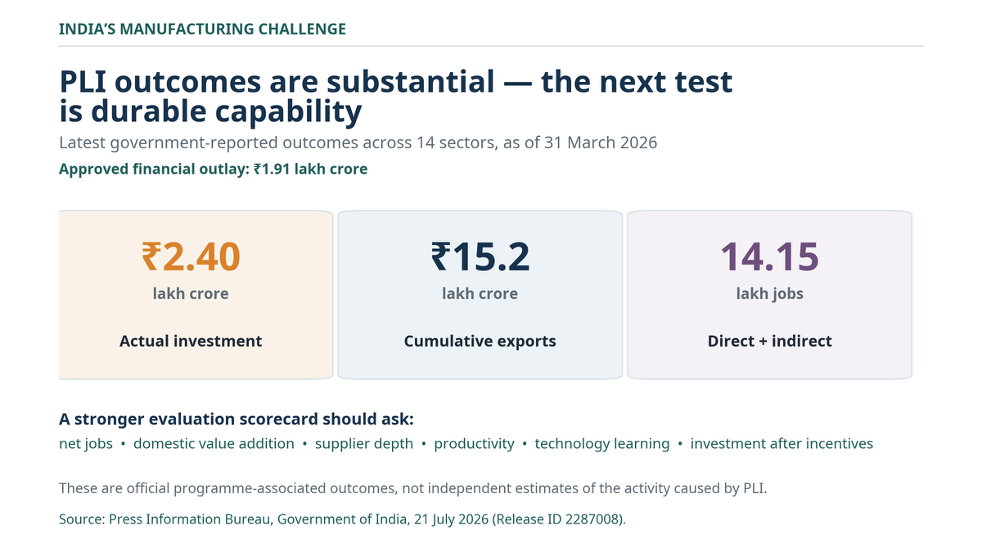
These figures should nevertheless be described precisely. They are official programme results, not independent estimates of the scheme’s causal impact. Jobs associated with participating projects are not necessarily all net additional jobs that would have been absent without the incentives. Production recorded under a scheme may also include activity that would have occurred in some form anyway. Proper evaluation requires a credible counterfactual.
Electronics is the programme’s most visible achievement. India has moved from being a major net importer to becoming a net exporter of mobile phones, and smartphone assembly has expanded rapidly. That is a genuine structural change. It should not be dismissed merely because imported components remain important: assembly can be the first step through which workers, suppliers and managers acquire production capability. [26, 30]
But assembly must become a platform for deeper participation rather than a permanent endpoint. India remains weaker in several high-value components, production equipment, design-intensive functions and parts of the semiconductor ecosystem. NITI Aayog’s work on electronics global value chains emphasises the need to deepen India’s participation across the chain, not merely increase the number of finished products assembled within the country. [31]
The share of exports classified as manufactures cannot settle this question. A smartphone counts as a manufactured export regardless of how many of its high-value components were imported. What matters is the domestic income, knowledge and capability created at each stage.
PLI should therefore be evaluated using a broader scorecard: net employment, domestic value addition, productivity, export complexity, supplier development, private investment after incentives expire, technological learning and the fiscal cost of each additional outcome. Manufacturing’s share of GDP remains important, but it is not the only meaningful test.
A Different Bus Is Still Running
The exact historical role played by China—a single economy becoming the dominant low-cost workshop for much of the world—appears unlikely to be reproduced. Automation is changing labour requirements, geopolitical tensions are fragmenting trade, and companies increasingly value resilience alongside cost.
But that does not mean India’s manufacturing opportunity has disappeared. It means the opportunity has changed.
India does not have to replace China across every product category. It can become one of several major manufacturing nodes in a more diversified system. Its domestic market can help firms reach scale in automobiles, appliances, electronics and other sectors before they export. Yet the domestic market cannot become an excuse for avoiding global competition. Exports remain an essential test of cost, quality, technology and reliability.
Entirely new areas are also being contested: batteries, electric mobility, renewable-energy equipment, semiconductors, advanced electronics, medical devices and new materials. At the same time, traditional labour-intensive sectors—garments, footwear, furniture, toys and food processing—still matter because they can create employment at a scale that highly automated industries may not.
The objective should not be to win every industry through subsidies. It should be to identify areas where India has, or can build, a credible combination of market size, workforce, entrepreneurship, supplier potential, technology and export access.
What a Workable Manufacturing Strategy Would Require
Make it easier for productive firms to grow—but not by making workers disposable. The new Labour Codes must be implemented clearly and consistently, with predictable procedures for employers and enforceable protections for workers. Written employment terms, timely wages, social-security coverage, compensation, reskilling and effective worker representation are part of a productive industrial system, not obstacles to it. The Ministry of Labour’s own guidance emphasises that notice, compensation and other safeguards continue under the new framework. [13, 14, 15]
Treat states and industrial regions as the principal units of delivery. Land, electricity distribution, local roads, urban services, policing, training institutions and many operating approvals depend heavily on state and local administration. National announcements cannot substitute for competent execution in an industrial district. India does not need every state to become equally competitive in every product. It needs several deeply capable manufacturing regions that can demonstrate what works and draw suppliers around them.
Use trade policy to help India import competitively so that it can export competitively. Global value chains require firms to source the best available components, machinery and materials. Tariffs on selected final goods may sometimes be justified, but protection of an upstream input can quietly tax every downstream exporter. Tariff stability, efficient customs procedures, trade agreements and mutual recognition of standards are as much a part of industrial policy as production subsidies. The World Bank’s trade assessment similarly stresses the importance of diversification and deeper participation in global value chains. [26]
Design industrial employment around women rather than waiting for women to adapt to existing factories. Safe transport, childcare, sanitation, secure hostels, suitable shift arrangements, workplace grievance mechanisms and protection against harassment must be built into industrial parks and employer practices. The question is not simply whether women are legally permitted to work. It is whether the surrounding social and physical infrastructure makes regular industrial employment realistically accessible.
Connect training directly with production. Technical institutes should be linked with particular clusters and employers. Apprenticeships should lead to recognised skills and credible employment pathways. Supervisory, maintenance and quality-control skills deserve as much attention as entry-level machine operation. Public training expenditure should increasingly be judged by placement, earnings and employer demand rather than enrolment alone.
Build supplier capability, not only headline factories. Large anchor investors matter, but the deeper prize lies in the firms that supply components, tooling, testing, packaging, software and industrial services around them. Local suppliers need access to technology, quality certification, patient finance and major customers. Without this layer, India may record impressive final-product exports while capturing too little of the value and learning beneath them.
Do not confuse faster approvals with weaker safeguards. Industrial land must be assembled lawfully, with fair compensation and rehabilitation where displacement occurs. Environmental assessment, pollution control, water management, occupational safety and emergency preparedness must be treated as essential infrastructure. Rana Plaza demonstrated the human and economic cost of industrialisation without enforceable safety. Cleaner and safer manufacturing is also increasingly necessary for access to demanding global markets.
Sustain policy long enough for learning to compound. Industrial ecosystems take years to develop. Frequent changes in tariffs, incentives, standards or eligibility rules create uncertainty and encourage firms to organise around the next concession rather than long-term productivity. What India most needs is not one dramatic policy announcement, but coordinated execution across Union, state and local institutions over several political cycles.
The Road Not Taken
India did not miss the earlier manufacturing opportunity in one dramatic moment. It narrowed the path through a long sequence of decisions: licensing that constrained expansion, reservations that made smallness a policy objective, trade barriers that protected inputs as well as outputs, infrastructure that arrived too slowly and reforms that advanced unevenly across states.
Many of these decisions were individually defensible. Small firms needed support. Workers needed protection. Domestic industry needed time to develop. Farmers and vulnerable sectors could not simply be exposed overnight to global competition. The failure lay not in recognising those concerns, but in repeatedly addressing them through arrangements that made productive growth harder and then allowing temporary protections to become permanent structures.
The cost cannot be calculated as a precise number of factory jobs that would otherwise certainly have existed. No credible counterfactual can tell us that. But the direction is clear: India created fewer opportunities than it might have for workers to move from low-productivity activities into regular, higher-productivity employment. It also lost years of supplier development, technical learning and participation in global production networks.
India’s demographic window will not remain open indefinitely, and automation may make the next phase of industrialisation less labour-intensive than the last. That adds urgency, but not hopelessness. The country still possesses a large market, capable firms, improving infrastructure, a growing electronics base and a broad entrepreneurial economy.
India does not need to become “the factory of the world.” It needs to become a country in which productive firms can grow without becoming lawless, workers can become more productive without becoming disposable, and industrial policy rewards capability rather than permanent dependence.
That is not the bus China caught. It is one India can still build for itself.
Data and interpretation note
| Manufacturing shares use the World Bank’s internationally comparable value-added measure. Export shares refer to manufactures as a percentage of merchandise exports, not all exports, and years differ by country. PLI figures are official programme-associated outcomes reported through 31 March 2026, not independent estimates of net additional activity caused by the scheme. |
References
References are numbered in the order in which they first appear in the article.
Official data and policy benchmarks
[1] World Bank. “Manufacturing, value added (% of GDP) [NV.IND.MANF.ZS].” World Development Indicators. https://data.worldbank.org/indicator/NV.IND.MANF.ZS
[2] World Bank. “Manufactures exports (% of merchandise exports) [TX.VAL.MANF.ZS.UN].” World Development Indicators. https://data.worldbank.org/indicator/TX.VAL.MANF.ZS.UN
[3] Government of India, Department for Promotion of Industry and Internal Trade. National Manufacturing Policy, 2011. https://www.dpiit.gov.in/documents/acts-and-policies/national-manufacturing-policy-ETOwATNtQWa?pageTitle=National-Manufacturing-Policy
[4] Press Information Bureau, Government of India. “National Manufacturing Policy.” 2 March 2015. https://www.pib.gov.in/newsite/PrintRelease.aspx?lang=2®=48&relid=117286
Historical policy and firm growth
[5] Government of India. The Industries (Development and Regulation) Act, 1951. India Code. https://www.indiacode.nic.in/indiacode/handle/123456789/2118?view_type=browse
[6] Panagariya, Arvind. “India in the 1980s and 1990s: A Triumph of Reforms.” IMF Working Paper WP/04/43, 2004. https://doi.org/10.5089/9781451846355.001
[7] Hemming, Richard, et al. India: Economic Reform and Growth. International Monetary Fund, 1995. https://doi.org/10.5089/9781557755391.084
[8] Martin, Leslie A., Shanthi Nataraj, and Ann E. Harrison. “In with the Big, Out with the Small: Removing Small-Scale Reservations in India.” American Economic Review 107, no. 2 (2017): 354–386. https://doi.org/10.1257/aer.20141335
[9] Kandilov, Ivan T., Asli Leblebicioğlu, and Ruchita Manghnani. “Deregulation and Firm Investment: Evidence from the Dismantling of the License System in India.” World Bank Policy Research Working Paper 7884, 2016. https://econpapers.repec.org/paper/wbkwbrwps/7884.htm
[10] Aghion, Philippe, Robin Burgess, Stephen J. Redding, and Fabrizio Zilibotti. “The Unequal Effects of Liberalization: Evidence from Dismantling the License Raj in India.” American Economic Review 98, no. 4 (2008): 1397–1412. https://doi.org/10.1257/aer.98.4.1397
[11] Alfaro, Laura, and Anusha Chari. “Deregulation, Misallocation, and Size: Evidence from India.” Journal of Law and Economics 57, no. 4 (2014): 897–936. https://doi.org/10.1086/680930
[12] Arnold, Jens Matthias, Beata Javorcik, Molly Lipscomb, and Aaditya Mattoo. “Services Reform and Manufacturing Performance: Evidence from India.” World Bank Policy Research Working Paper 5948, 2012. https://documents.worldbank.org/en/publication/documents-reports/documentdetail/539861468040584121
Labour, logistics and employment
[13] Ministry of Labour & Employment, Government of India. “Labour Codes” official portal, including implementation notifications and central rules. https://www.labour.gov.in/offerings/schemes-and-services/details/labour-codes-gzNzQzMtQWa
[14] Government of India. The Industrial Relations Code, 2020 (No. 35 of 2020). https://www.labour.gov.in/offerings/schemes-and-services/details/labour-codes-gzNzQzMtQWa
[15] Government of India. Industrial Relations (Central) Rules, 2026. https://www.labour.gov.in/offerings/schemes-and-services/details/labour-codes-gzNzQzMtQWa
[16] Government of India, Ministry of Finance. Economic Survey 2018–19, Chapter 3, “Nourishing Dwarfs to Become Giants: Reorienting Policies for MSME Growth.” https://www.indiabudget.gov.in/budget2019-20/economicsurvey/index.php
[17] National Council of Applied Economic Research and Department for Promotion of Industry and Internal Trade. “Logistics Cost in India” dashboard, reference year 2023–24. https://ncaer.org/logistics-dashboard/
[18] Ministry of Statistics & Programme Implementation, Government of India. “Periodic Labour Force Survey (PLFS) Annual Report, 2025 [January 2025–December 2025].” Press Information Bureau, 27 March 2026. https://www.pib.gov.in/PressReleasePage.aspx?PRID=2246009®=3&lang=1
East Asia, trade and global value chains
[19] World Bank. “Building Engines for Growth and Competitiveness in China: Experience with Special Economic Zones and Industrial Clusters.” 2010. https://www.worldbank.org/en/news/feature/2010/12/19/building-engines-growth-competitiveness-china-experience-special-economic-zones-industrial-clusters
[20] World Trade Organization. “China and the WTO.” https://www.wto.org/english/thewto_e/countries_e/china_e.htm
[21] International Energy Agency. Solar PV Global Supply Chains. 2022. https://www.iea.org/reports/solar-pv-global-supply-chains
[22] International Energy Agency. Global EV Outlook 2026. https://www.iea.org/reports/global-ev-outlook-2026
[23] World Bank. Viet Nam 2045: Trading Up in a Changing World. 2025. https://www.worldbank.org/en/country/vietnam/publication/viet-nam-2045-trading-up-in-a-changing-world
[24] International Labour Organization. “The Rana Plaza Disaster Ten Years On: What Has Changed?” InfoStory. https://webapps.ilo.org/infostories/en-GB/Stories/Country-Focus/rana-plaza.html
[25] International Labour Organization. “International Accord for Health and Safety in the Textile and Garment Industry.” https://cbsd.ilo.org/cbsd_initiatives/international-accord-for-health-and-safety-in-the-textile-and-garment-industry-formerly-known-as-the-accord-on-fire-and-building-safety-in-bangladesh
[26] World Bank. India Development Update: India’s Trade Opportunities in a Changing Global Context. September 2024. https://documents.worldbank.org/en/publication/documents-reports/documentdetail/099513209032434771
[27] Press Information Bureau, Government of India. “India’s On-Going Trade Negotiations.” 13 March 2020. https://www.pib.gov.in/newsite/PrintRelease.aspx?lang=2®=48&relid=200213
The next manufacturing opportunity
[28] Rodrik, Dani. “Premature Deindustrialization.” Journal of Economic Growth 21, no. 1 (2016): 1–33; NBER Working Paper 20935. https://www.nber.org/papers/w20935
[29] Kochhar, Kalpana, Utsav Kumar, Raghuram Rajan, Arvind Subramanian, and Ioannis Tokatlidis. “India’s Pattern of Development: What Happened, What Follows?” IMF Working Paper WP/06/22, 2006. https://doi.org/10.5089/9781451862829.001
[30] Press Information Bureau, Government of India. “PLI Schemes Attract Over ₹2.40 Lakh Crore Investment, Generate More Than 14.15 Lakh Jobs.” 21 July 2026. https://www.pib.gov.in/PressReleasePage.aspx?PRID=2287008&lang=1®=1
[31] NITI Aayog. Electronics: Powering India’s Participation in Global Value Chains. 18 July 2024. https://www.niti.gov.in/node/1360
————————————————————————————————————————————
Amulya Charan writes on energy systems, infrastructure economics, and development policy at amulyacharan.com.