India’s Navy Escorted Tankers Through Hormuz. The Real Test Was Everything Behind It
India’s Navy Escorted Tankers Through Hormuz. The Real Test Was Everything Behind It
The Gulf crisis showed why merchant ships, logistics, ports, oil stocks and insurance belong in the same conversation as naval power.
| HORMUZ LESSONS — IN SHORT• The Navy could escort ships; India could not escape its dependence on foreign merchant tonnage.• A long deployment is limited as much by fuel, maintenance, berths and fleet-support ships as by combat power.• Indian maritime interests extend beyond the Indian flag because Indians crew ships registered all over the world.• Ports, refineries and terminals are part of the security chain. Getting a tanker home is not the end of the job.• Strategic storage capacity matters, but the harder question is how much usable oil is actually available when a crisis begins.• The Bharat Maritime Insurance Pool showed that finance can become a chokepoint too. |
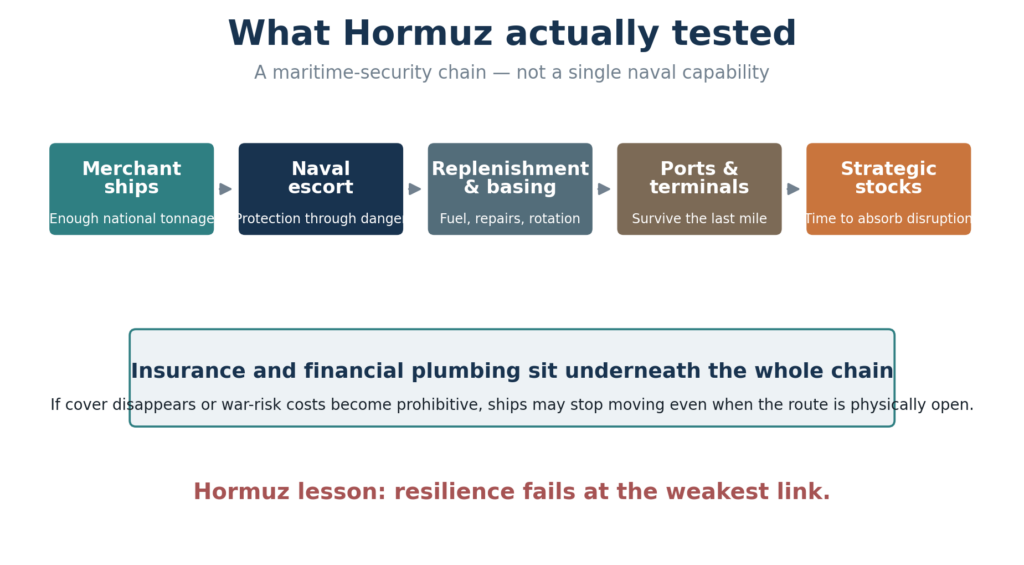
Infographic 1. Hormuz tested a chain of capabilities, with insurance and finance running underneath it.
The shock moved faster than the policy machinery
For years, India has discussed maritime security in the most visible language available: destroyers, submarines, aircraft carriers, surveillance networks. Hormuz forced a less comfortable conversation. A warship can protect a tanker. It cannot conjure up the tanker, insure its cargo, refill its own fuel tanks indefinitely, build a berth in a week or put crude into an empty storage cavern.
That was the real value of the 2026 crisis. It turned a distant chokepoint into a practical audit of India’s maritime system.
The shock travelled quickly. S&P Global reported that crude and condensate exports from Persian Gulf producers to India fell from roughly 2.8 million barrels a day in February to about 673,000 barrels a day in March. LPG flows dropped from about 712,000 barrels a day to 132,000. Those are not small adjustments around the edges. They are the kind of numbers that force refiners, shipping companies and governments to improvise.
By March, Indian naval ships were escorting nationally owned or flagged tankers in and around the Gulf of Oman. India had been present in these waters for years under Operation Sankalp; escorting named merchant vessels is different. Presence is a posture. Escort is a promise tied to a particular ship and a particular passage.
By 4 August, the government told Parliament that 60 vessels carrying cargo for India had safely transited the Strait of Hormuz and 3,972 Indian seafarers had been repatriated from the Gulf region. On its own terms, that is a solid operational record. It also raises the more interesting question: what happens if the requirement lasts not for weeks, but for months?
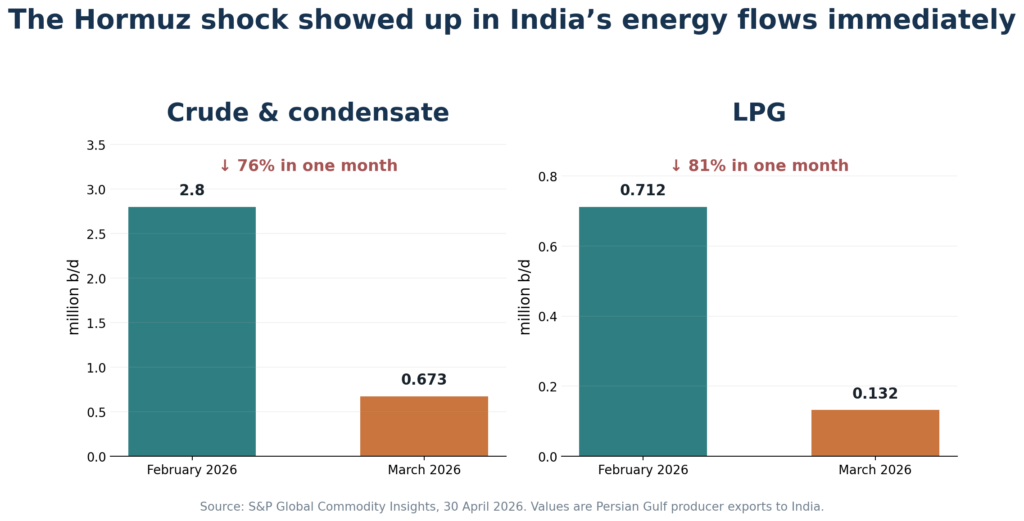
Infographic 2. Persian Gulf crude/condensate and LPG exports to India fell sharply between February and March 2026. Source: S&P Global Commodity Insights.
The first bottleneck was not the Navy
India is one of the world’s largest trading and energy-importing economies. Yet much of that trade still moves on ships India does not own or flag.
Petroleum Minister Hardeep Singh Puri put the imbalance plainly in 2025: only about 20% of India’s trade cargo was being carried on Indian-flagged or Indian-owned vessels. Over the previous five years, public-sector oil companies had spent nearly $8 billion chartering ships. In normal times that is an efficiency question. During a conflict it becomes a question of control.
The fleet is also ageing. At the end of 2025 India had 1,592 registered vessels totalling 14.02 million gross tonnes. Nearly half—744 ships—were already more than 20 years old. The overseas-trade fleet looked somewhat better, but 207 of its 503 vessels were still over 20.
This is the constraint that naval procurement cannot fix. The Navy can escort available shipping; it cannot expand the national merchant fleet by itself. That is why the post-Hormuz push for new crude carriers, LPG tankers and other merchant vessels matters. Shipbuilding policy sounds industrial. In a crisis, it is national-security policy with invoices and steel plates.
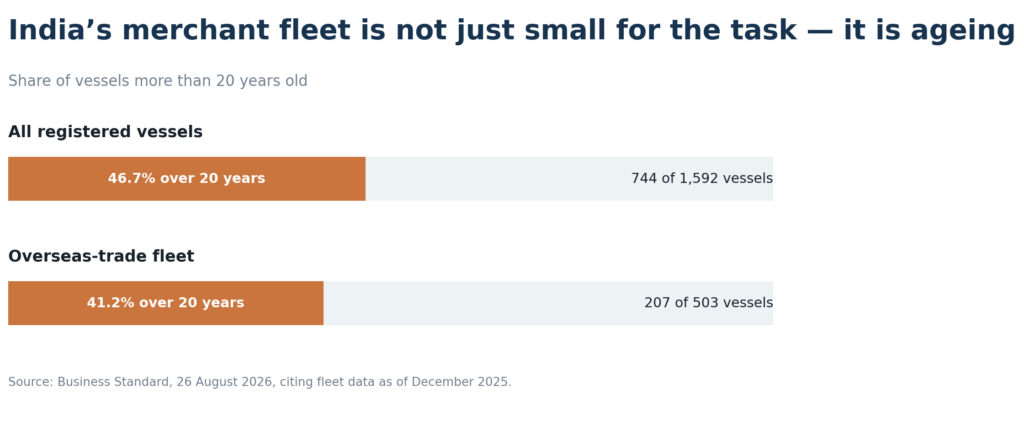
Infographic 3. Nearly half of India’s registered merchant fleet was more than 20 years old at end-2025. Source: Business Standard, citing official fleet data.
Indian seafarers do not stop at the Indian flag
There is another wrinkle. India owns a modest slice of global merchant tonnage, but Indians crew a very large share of the world’s ships.
The BIMCO-ICS Seafarer Workforce Report 2026, cited by the government, puts India at 311,936 maritime professionals—12.16% of the global seafaring workforce, second only to the Philippines. Many of those men and women work on vessels registered somewhere else.
That makes a neat registry-based view of protection impossible. An Indian seafarer may be on a Liberian-, Panamanian- or Singapore-flagged ship, working for a foreign owner and insured through an international market. The relevant safety net can involve the flag state, shipowner, insurer, coastal state, Indian diplomatic missions and the Directorate General of Maritime Administration.
The government’s July ‘Seafarer-First’ response was therefore important. It ordered vessel-by-vessel monitoring and said Indian seafarers in the affected region should be accounted for irrespective of the flag on the stern. That is more than welfare administration. It is an acknowledgement that India’s maritime footprint is larger than its register.
A warship is only as useful as the logistics behind it
The glamorous part of naval power is firepower. The limiting part is often fuel.
A destroyer operating thousands of kilometres from home still needs water, stores, ammunition, spares and maintenance. Crew endurance matters too. The longer a deployment lasts, the more quickly the conversation shifts from missiles to replenishment.
India recognised this before Hormuz. In August 2023 the Ministry of Defence signed a roughly ₹19,000-crore contract with Hindustan Shipyard for five Fleet Support Ships. Their job is to replenish combat ships at sea so those ships can stay deployed rather than repeatedly returning to harbour. Delivery is scheduled to begin from mid-2027.
The timing is revealing. The requirement arrived before the new support fleet did. That does not make the programme late in any contractual sense; it shows how quickly strategy can outrun procurement. For the Navy, the years until the new ships are fully available are not an abstract gap. They are the period in which a sustained western deployment has to be supported with what already exists.
Karwar suddenly looks like energy infrastructure
Ships also need somewhere to come back to.
India has useful access in Oman, including at Duqm, but it does not have a chain of permanent overseas naval bases across the Gulf. That makes the western Indian coast do more work than the map sometimes suggests.
Project Seabird at Karwar was conceived long before this crisis. Phase IIA is intended to accommodate 32 ships and submarines and 23 yard craft, with a naval air station, dockyard facilities, covered dry berths and logistics support. Read as a construction project, those are impressive numbers. Read after Hormuz, they mean something more practical: repair, rotation, rearming and replenishment close to the Arabian Sea.
A ship that can turn around at Karwar is a ship that spends less time travelling back for support. That is why a base built for naval expansion now looks, in part, like energy-security infrastructure.
The budget still reveals an old bias
India is spending more on defence, but not every rupee buys endurance.
MP-IDSA’s analysis of the 2026–27 defence budget noted that the three main Navy modernisation heads together rose by about 4% over the previous Budget Estimate, to ₹32,496.1 crore. The Naval Fleet head itself rose 2.6%, while Naval Dockyards/Projects fell 3.7%.
There is a fair caveat: the Union Budget was presented on 1 February, before the late-February escalation in West Asia. It would be wrong to treat those numbers as a response to Hormuz. Still, they illustrate a familiar political economy. New combat platforms are visible. Maintenance capacity, dry docks, fuel farms and support ships are not. Yet a long deployment notices the invisible assets first.
The dangerous end of the voyage is on land
Getting a tanker across dangerous water is only half the journey. The cargo still has to be unloaded, stored, refined and moved inland.
India has built a much stronger coastal-security architecture since the 2008 Mumbai attacks. Naval and Coast Guard surveillance, coastal radars, Automatic Identification System data, port-security regimes and marine policing have all improved. But the threat has changed as well.
A surveillance network that is good at finding suspicious vessels is not, by itself, an air-defence system. Drones, loitering munitions, electronic interference and precision weapons create a different problem. Significantly, the government’s own February 2026 maritime advisory required ship-shore security drills covering loitering munitions and unmanned surface vessels. The threat is no longer theoretical.
For major oil terminals and refineries, resilience means more than buying a counter-drone system. It includes layered detection, electronic warfare, hard-kill options where appropriate, cyber protection, backup power, communications redundancy, emergency repair plans and alternative routes for moving product. It also means asking an awkward question before a crisis: what happens if one important terminal is unavailable for a week?
The Navy can bring a tanker home. It cannot make the receiving infrastructure indestructible.
Strategic reserves: storage is not the same as oil
Hormuz also revived an argument India has had many times: how much strategic petroleum reserve is enough?
The first-phase Strategic Petroleum Reserve provides 5.33 million metric tonnes of underground crude-storage capacity at Visakhapatnam, Mangaluru and Padur. A second phase, approved in 2021, envisages another 6.5 MMT at Chandikhol and Padur.
The important word is capacity. A cavern that can hold oil is not necessarily a cavern filled to that level on the day a crisis begins. Commercial stocks held by refiners and oil-marketing companies provide another buffer, so slogans about India having only a fixed number of ‘days of oil’ can be misleading unless the underlying assumptions are made clear.
The policy question is more useful when framed differently: what minimum strategic inventory should India be able to call on at short notice, over and above normal commercial stocks? For a country that imports most of its crude, that number deserves the same seriousness as the size of the storage system itself.
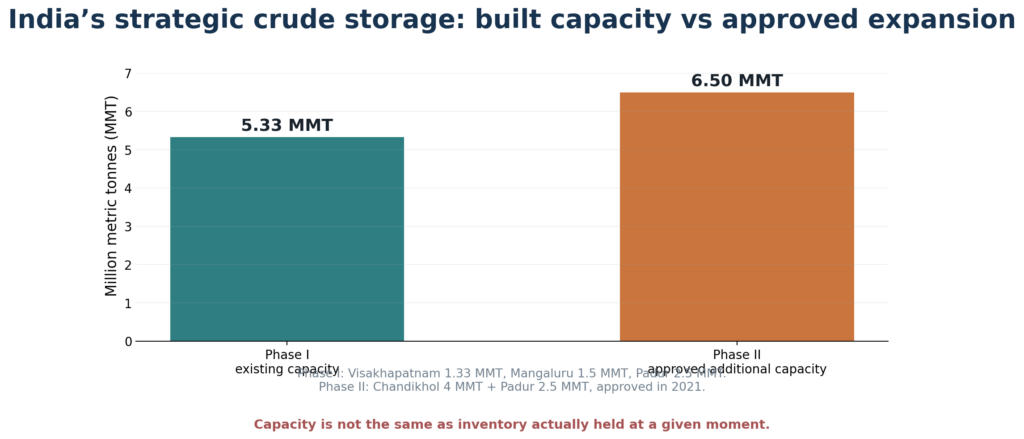
Infographic 4. India has 5.33 MMT of Phase-I strategic crude-storage capacity; a further 6.5 MMT was approved under Phase II. Capacity should not be confused with inventory on hand.
Insurance quietly became security infrastructure
One of the clearest lessons of Hormuz came from a place rarely associated with national strategy: the insurance market.
A ship may be physically capable of sailing through a risky corridor and still remain at anchor if war-risk cover is unavailable or prohibitively expensive. India has long depended heavily on international insurance and P&I arrangements. In April, the Cabinet approved the Bharat Maritime Insurance Pool with a sovereign guarantee of ₹12,980 crore; it was launched in May with capacity of $1.5 billion.
By 29 July, 1,608 cargo-war and hull-war policies had been issued under the pool. The Department of Financial Services also said war-risk premium rates had fallen roughly 35–40% from levels seen at the height of the West Asia conflict after the pool’s introduction.
That makes the pool more than a shipping subsidy. It is an attempt to keep a piece of the financial plumbing under Indian control when geopolitical risk is highest. In a maritime crisis, sovereignty includes the ability to insure the voyage.
What changed after Hormuz — and what still has to connect
India has not ignored the vulnerabilities the crisis exposed. Some important responses were already under way; others accelerated once the disruption became real.
Five Fleet Support Ships are being built. Karwar is expanding. A programme to add 62 merchant vessels was advanced in the middle of the crisis. The Bharat Maritime Insurance Pool went from approval to operation in a matter of weeks. Seafarer tracking became more systematic. Strategic reserve expansion remains on the agenda.
The harder problem is institutional. These pieces sit in different ministries, budgets and regulatory systems. Shipping, defence, petroleum, ports, insurance and seafarer welfare each have their own machinery. Hormuz did not arrive organised that way. It hit all of them at once.
That suggests the next useful step is not another slogan about becoming a maritime power. It is a practical national maritime-resilience framework built around real scenarios: a closed chokepoint, a damaged terminal, unavailable insurance, disrupted navigation signals, foreign-flagged ships with Indian crews, or a naval deployment that has to be sustained for six months.
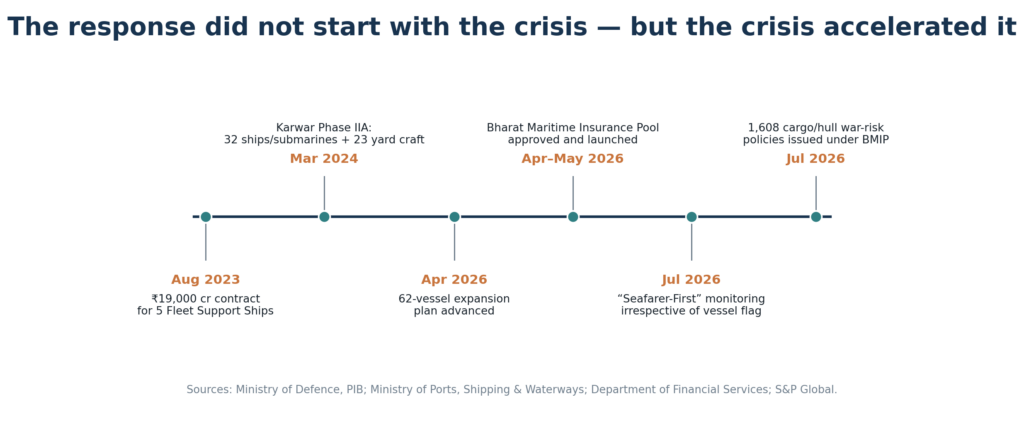
Infographic 5. Several resilience measures pre-dated Hormuz; the crisis accelerated or validated others.
What India should do next
Build the merchant fleet faster. New ships have to do two jobs at once: replace ageing tonnage and increase India’s share of the trade it can control directly. Crude tankers, LPG carriers and other strategically important vessels deserve particular attention.
Treat replenishment as combat capability. The Fleet Support Ships are not back-office assets. They determine how long frontline ships can stay forward. Until the new vessels arrive, interim charter or commercial-support arrangements deserve serious examination.
Finish the west-coast logistics backbone. Karwar’s value should be measured in operational turnaround time, not only in the number of berths completed.
Set a clear strategic-stock policy. Expanding storage matters, but government should also be clear about the minimum inventory it wants available above ordinary commercial holdings.
Harden the receiving end. Ports, refineries and terminals need layered physical and cyber resilience, not a single gadget labelled ‘counter-drone’.
Keep the insurance pool permanent and test it under stress. The meaningful metric is whether Indian trade keeps moving at an acceptable cost when global risk markets seize up.
Above all, join the pieces. India already has naval strategy, shipping policy, energy policy and port policy. Hormuz showed why they need to meet in the same contingency plan.
Hormuz was an audit, not just an operation
The simplest reading of 2026 is that the Indian Navy did its job. Ships deployed, merchant vessels moved and thousands of Indian seafarers came home. That deserves credit.
The more useful reading is that Hormuz audited everything around the Navy.
It exposed how much Indian trade still depends on foreign tonnage. It showed why Indian sailors cannot be protected only through the Indian register. It reminded planners that fleet support and basing decide endurance. It pushed insurance into the realm of national security and put a sharper question behind strategic petroleum storage: not just how much space India has, but how much usable buffer is actually there when the route closes.
The next phase of India’s maritime rise may therefore look rather unglamorous. More tankers. More support ships. Better dry docks. Stronger terminals. Deeper stocks. Domestic insurance. Boring things, mostly.
But that is the point. A maritime power is not the navy photographed on Navy Day. It is the system that keeps those ships—and the country behind them—working when the sea stops being friendly.
Major references used
The article relies primarily on Government of India releases, parliamentary material, defence-budget analysis and specialist maritime reporting. Links below were checked in September 2026.
1. S&P Global Commodity Insights, “India plans 62-ship investment project to shore up supply chains amid Hormuz crisis,” 30 April 2026. Open source
2. USNI News, “India, Pakistan Escort Nationally-owned Tankers in Gulf of Oman,” 17 March 2026. Open source
3. PIB, Ministry of Ports, Shipping and Waterways, “Seafarer-First Initiative,” Rajya Sabha reply, 4 August 2026. Open source
4. PIB, Ministry of Ports, Shipping and Waterways, Hardeep Singh Puri remarks on Indian-owned/flagged cargo share and PSU chartering costs, 2025. Open source
5. Business Standard, “India’s merchant fleet to get 100 ships, but ageing fleet remains a hurdle,” 26 August 2026. Open source
6. PIB, Ministry of Ports, Shipping and Waterways, “India Emerges as World’s Second-Largest Supplier of Seafarers,” 28 July 2026. Open source
7. PIB, Ministry of Ports, Shipping and Waterways, “Seafarer-First Response as India Intensifies Maritime Vigil in West Asia,” 14 July 2026. Open source
8. PIB, Ministry of Defence, contract for five Fleet Support Ships with Hindustan Shipyard Ltd., 25 August 2023. Open source
9. PIB, Ministry of Defence, Fleet Support Ships scheduled for delivery commencing mid-2027, 10 April 2024. Open source
10. PIB, Ministry of Defence, Project Seabird Phase IIA infrastructure at Karwar, 4 March 2024. Open source
11. MP-IDSA, “Ministry of Defence 2026–27 Budget Estimates: An Analysis,” 13 February 2026. Open source
12. PIB, Ministry of Petroleum & Natural Gas, “Government steps to Strengthen Strategic Petroleum Reserves,” 20 March 2025. Open source
13. PIB, Ministry of Petroleum & Natural Gas, Phase-II Strategic Petroleum Reserve facilities of 6.5 MMT, 26 July 2021. Open source
14. PIB, Cabinet approval for Bharat Maritime Insurance Pool with ₹12,980-crore sovereign guarantee, 18 April 2026. Open source
15. PIB, Department of Financial Services, launch of $1.5-billion Bharat Maritime Insurance Pool, 12 May 2026. Open source
16. PIB, Department of Financial Services, BMIP P&I product; 1,608 war-risk policies issued by 29 July and reported premium reduction, 30 July 2026. Open source