How Small Businesses Help India Grow
What India’s MSMEs contribute and what we can learn from the United States, Germany, China and Brazil
Updated 18 November 2026
How Small Businesses Help India Grow
A note on Indian numbers. One lakh is 100,000 (one hundred thousand). One crore is 10 million (10,000,000), or 100 lakh. For example, 35.2 lakh is 3.52 million. The ₹ symbol denotes Indian rupees.
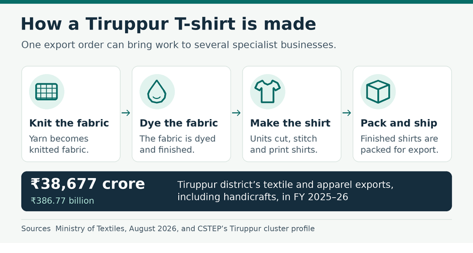
A T-shirt shipped from Tiruppur passes through many hands. One unit knits the fabric, another dyes it, and others cut, stitch, print or pack it. A foreign buyer may deal with one exporter, but the order creates work across a town. Tiruppur led India’s districts in textile and apparel exports, including handicrafts, in FY 2025–26, with shipments worth ₹38,677 crore. That is the district’s total. What makes it interesting is how a network of specialised businesses can deliver an order few of them could handle alone. [1] [2]
We see the same pattern around Pune. A small forge or heat-treatment unit may never sell a car or export a crate in its own name. Its work still helps an Indian vehicle or parts maker deliver on time and meet a buyer’s specifications. When that supplier learns to make a part more accurately or with less waste, the gains travel down the production line. This is one of the ways micro, small and medium enterprises, or MSMEs, make Indian industry more competitive. [3]
What small businesses contribute to India
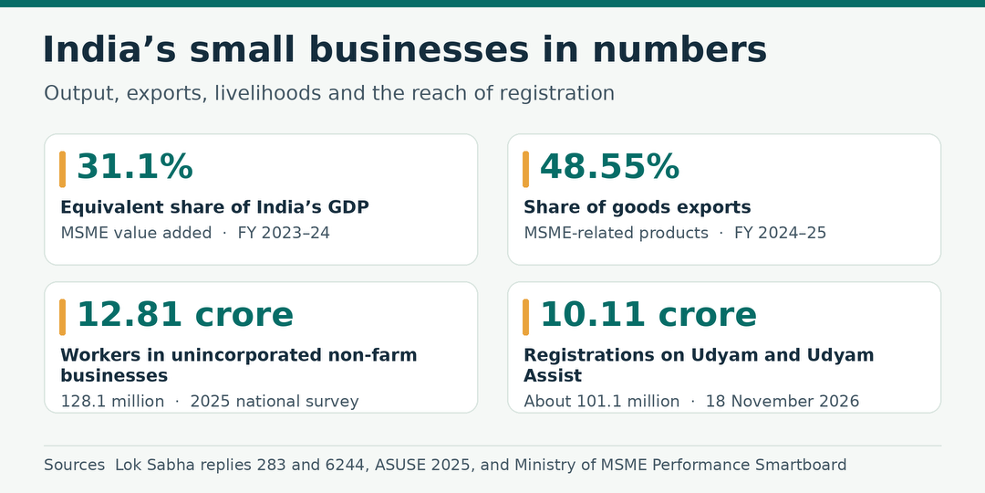
In FY 2023–24, the value MSMEs added was equivalent to 31.1% of India’s GDP. In FY 2024–25, goods identified by the Ministry of MSME as MSME-related accounted for 48.55% of merchandise exports, up from 45.74% the year before. That second figure measures categories of goods, which can also be shipped by large companies. A small firm’s contribution can also travel abroad inside a larger company’s finished product. [4] [5]
For many families, the more immediate contribution is work close to home. The 2025 national survey estimated that 7.92 crore unincorporated non-farm establishments supported 12.81 crore workers, about 6 crore of them in rural areas. The survey counted an estimated 74.5 lakh more workers than in its preceding round, which covered October 2023 to September 2024. Services other than trade accounted for about two in five workers in 2025. Women owned 27% of the proprietary establishments in the survey. A repair shop keeps farm equipment running, a food processor buys from nearby growers, and a tailoring unit can give someone a first paid job. That is how growth reaches places that may never have a large factory. [6]
The MSME Ministry recorded 10.11 crore registrations across Udyam and Udyam Assist on 18 November 2026. The registration total shows how far the two platforms have reached. The survey estimates how many establishments were operating in the activities it covers. India also raised the investment and turnover limits for each MSME category in April 2025, giving firms more room to grow within a category. The economic test is what those firms go on to produce, sell and pay their workers. [7] [8]
How small businesses compare across five economies
Small businesses matter in all five countries, though each country counts them differently. India classifies firms by investment and turnover. The US Small Business Administration generally uses fewer than 500 employees in its research, while Germany’s figures below use the EU definition, which combines a staff ceiling of fewer than 250 with a financial test. Each row gives a sense of the sector’s role in that economy. [8] [9] [10] [11]
| Economy | Scale and contribution | How firms can grow |
| India | 10.11 crore registrations in November 2026. MSME value added equalled 31.1% of GDP in FY 2023–24. | Build on industrial clusters such as Tiruppur and Pune. [3] [4] [7] |
| United States | 3.62 crore small businesses and 45.9% of private-sector employees in the SBA’s 2026 report, using 2022 firm data. | Local technical advice helps small manufacturers upgrade. [9] [12] |
| Germany | 35.2 lakh SMEs and 54.4% of employees in Germany’s 2024 business register. | Apprentices learn on the job and at vocational school. [10] [13] |
| China | More than 6 crore SMEs reported in late 2025, including about 17,600 firms selected as national-level “little giants”. | Industrial clusters and specialist suppliers help build domestic supply chains. [14][15] |
| Brazil | 2.4 crore active small businesses reported in June 2026. Micro and small firms accounted for about 80% of net formal job creation in 2025. | Local export advisers help firms prepare for their first shipment. [16] [17] [18] |
What the United States and Germany do well
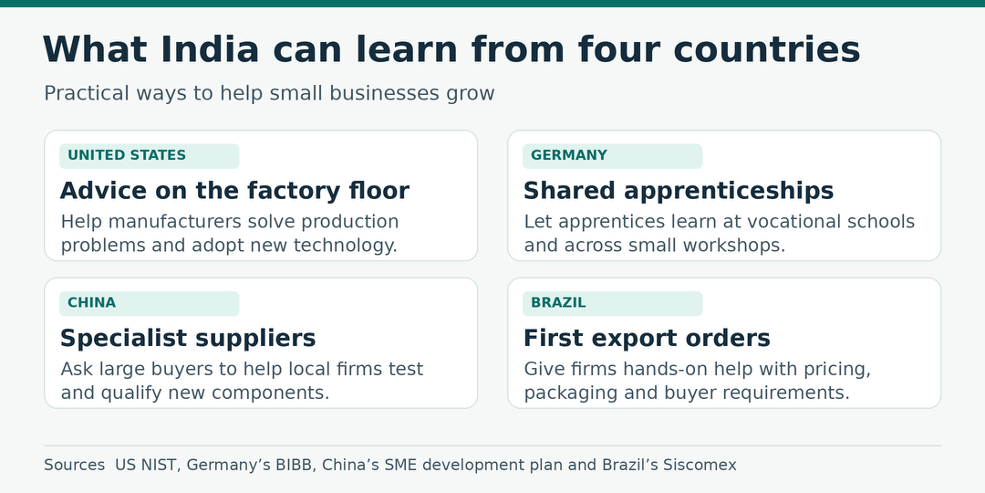
The American Manufacturing Extension Partnership brings practical help to the factory floor. A local adviser can work with a manufacturer on a production problem or help it adopt a new technology. India already has Technology Centres and a programme for shared facilities. A small firm should be able to bring in a faulty component, find out why it failed and get help fixing the process that produced it. [5] [12] [19]
Germany shows how to make training part of the working week. Apprentices learn at a vocational school and in the workplace, and firms can use shared training centres. In 2024, establishments with fewer than 250 employees trained about 68% of Germany’s apprentices. In India, an industrial training institute could arrange for apprentices to rotate among several small factories. A six-person workshop rarely has the equipment to teach every skill on its own. [10] [13]
What China and Brazil can teach India
China has encouraged smaller companies to specialise in parts, materials and processes that larger manufacturers need. Its “little giant” programme singles out firms with technical strengths, and its five-year SME plan announced in September 2026 sets a target of 22,000 such firms by 2030. In India, a similar effort can begin with a manufacturer identifying a component it struggles to source locally, sharing the specifications with nearby suppliers, and helping them take prototypes through testing and qualification. Then there is a customer waiting if they get it right. [14] [15]
Brazil offers a lesson for firms that want to sell overseas. Through ApexBrasil’s PEIEX programme, advisers assess a company’s readiness and work with it on an export plan. In India, district-level teams and export promotion councils could take a first-time food exporter through packaging, shelf-life testing, landed costs and buyer requirements. The practical measure of progress is how many firms make a first shipment and win a repeat order. Brazil’s approach is particularly relevant to Indian districts where a good product already exists but the owner has never costed or arranged an overseas shipment. [18]
Where India should put its effort
Pay suppliers promptly. A growing manufacturer can run short of cash precisely when it wins a bigger order. It must buy materials and pay wages well before the customer pays. On TReDS, an RBI-regulated invoice financing system, a firm can get early payment on an accepted bill. Large buyers and government departments can make this work better by accepting invoices promptly and tracking how many bills go overdue. [20]
Make shared facilities work for the smallest firms. State governments and industry associations could put testing, tooling and training within reach of the clusters that need them. An affordable slot at a shared lab can let a small producer compete for an order it would otherwise have to turn down. Publish what a test costs, how long it takes, and how many firms use the facility again. [19]
Use registrations to reach firms and track their growth. District teams could follow up with newly registered firms to find out what stands between them and their next customer or first employee. For a home-based food business, it may be a shared packaging line. For a parts maker, it may be a skilled machinist or a buyer willing to test a sample. Track sales, repeat orders and paid jobs to see whether the help has made a difference.
We should keep an eye on what happens after the next order arrives. If a Tiruppur unit can buy better equipment, train another worker and sell to a second buyer, the benefits spread to the people and businesses around it. That is how small enterprises help India grow, one supplier and one town at a time.
References
01 Ministry of Textiles, Garment Exports, 11 August 2026
02 CSTEP, MSME cluster profile for Tiruppur
03 Bureau of Energy Efficiency, Pune forging and heat treatment cluster
04 Lok Sabha, question 283, MSME value added as a share of GDP
05 Lok Sabha, question 6244, MSME-related exports and technology support
06 MoSPI, Annual Survey of Unincorporated Sector Enterprises 2025, chapter 3
07 Ministry of MSME, Performance Smartboard, accessed 18 November 2026
08 Ministry of MSME, revised classification effective 1 April 2025
09 US Small Business Administration, Small Business FAQs, February 2026
10 IfM Bonn, the economic significance of German SMEs
11 European Commission, SME definition
12 US National Institute of Standards and Technology, MEP centres, July 2026
13 Germany’s Federal Institute for Vocational Education and Training, shared training centres
14 People’s Daily via Henan government, China’s SME figures, December 2025
15 State Council of China, five-year SME development plan, September 2026
16 Sebrae, active small businesses in Brazil, June 2026
17 Sebrae analysis of Brazilian formal employment records for 2025
18 Brazil’s foreign trade portal, ApexBrasil export readiness programme
19 Ministry of MSME, Cluster Development Programme and shared facilities
20 Reserve Bank of India, Trade Receivables Discounting System Directions 2026