The Sindoor Arithmetic: Why Operation Sindoor May Be the Most Profitable Military Operation in Modern Indian History
A 96-hour campaign cost India roughly $408 million. It cost Pakistan $1.5 billion. But the real story sits in the second decimal place — the asymmetric weight of every dollar spent, the export contracts that followed, and the strategic dividend that turned a defence outlay into an economic windfall. All figures here are best-available estimates as of May 2026; precise wartime costs remain subject to revision.
1. The Morning Nifty Yawned
On the morning of 7 May 2025, the Indian Air Force struck nine terrorist-linked sites across Pakistan and Pakistan-occupied Kashmir. SCALP cruise missiles tore into Markaz-e-Subhan Allah in Bahawalpur. Crystal Maze ballistic missiles hit Markaz-e-Taiba in Muridke. Rafales, Mirage 2000s and Su-30 MKIs released their loads from well inside Indian airspace. Within hours, drone swarms and counter-strikes lit up the Line of Control. Pakistan declared the strikes a “blatant act of war.” India called it Operation Sindoor.
Now look at where the Sensex closed that day: marginally higher. The Nifty 50 finished up 0.1%. Foreign institutional investors who had spent the night reading takedown footage from Bholari and Jacobabad woke up, looked at the screens, and bought.
There is a story buried in that flat green line. It is not a story about cold-blooded markets shrugging off geopolitical risk. It is a story about the economics of credibility — about a country that had finally learned to make terrorism so expensive for its neighbour that the strategic equation, the export balance sheet, and the long-term capital-allocation case for India all moved in the same direction in the same week.
Most analyses of Operation Sindoor read like a casualty list. The interesting analysis is a profit-and-loss statement.
2. Reading the War as a Balance Sheet
Conventional military accounting asks: who lost more men, more aircraft, more airbases? By that measure Pakistan clearly came off worse. Indian forces destroyed runways at Rahim Yar Khan, hit hardened hangars at Jacobabad, damaged the Bholari airbase near Karachi, and degraded radar sites at Pasrur. India admits to the loss of 23 soldiers and, by independent assessments including AirForces Monthly, three combat aircraft. Pakistan’s losses, by satellite imagery and post-strike analysis, were an order of magnitude greater.
But the framework that makes the operation genuinely interesting is not absolute losses. It is three things working in the same direction at the same time:
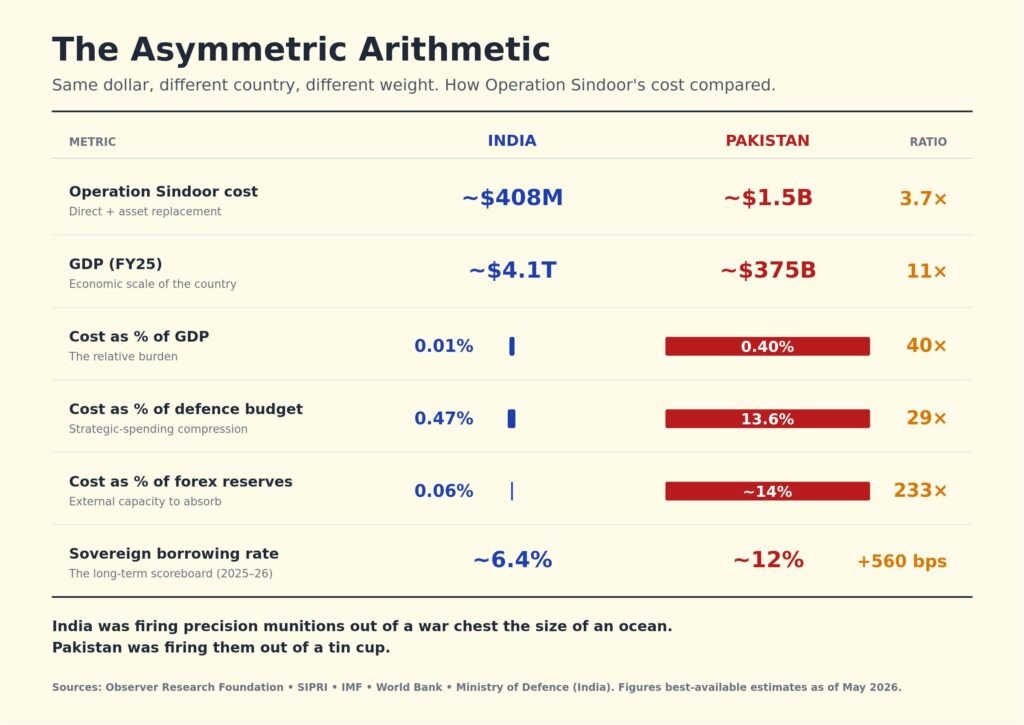
- Asymmetric cost burden. Pakistan spent roughly 3.7× what India spent in absolute dollars during the 96-hour conflict, but the relative burden on Pakistan’s economy was perhaps 30 to 40× heavier than India’s.
- Operational signalling that doubled as a sales pitch. Indigenous Indian systems were “bloodied” in live combat. Within a year, that turned into a 62.6% surge in Indian defence exports.
- Collateral damage to a third party. China’s HQ-9B air defence system failed visibly. The reputational hit to Chinese defence exports widened India’s competitive runway in the global arms market.
Each in isolation would be notable. Together they describe a military operation that returned a strategic dividend in months and a commercial dividend within a fiscal year. India did not just survive Operation Sindoor economically. It compounded.
3. What India Spent — The Cost Ledger
The Observer Research Foundation’s post-conflict accounting puts India’s total cost at approximately US$407.75 millionover the four-day operation. The number conceals an unusually disciplined cost structure.
Begin with the missiles. The IAF deployed a graduated arsenal: SCALP and Crystal Maze missiles on the first day for the high-value Jaish-e-Mohammed and Lashkar-e-Taiba targets; BrahMos cruise missiles for deeper strikes; Akash interceptors and S-400 missiles for the air-defence umbrella. SCALP rounds cost roughly $1.4–1.5 million each, BrahMos in a similar band, Crystal Maze higher still. Six SCALPs at Markaz-e-Subhan Allah and four to five Crystal Maze missiles at Markaz-e-Taiba on a single day represent perhaps $15–20 million of munitions on Day One alone — not counting standoff bombs, Hammer rounds, and counter-drone interceptors deployed over the following nights.
Now consider the artillery layer. The Indian Army used M-777 howitzers, Bofors guns, and Polish-made loitering munitions across the Line of Control. A standard 155mm Bofors shell costs around $1,100. A precision-guided Excalibur round costs roughly $100,000 — almost a hundred times more. Indian commanders fired conventional “dumb” rounds in volume for area suppression, reserving Excalibur for hardened or high-value targets. This is what disciplined cost optimisation looks like in a war: matching the price of the munition to the value of the target, rather than firing premium ordnance at every coordinate.
Add the operational tempo cost: fuel and maintenance for over 50 strike sorties on the opening night, persistent ISR drones loitering for days, S-400 batteries activated across western sectors, satellite tasking for damage assessment, and the depletion of Akash and other interceptor stocks.
For context, $408 million is roughly 0.01% of India’s GDP for FY25, and 0.47% of its annual defence budget of approximately $86 billion. In macroeconomic terms, Operation Sindoor cost India less than a rounding error in the Union Budget — the equivalent of a single mid-sized infrastructure project on what was, by any honest assessment, the most consequential cross-border operation since 1971.
4. Pakistan’s Bill — Absolute and Relative
Pakistan’s bill, by the same ORF accounting, came to approximately US$1.5 billion — roughly 3.7× India’s spend. Indian-source estimates citing official assessments put direct Pakistani losses around ₹7,900 crore (~$950 million) just in physical assets destroyed; the larger $1.5 billion figure incorporates infrastructure repair, operational tempo, and asset replacement.
The physical inventory tells the story in concrete terms. Three Jordanian F-16s were reportedly destroyed at Jacobabad — at refurbished F-16 pricing benchmarks of roughly $18 million per airframe, this alone is around $54 million. The Rahim Yar Khan base, a critical forward operating location for UAV and jet deployment, suffered runway damage severe enough to ground all PAF aircraft there. Bholari took infrastructure damage visible on satellite. Pasrur and other locations lost air-defence radar sites. A C-130 transport aircraft was reported damaged. Several AWACS/AEW&C assets were affected.
Each of these losses is not merely an accounting item. A radar site destroyed is an air-defence capability degraded for the months it takes to procure, install, and integrate a replacement. A runway cratered is sorties not flown. An AEW&C platform damaged is a strategic asset that small air forces cannot easily backfill. Pakistan’s air force was not destroyed in 96 hours, but its operational capacity was visibly reduced in ways the cost of repair will compound over years.
The Pakistani military spent, in 96 hours, an amount equivalent to over six weeks of its entire defence outlay. The same expenditure consumed roughly 14% of forex reserves — money the country did not have in any meaningful sense, since those reserves were already pledged against import obligations and IMF conditions.
This is what economists mean by “asymmetric burden.” The same dollar spent does not mean the same thing on both sides. India was firing precision munitions out of a war chest the size of an ocean. Pakistan was firing them out of a tin cup. For every rupee Pakistan spent, the effective economic cost relative to its capacity was perhaps 30 to 40 times what India bore. That kind of asymmetry does not just lose a war. It changes whether the loser can afford to start another one.
5. The Water Weapon — Sindoor’s Quiet Lever
The economic story of Operation Sindoor cannot be told without the Indus Waters Treaty (IWT).
Within hours of the 22 April Pahalgam attack — the trigger that produced Sindoor — India announced the suspension of the 1960 World Bank-brokered treaty that governs the Indus basin. As of mid-2026, a year on from the operation, the treaty remains in abeyance. The Ministry of External Affairs has been consistent: water cooperation resumes only when Pakistan credibly and irrevocably abjures cross-border terrorism.
The IWT gives India the eastern rivers — Ravi, Beas, Sutlej. Pakistan gets the western rivers — Indus, Jhelum, Chenab — which account for nearly 80% of the basin’s water. Those western rivers irrigate Pakistan’s Punjab and Sindh agricultural heartlands. Pakistan’s agriculture sector is approximately 22% of GDP and employs roughly 37% of its workforce. The country’s wheat, rice, sugarcane, and cotton economy depends on Indus water with almost no substitute supply.
When India suspended the treaty, it took several concrete actions. It stopped flows on the Chenab via the Baglihar Dam as a “short-term punitive action.” It conducted reservoir flushing on Salal and Baglihar — operations India would normally coordinate with Pakistan under the treaty, but which were now executed without notification. None of this constituted a blockade. But it was a credible demonstration that India holds, and is willing to use, the upstream lever.
The economic exposure on Pakistan’s side is significant by any measure. Even a partial, sustained disruption of seasonal flow timing — short of total cessation — would affect Pakistani sowing and harvest cycles, food-security buffers, rural employment, downstream hydropower output, and thermal-cycle water demand. The 2025 Ecological Threat Report from the Institute for Economics and Peace categorised the IWT as a “core conflict-resolution tool” whose suspension marked a period of acute South Asian ecological risk. Independent estimates of Pakistan’s combined agricultural and power-sector exposure suggest that a sustained suspension could measurably depress Pakistan’s growth trajectory year on year — though the precise magnitude depends on India’s actual flow-management choices, which remain unannounced.
This is what makes Sindoor economically unusual among South Asian crises. It bundled three coercive instruments: military strikes, diplomatic isolation (including India’s lobbying at the IMF board), and resource leverage. The water dimension costs India almost nothing to maintain but costs Pakistan dearly every season the treaty stays in abeyance. It is a free option India now holds and refuses to give back.
6. The Battlefield as Showroom
Now the story turns from cost to revenue.
Operation Sindoor was a live operational demonstration of Indian indigenous defence systems against a peer adversary equipped with Chinese, American, and European platforms. For decades, Indian defence exports had been hobbled by a credibility problem: the systems were affordable, but no foreign buyer had seen them fight. Defence equipment is what economists call a credence good — buyers cannot easily verify quality except through use, and combat use is the rare audit event. After Sindoor, the audit was public and favourable.
The numbers are stark. India’s defence exports for FY24–25 had been roughly ₹23,622 crore (about $2.8 billion). For FY25–26, defence exports reached ₹38,424 crore — a 62.6% year-on-year jump, per Ministry of Defence figures released in April 2026. The MoD attributes a substantial share of the incremental surge to four battle-proven platforms.
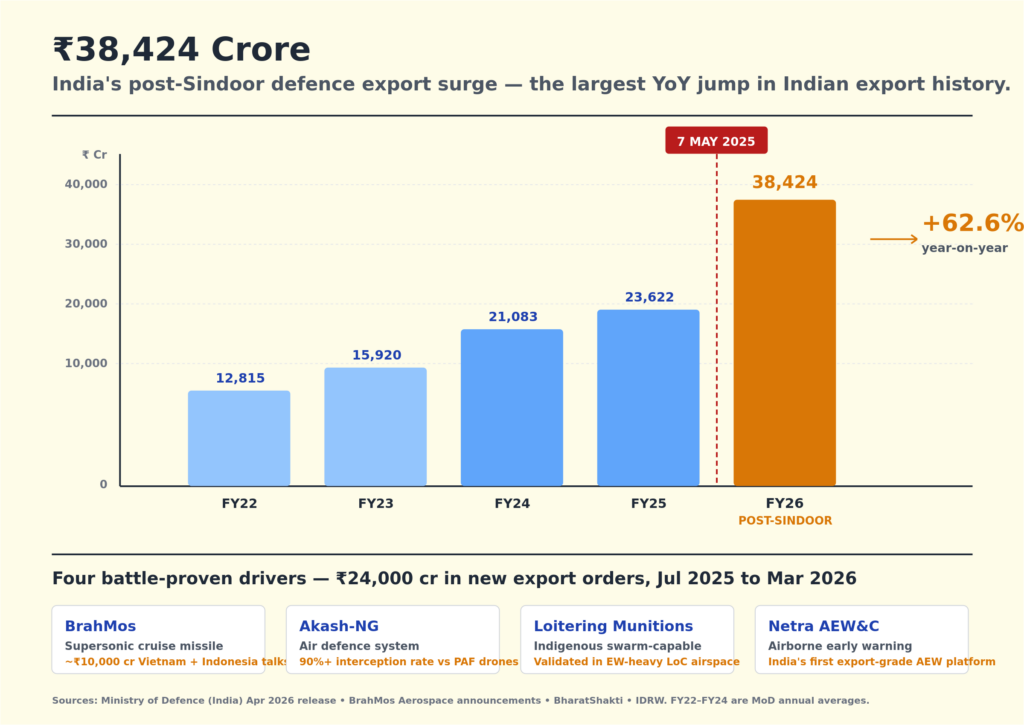
BrahMos is the headliner. The supersonic cruise missile struck Pakistani airbases including Nur Khan and Rahim Yar Khan, penetrating the Chinese-supplied HQ-9B air-defence system on multiple sorties. Defence Minister Rajnath Singh confirmed in October 2025 that BrahMos Aerospace had signed export contracts worth approximately ₹4,000 crore (~$455 million) with two undisclosed countries in the previous month alone. Vietnam is in advanced negotiations on a deal valued near ₹6,000 crore. Indonesia confirmed a deal over $340 million. The Philippines, which signed the first BrahMos export deal in 2022 at $375 million, is now reportedly in talks for follow-on batteries, with active interest reported across Southeast Asia, the Gulf, and Latin America. BrahMos Aerospace alone now accounts for roughly a third of total Indian defence exports.
Akash-NG intercepted Pakistani drones and missiles with a reported success rate exceeding 90% — a number now front-and-centre in Indian marketing material aimed at procurement officers in Africa and South America who have historically bought Russian or French air defence at substantially higher cost. Indigenous loitering munitions, deployed in the electronic-warfare-heavy LoC environment, demonstrated survivability and target acquisition in the kind of contested airspace that buyers in conflict-prone regions specifically want validated. The Netra AEW&C platform delivered the airborne early-warning picture that coordinated Indian air operations across multiple sectors — a capability historically available only from Israeli, American, or Swedish suppliers at multiples of Netra’s cost. Between July 2025 and March 2026, these four platforms drove approximately ₹24,000 crore in new export orders.
The valuation impact rippled into public markets. Indian defence stocks — HAL, BEL, BDL, Bharat Forge, L&T Defence, Mazagon Dock, Cochin Shipyard, and the Tata and Adani defence arms — collectively surged approximately 49% in the post-Sindoor window. HAL secured orders for 97 Tejas Mk-1A jets worth over ₹62,000 crore and 12 additional Su-30 MKI aircraft. BEL signed a ₹1,950 crore contract for mountain radars and partnered with France’s Safran to produce HAMMER precision weapons domestically. BDL inked ₹2,096 crore for INVAR anti-tank missiles. Reliance Defence won a ₹600 crore export order for ammunition. Mazagon Dock is finalising a ₹90,000 crore submarine deal with Germany. The private sector’s share of defence exports crossed ₹17,352 crore in FY26 — about 45% of the total, a 54% year-on-year jump.
The Atmanirbhar Bharat framework, launched in 2020 and critiqued for years as more slogan than strategy, produced the data point that retroactively justified the policy. Defence production reached ₹1,54,000 crore in FY25, a 3.2× increase over the past decade. By FY26, 65% of military equipment used by Indian forces was manufactured domestically.The defence budget itself has tripled since FY14, hitting ₹7,85,000 crore for FY27 — about 14.67% of the Union Budget. The systems that performed best in combat were predominantly Indian-built or India-assembled. Conversely, the systems that performed worst — and this is the consequential observation — were Chinese-supplied platforms on the Pakistani side.
7. The China Spillover — Beijing’s Bill
The most under-appreciated economic consequence of Operation Sindoor was not paid by India or Pakistan. It was paid by China.
China is the world’s fourth-largest arms exporter and the dominant supplier to Pakistan. Chinese firms — AVIC, NORINCO, CETC — had spent two decades selling air-defence systems, fighters, frigates, and drones to Pakistan, Bangladesh, Myanmar, Saudi Arabia, Egypt, Algeria, and a range of African and Middle Eastern buyers. The HQ-9B had been marketed as a credible alternative to the Russian S-400 and the American Patriot.
Then came Sindoor. According to a Maldivian media analysis widely cited across Indian and Asian outlets, the HQ-9B failed to stop Indian air-launched cruise missiles. Indian strikes destroyed multiple Pakistani radar installations of Chinese origin. The Akashteer-integrated Indian air defence network appeared to outperform its Chinese-origin Pakistani counterpart in the same airspace. The reputational shock spread. When Iran’s HQ-9B failed against US-Israeli strikes on Natanz and Fordow in July 2025 — two months after Sindoor — the pattern began to look systemic. Chinese defence stocks (AVIC, NORINCO, CETC) reportedly saw share-price declines as global buyers paused procurement decisions. Several Middle Eastern and African buyers in early-stage Chinese negotiations reportedly opened parallel conversations with Indian, Turkish, and Israeli suppliers.
The China-Pakistan Economic Corridor (CPEC) felt the second-order effects. With Pakistan’s military heavily deployed eastward during the conflict, Baloch insurgents escalated attacks on CPEC infrastructure in Kech and Panjgur, including sabotage of gas pipelines and ambushes on military convoys protecting Chinese workers. Chinese citizens working on CPEC projects had been targeted repeatedly through 2024 and early 2025; the conflict period saw further deterioration. Beijing now faces a compound problem: its flagship Belt and Road investment in Pakistan is exposed to insurgency that intensifies whenever its client state’s military is pinned elsewhere, even as the export systems supplied to that client state lose credibility on global battlefields.
India’s gain here is direct. Every Egyptian, Saudi, Algerian, or Brazilian buyer who pauses a Chinese deal is a buyer that Indian, Turkish, Israeli, or French exporters can win. In the segmented global defence market, where contracts are sticky and supplier relationships span decades, a few high-profile audit failures can shift export market share for years. China lost credibility points in a four-day operation that did not even directly involve its forces.
8. Why Indian Markets Barely Moved
Indian markets closed higher on the day Indian missiles hit Pakistani territory. This was not historically unusual.
In the five previous India-Pakistan crises — Kargil 1999, the 2001 Parliament attack, 26/11 in 2008, Uri 2016, Balakot 2019 — the Nifty’s average drawdown was just 5.3%. In 1999 and 2008, six-month forward returns exceeded 35%. Indian markets have a well-developed muscle memory for these events: short-term volatility, swift recovery, often a sectoral rotation into defence, oil-and-gas, and PSU stocks.
But something was distinctive about the May 2025 reaction. The Nifty 50 and Sensex did not even register the conventional crisis dip. They opened lower, recovered intraday, and closed roughly flat to up. By the time the ceasefire was announced on 10 May, the index had absorbed the headlines without flinching. Defence stocks rallied. Oil-and-gas absorbed a modest spike. The broader market continued its FY26 trajectory.
What did the markets see that headlines missed? Three things. First, they read correctly that this was a calibrated operation, not the prologue to general war — targeting was specific, geography was contained, ceasefire backchannels were live almost from the first night. Second, they read correctly that the cost to India was small and the cost to Pakistan was large — a strategic gain on the cheap. Third, they read correctly that the operation accelerated rather than disrupted the FDI and capex thesis on India. Foreign institutional investors who had been overweight India on a “China + 1” thesis saw their hypothesis tested under fire and validated.
There is a broader principle here that India’s policy establishment has spent years trying to establish: that India’s growth story is robust enough to absorb security shocks without derating. Operation Sindoor was the live test of that thesis, and the test came back clean. The market’s flat-line on 7 May was not indifference. It was a vote of confidence with money on the line.
9. Pakistan’s IMF Squeeze — Sovereignty as Collateral
If India’s economic story from Sindoor is a compounding dividend, Pakistan’s is a tightening noose.
At the time of the conflict, Pakistan was halfway through a $7 billion IMF Extended Fund Facility programme, the country’s 25th IMF engagement since 1950. The programme required Pakistan to maintain fiscal discipline, reduce subsidies, expand the tax base, and avoid additional military expenditure beyond budgeted lines. The conflict blew through several of these conditions in 96 hours.
Worse for Islamabad, India did not stay silent at the IMF board. On 8 May 2025, Foreign Secretary Vikram Misri publicly announced that New Delhi would urge the IMF to reconsider any fresh disbursement to Pakistan. India’s argument was simple and uncomfortable: a country that uses its fiscal space to support cross-border militancy and then needs international bailout funds to absorb the consequences is, in effect, asking the international community to subsidise terrorism.
The IMF approved a tranche disbursement that month, but reportedly added conditions tied to security spending, tax collection, energy subsidy reductions, and macroeconomic stabilisation. By December 2025, reports indicated Pakistan was operating under approximately 11 new conditions that meaningfully constrained Islamabad’s economic policy autonomy.
The deepest cost, however, sits in Pakistan’s cost of capital. The country’s sovereign borrowing rate in 2025–26 ran near 12%; India’s ran near 6.4%. That ~560-basis-point spread is the long-term scoreboard. On Pakistan’s roughly $130 billion external debt stock, every 100 basis points of additional spread costs the country approximately $1.3 billion a year in incremental debt service — money that would otherwise flow to schools, hospitals, energy infrastructure, or productive investment. Operation Sindoor did not create that spread, but it widened the components that feed it: sovereign-risk perception, contingent military liability, and the international community’s discount on Pakistani policy credibility. Even a modest, sustained widening of the spread — say 50 basis points attributable to post-Sindoor risk repricing — translates into perhaps $650 million a year in additional debt service, which is roughly half the entire direct cost of the operation, payable annually, indefinitely.
In this context, the $1.5 billion direct cost of Sindoor is the small number. The larger number is the macroeconomic policy autonomy Pakistan has had to surrender to keep the lights on. Wars between states of vastly different economic capacity are not really won by the side that inflicts more damage. They are won by the side that imposes more permanent strategic cost — cost that compounds long after the ceasefire.
10. The Honest Reckoning — What This Frame Does Not Capture
A piece arguing that a war was economically rational owes the reader an honest accounting of what that frame misses.
The first thing it misses is the human cost. Twenty-three Indian soldiers died during the 96-hour operation. Indian civilians along the Line of Control were killed by Pakistani shelling. AirForces Monthly, in its June 2025 assessment, recorded the loss of three Indian combat aircraft — losses the Indian government has not formally itemised. Kashmir’s tourism economy, already battered by the Pahalgam attack that triggered Sindoor, contracted further through summer 2025; valley businesses dependent on the season lost a year of revenue. Indian carriers absorbed route-diversion costs as overflight options narrowed temporarily. None of these costs sits on the defence-export balance sheet, and none should be erased by it.
The second thing the frame misses is the contested international reading. The Financial Times argued that the US-mediated ceasefire on 10 May gave Pakistan the “diplomatic upper hand,” bracketing India alongside what Western audiences perceived as a “terrorism-backing rogue state.” The Atlantic Council’s Manal Fatima observed that the conflict appeared to unify Pakistan’s fractured political establishment domestically. Srujan Palkar at the same institution argued that Sindoor “exposed an imbalance in US policy toward South Asia.” These are not Indian framings, but a credible analytical piece has to register them.
The third thing the frame misses is causal complexity. The IMF’s tightening on Pakistan reflects pre-existing programme conditions, not solely the post-Sindoor disbursement review. The post-Sindoor defence-export surge built on Atmanirbhar Bharat capacity-scaling that predates the operation by years; Sindoor was the catalyst, not the cause. AirForces Monthly’s October 2025 follow-up expressed scepticism about India’s claim, made three months after the conflict, of having downed five Pakistani aircraft and an AEW&C Erieye at 300 kilometres using S-400 missiles — a claim the magazine described as “lacking supporting evidence.” Casualty figures, exact damage assessments, and aircraft-loss numbers remain contested between Indian, Pakistani, and independent sources. A US-China Economic and Security Review Commission report observed that both countries struck targets deeper into each other’s territories than at any time in fifty years — a sober reminder that next time, the escalation ladder may have fewer rungs.
The Sindoor Arithmetic is a useful frame, not a complete one. The case for its central conclusion — that the operation was, on net, economically advantageous for India — rests on direction of travel rather than absolute precision. The numbers that matter are robust to revision. But the human and contested-narrative dimensions belong on the same page as the export figures, because honest analysis requires keeping both in view.
11. The New Indian Doctrine — Terror as Bad Economics
The most quotable line about Sindoor is also the most precise: India did not just retaliate for terrorism. India re-priced it.
For 30 years, the implicit calculation of Pakistan-based militant groups, and of the security establishment that tolerated and at times sponsored them, was that cross-border attacks against India delivered strategic returns at affordable cost. The 2019 Pulwama attack prompted the Balakot strike, which produced limited damage and a quick diplomatic resolution. The 2016 Uri attack produced the surgical strike, again limited in scope. Earlier attacks — Mumbai 2008, the 2001 Parliament attack — produced diplomatic protest, troop mobilisation, and eventually de-escalation.
Operation Sindoor changed the price. The next Pakistan-based attack on India must now be evaluated against the possibility of a four-day, multi-domain Indian response that costs Pakistan billions, damages strategic airbases, exposes the inadequacy of imported Chinese air defences, prompts IMF re-conditioning, suspends the Indus Waters Treaty, and accelerates Indian defence exports while denting Chinese ones. The expected cost of sponsoring terrorism has gone up by an order of magnitude.
In economic terms, this is the textbook definition of effective deterrence: not the absolute prevention of bad behaviour, but the systematic increase of its cost until the cost-benefit ratio inverts. India did not promise there will be no more attacks. It demonstrated that future attacks will be answered in a currency Pakistan cannot afford to spend.
12. The Long Tail — What FY26 Tells Us About FY30
One year on, the FY26 numbers offer a forward-looking view of where this is heading.
Indian defence exports at ₹38,424 crore in FY26 represent the third successive year of 30%+ growth. The Ministry of Defence’s stated target of ₹50,000 crore by FY27 now looks conservative; private analyst forecasts run as high as ₹65,000–₹75,000 crore by FY28 if BrahMos contract conversions track at current rates and Akash-NG enters serial export production. India’s share of the global arms-export market — historically below 0.5% — is on track to cross 2% by the end of the decade. Modest by absolute standards, but for a country that was the world’s largest arms importer just a decade ago, the trajectory is transformational.
The fiscal multiplier is substantial. Defence manufacturing is unusually labour-intensive in its supply chain — Tier-2 and Tier-3 components, precision machining, electronics, and software employment scale faster than primary assembly. The Ministry of Defence credits the post-Sindoor export surge with supporting approximately 1.5 lakh jobs across HAL, BEL, BDL, the private defence cluster, and the broader component ecosystem; the broader multiplier through component manufacturers, software exporters, and dual-use technology firms is likely several times larger. For an economy where employment generation is the principal political constraint, a defence industrial cluster that scales output by 60%+ in a single fiscal year is not just a security gain. It is a labour-market policy.
Profits from export contracts are being reinvested in next-generation programmes: AI-driven autonomous swarms, hypersonic glide vehicles, quantum-secure communications. BrahMos exports to ASEAN deepen India’s “Act East” footprint at a moment of intensified strategic competition in the Indo-Pacific — each battery sold to Vietnam, the Philippines, or Indonesia is a permanent strategic relationship anchored in multi-decade maintenance and upgrade contracts.
Pakistan’s trajectory through 2026 has trended in the opposite direction. IMF programme conditions tightened. FDI to Pakistan declined post-Sindoor. The Pakistani rupee weakened against the dollar through the months following the conflict. Pakistan’s FY26 defence budget was reportedly increased in absolute terms despite IMF pressure for restraint — a politically necessary signal of capability that further constrained social and infrastructure spending. The longer this trajectory runs, the harder it becomes to reverse.
13. The Final Tally
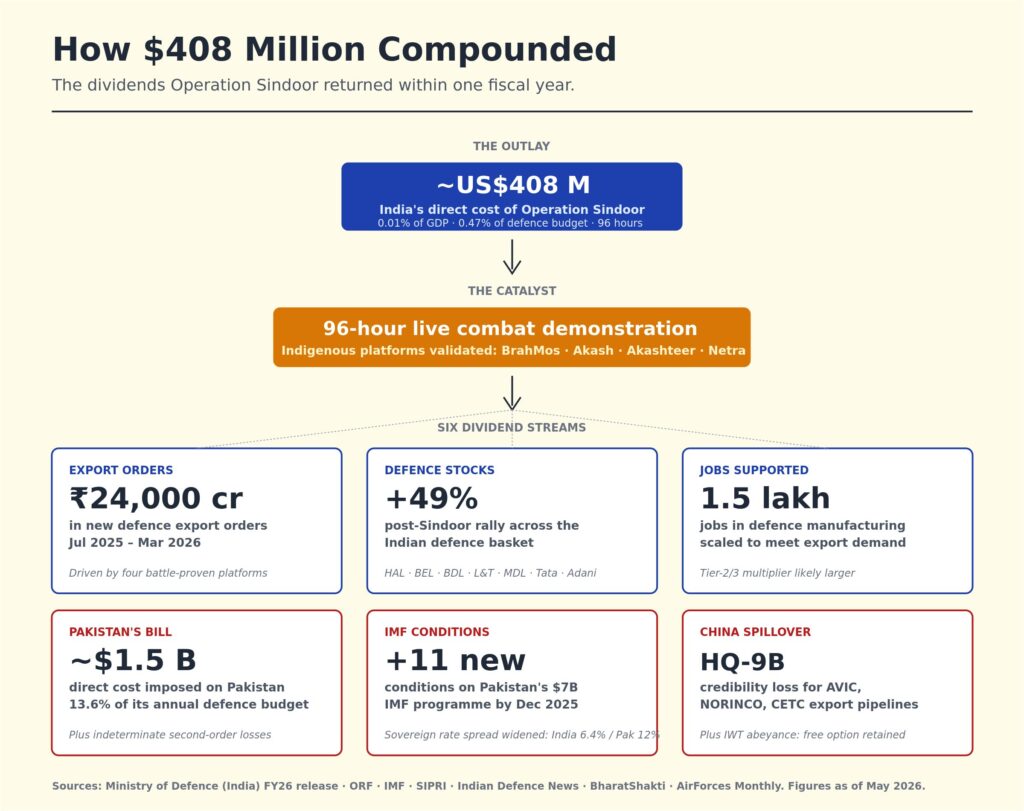
Strip away the geopolitics, the news cycle, and the partisan claims of victory and defeat, and Operation Sindoor reduces to a simple economic transaction. India spent approximately $408 million over four days.
In return, it:
- Imposed approximately $1.5 billion of direct cost on Pakistan, plus indeterminate but significantly larger second-order costs.
- Held the Indus Waters Treaty in abeyance as ongoing leverage.
- Triggered a 62.6% surge in defence exports, reaching ₹38,424 crore in FY26.
- Validated indigenous platforms — BrahMos, Akash, Akashteer, Netra — in live combat.
- Generated approximately ₹24,000 crore in new export orders for four platforms over the following nine months.
- Damaged Chinese defence-export credibility, widening India’s competitive space.
- Supported an estimated 1.5 lakh jobs in defence manufacturing.
- Reinforced foreign investor confidence in India’s ability to absorb security shocks.
- Established a deterrent doctrine that prices cross-border terrorism beyond Pakistan’s sustainable means.
Set the $408 million cost against just the incremental export revenue, and Operation Sindoor stands out as something unusual in modern military history: a defence operation that paid for itself within a fiscal year.
Twenty-three Indian soldiers did not come home, and civilian casualties on both sides of the Line of Control were real. None of that is erased by a defence-export number. But on the policy question of what Sindoor teaches India about credible deterrence, the answer is unambiguous. Well-prepared, narrowly-targeted, technologically self-reliant operations against a vastly weaker adversary do not just deter. They generate.
Somewhere between Bahawalpur and Bholari, the price tag on Indian deterrence moved into a different category — the one in which the operation does not appear as an expense on the national accounts. It appears as revenue.
Sources include Observer Research Foundation analysis, Ministry of Defence (India) FY26 export figures, SIPRI, IMF programme documentation, World Bank, the 2025 Ecological Threat Report from the Institute for Economics and Peace, AirForces Monthly, the Financial Times, the Atlantic Council, the US-China Economic and Security Review Commission, the Economic Times, the Indian Express, and post-conflict satellite imagery assessments. All figures are best-available estimates as of May 2026; precise wartime costs are inherently subject to revision.
Amulya Charan writes on energy systems, infrastructure economics, and development policy at amulyacharan.com. This analysis draws on reporting from Business Standard, ThePrint, Business Today, and the Press Information Bureau, and on policy research from the Takshashila Institution and the Observer Research Foundation.
A comprehensive and well researched report! Amulya, you just have spent days and weeks collating all the data. Hats off! And it makes all of us, Indians proud.