From Arms Buyer to Arms Seller: India’s Defence Export Story Is Changing
India remains one of the world’s largest importers of military equipment. But record exports and landmark overseas sales show that a second identity is beginning to emerge.
Position as of 3 September 2026
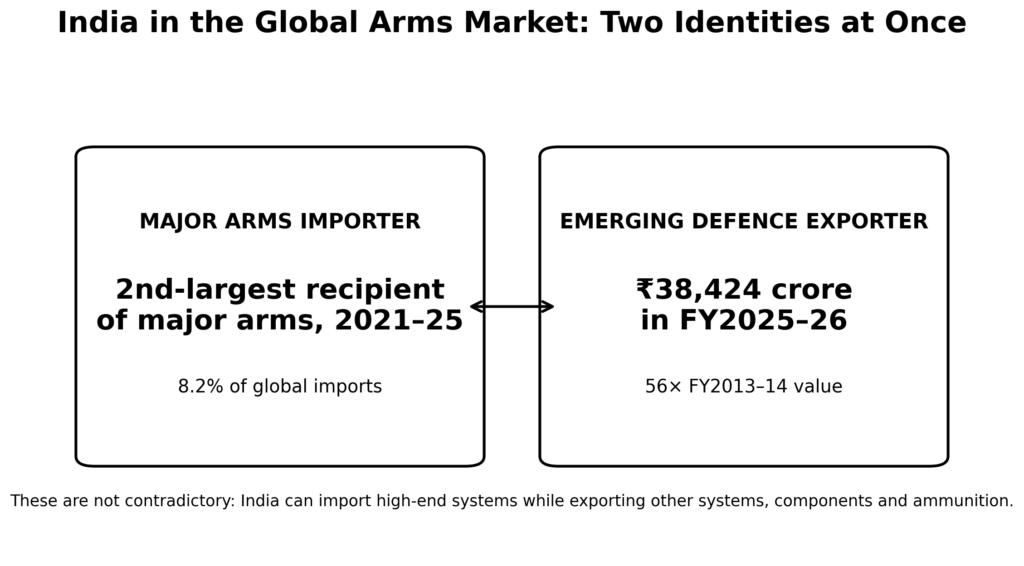
Figure 1. India can remain a major importer while becoming a meaningful exporter. Original infographic based on SIPRI and Ministry of Defence data.
For decades, India’s place in the global arms trade was easy to describe: India was a buyer.
Russian fighters and submarines, French aircraft, Israeli sensors and missiles, American helicopters and maritime aircraft — the discussion around Indian defence almost invariably concerned what New Delhi planned to import next, how much it would cost, and how much technology transfer India might obtain in return.
That picture has not disappeared. According to the Stockholm International Peace Research Institute (SIPRI), India was the world’s second-largest recipient of major arms during 2021–25, accounting for 8.2% of global imports. India’s imports were 4% lower than in 2016–20, but the country remained one of the international arms market’s most important customers. [SIPRI]
But something else is happening at the same time. India is beginning to sell.
In FY2025–26, Indian defence exports reached a record ₹38,424 crore, an increase of 62.66% over ₹23,622 crore a year earlier. Defence Public Sector Undertakings accounted for ₹21,071 crore, while private companies contributed ₹17,353 crore. [Ministry of Defence]
That is a remarkable change from FY2013–14, when defence exports were only ₹686 crore. By FY2025–26, the value had risen roughly 56-fold. The latest Ministry of Defence summary says Indian defence products are exported to more than 80 countries and the exporter base has expanded to 145 firms. [Ministry of Defence]
| India is no longer only an arms customer. It is becoming an increasingly visible supplier as well. |
From ₹686 crore to ₹38,424 crore
The long-term rise matters more than the exceptional growth rate in any one year. Defence exports are naturally lumpy: a missile battery, ammunition consignment or naval platform can shift from one financial year to another, making annual percentage changes look dramatic. Yet the twelve-year trend is unmistakable.
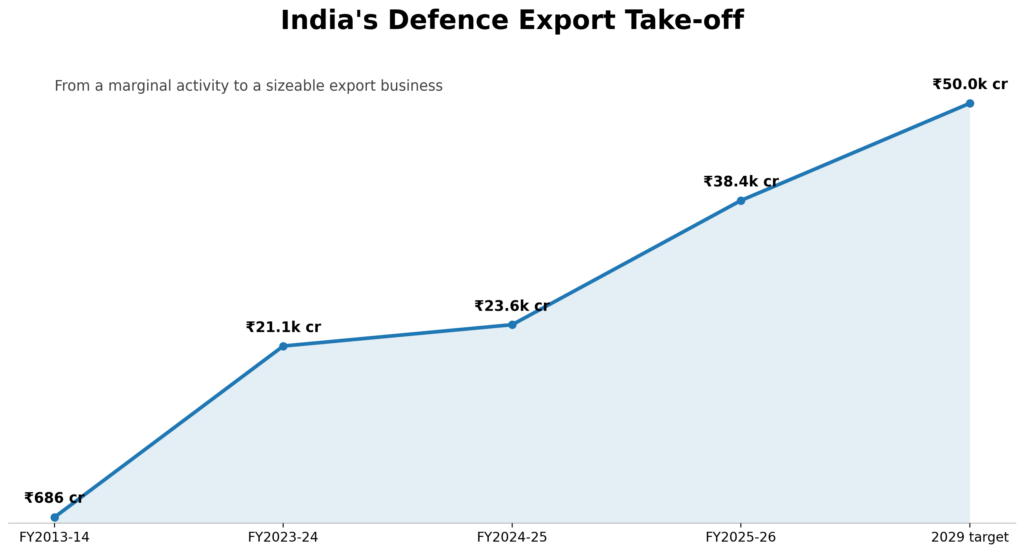
Figure 2. India’s defence exports have increased roughly 56-fold since FY2013–14. Original infographic; data from the Ministry of Defence.
The government has set a target of ₹50,000 crore in annual defence exports by 2029. From the FY2025–26 base, that requires average growth of a little over 9% a year for three years — much less spectacular than the latest 62.66% jump, but still dependent on negotiations turning into signed contracts and contracts turning into deliveries. [Ministry of Defence]
A useful caution is necessary here. National financial arms-export figures are not internationally standardised. SIPRI notes that governments use different definitions and reporting systems, so India’s rupee total should not be converted into dollars and inserted casually into a global league table. [SIPRI methodology]
What exactly is India exporting?
“Defence exports” covers a much wider range of products than missiles and fighter aircraft. India’s export portfolio includes complete systems, ammunition, electronics, protective equipment, aircraft and maritime products, as well as components supplied into foreign defence-company production lines. [PIB factsheet]
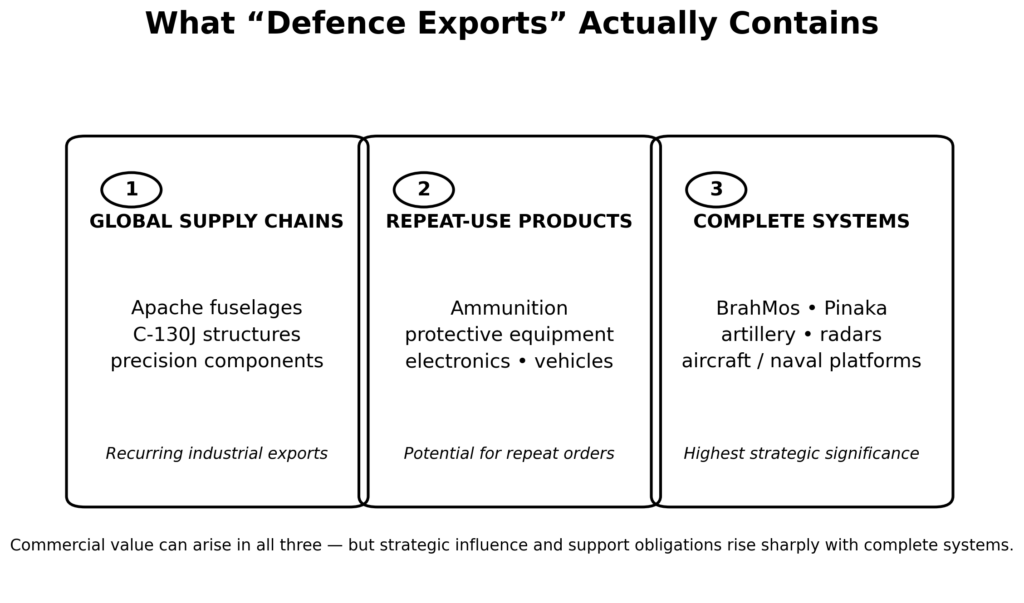
Figure 3. Three different export businesses sit behind one headline number. Original infographic.
At one end are Indian components entering the global supply chains of some of the world’s largest defence companies. Tata Boeing Aerospace in Hyderabad is the global sole-source supplier of fuselages for Boeing’s AH-64 Apache attack helicopter. By February 2025, the facility had delivered its 300th fuselage. Boeing says more than 90% of the parts used in these aerostructure assemblies are manufactured in India through more than 100 Indian MSME suppliers. [Boeing]
Similarly, Tata Lockheed Martin Aerostructures is the single global source of empennage assemblies for newly manufactured C-130J Super Hercules aircraft and had manufactured more than 220 assemblies by September 2024. [Lockheed Martin]
These are genuine defence exports even though the finished aircraft ultimately carry Boeing or Lockheed Martin names rather than an Indian brand. They are commercially important because they place Indian companies inside international production networks and can generate recurring orders over long periods.
But the part of the story most likely to change India’s strategic reputation begins when another government buys an Indian weapon system.
BrahMos changed the conversation
The clearest breakthrough was the BrahMos missile. In January 2022, BrahMos Aerospace signed a contract with the Philippine Department of National Defence for a shore-based anti-ship missile system. [Ministry of Defence]
The government subsequently described the contract as worth US$375 million. The first deliveries took place in 2024. [PIB]
Its significance went well beyond the money. The Philippines faces continuing maritime tensions with China in the South China Sea. A shore-based anti-ship missile is therefore not ceremonial equipment; Manila was acquiring a deterrent capability, and India had become the supplier.
That represented a substantial reversal of roles for a country so long identified mainly as a buyer of sophisticated foreign weapons.
The BrahMos story is also moving beyond its first customer. During Prime Minister Narendra Modi’s July 2026 visit to Indonesia, the official list of outcomes included “Cooperation on BrahMos Missile System” and an “Air-to-Air Missile Cooperation Agreement”. The public document did not disclose price, quantity or delivery schedule, so Indonesia should not yet be added casually to delivered export revenues. [Government of India]
That distinction matters. Interest, political agreement, signed procurement contract, delivery and recognised export revenue are different milestones. India’s defence-export story becomes more credible when these stages are kept separate.
Armenia may prove even more interesting
If the Philippines demonstrated that India could export a sophisticated missile system into Southeast Asia, Armenia suggests the possibility of a foreign country buying a broader family of Indian defence products.
India’s Ministry of External Affairs records that a 29-member Indian defence delegation visited Armenia in September 2022 and that contracts worth more than US$350 million were signed between the Armenian side and Indian companies. [MEA Annual Report]
Since then, Armenian purchases involving Indian rocket systems, artillery, air defence, radars and ammunition have been widely reported. Not every quoted value can be verified from official disclosures, so cumulative totals should be treated cautiously rather than repeated as settled fact.
Some deliveries, however, are now concrete. In January 2026, Defence Minister Rajnath Singh formally flagged off the first tranche of guided Pinaka rockets destined for Armenia. [Ministry of Defence]
The significance is not merely that India sold another weapon. Armenia has historically depended heavily on Russian equipment and has been trying to diversify its suppliers. India now has an opportunity to become part of that diversification.
A rocket launcher or air-defence system creates continuing requirements for ammunition, spares, training, repairs and perhaps upgrades. If the first Indian systems perform well and Armenia buys again, the second order may matter more than the first.
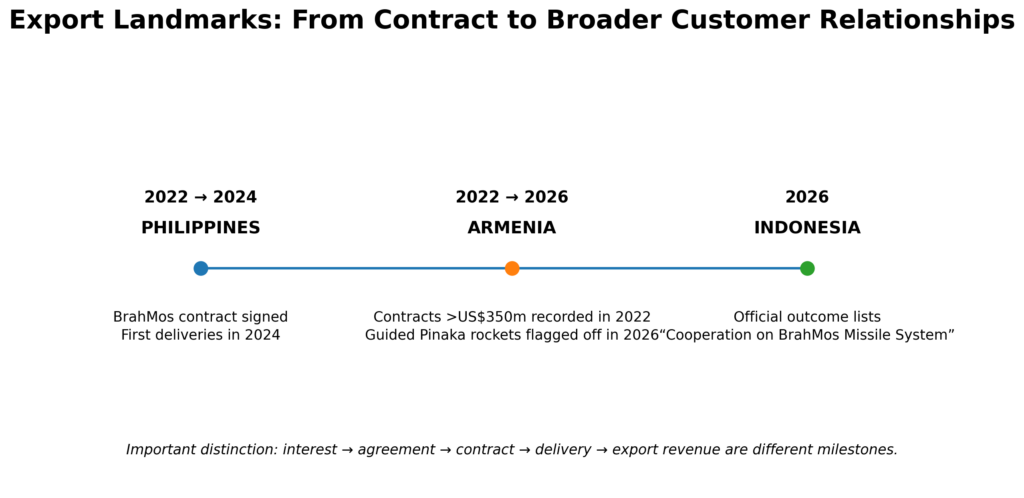
Figure 4. Selected export milestones. Original infographic based on official Indian sources; “cooperation” is not treated as delivered revenue.
India has entered the market at an unusual moment
India’s rise as an exporter has coincided with a major increase in international demand. SIPRI reports that the global volume of transfers of major arms in 2021–25 was 9.2% higher than in 2016–20, while European arms imports increased by 210%. [SIPRI]
Governments have been seeking artillery ammunition, air defence, missiles, drones, counter-drone systems and replacements for depleted inventories. At the same time, many countries have reasons to diversify their suppliers.
Some do not want excessive dependence on Russia. Some are reluctant to rely on China. Others cannot afford, or cannot obtain quickly, the most expensive American and European systems. This does not mean India automatically wins their business. It does mean more customers have reasons to consider suppliers they may have ignored a decade ago.
India brings longstanding political relationships across much of the Global South, large armed forces that can provide a domestic reference customer for Indian systems, and the possibility of combining equipment sales with training and government-to-government cooperation.
Price can matter, but claims of extraordinary price advantages should be treated carefully. Defence contracts often include different combinations of ammunition, launchers, spares, maintenance, infrastructure, training and financing, so headline “unit price” comparisons can be misleading.
America and France tell another side of the story
The government identified the United States, France and Armenia as India’s top three defence-export destinations in FY2023–24. [PIB]
At first sight, that may look peculiar. The United States and France are themselves among the world’s leading exporters. But their presence on India’s customer list makes sense once components, aerostructures and supply chains are included.
India sells substantially different things to these markets than it does to Armenia. Exports to Western defence industries are heavily associated with components and supply-chain inputs, while Armenia is more significant as a buyer of Indian weapon systems.
Both matter. One creates industrial integration and recurring commercial work. The other builds Indian defence brands, long-term customer relationships and strategic influence.
Smaller countries may offer a surprisingly large opportunity
The international market is not confined to countries buying fleets of combat aircraft or billion-dollar missile programmes. Smaller states require patrol vessels, surveillance systems, transport aircraft, helicopters, vehicles, radars, protective equipment and coastal-security systems.
For many such buyers, the financing package can be as important as the equipment. Major exporters routinely combine government-backed credit, guarantees, training and long-term support with the hardware itself. India has already used Lines of Credit and government-to-government assistance in several developing-country relationships; expanding this capability will be important if it wants to compete more widely in Africa, Southeast Asia, the Indian Ocean, the Middle East and Latin America.
Why defence exports are unlike ordinary exports
Selling a missile is nothing like exporting a car. The customer is making a decision that may affect its security for decades.
Will spare parts still arrive ten years from now? Will ammunition remain available? Will technicians come when equipment needs repair? Will software updates and upgrades be provided? Can personnel be trained? Will political relations remain strong enough for the supplier to continue supporting the system during a crisis?
Those questions help explain why established arms exporters are difficult to displace. They do not merely have weapons; they have financing agencies, diplomatic networks, military relationships, service organisations and decades of customer-support experience.
India is still building that reputation. The real test of BrahMos, Pinaka and other export programmes will not be the first delivery but whether overseas customers remain satisfied and return for additional purchases.
A necessary regulatory responsibility
Defence goods also carry responsibilities that ordinary commercial exports do not. India controls military and dual-use exports through the SCOMET framework. Category 6 is the Munitions List, and the current list states that an authorisation from the Department of Defence Production is generally required for export of Category 6 items, subject to specified exceptions. [DGFT SCOMET List]
End-user restrictions, re-transfer controls and verification conditions are not merely bureaucratic obstacles. They are part of becoming a responsible arms exporter. Weapons may remain in service for decades, governments change, alliances shift and equipment can be transferred. A mature exporter must consider not only whether it can make a sale, but also who will ultimately use the equipment and under what conditions.
In August 2026, the Ministry of Defence also announced further simplification of the Defence Export SOP and Open General Export Licence framework, aimed at reducing procedural burden while widening legitimate market access. [Ministry of Defence]
So why doesn’t SIPRI show India among the big exporters?
This is perhaps the most important statistical issue in the story. SIPRI does not place India among the 25 largest suppliers of major arms during 2021–25. At first glance, that may appear inconsistent with defence exports of ₹38,424 crore. It is not.
SIPRI’s Arms Transfers Database measures transfers of defined categories of major conventional weapons and uses a Trend Indicator Value (TIV) designed to measure the volume of military resources transferred, not the financial price of the transaction. [SIPRI methodology]
India’s official export figure is a broader monetary measure. Because the baskets and methodologies differ, they cannot be compared as if they were two versions of the same league table. [SIPRI financial-value note]
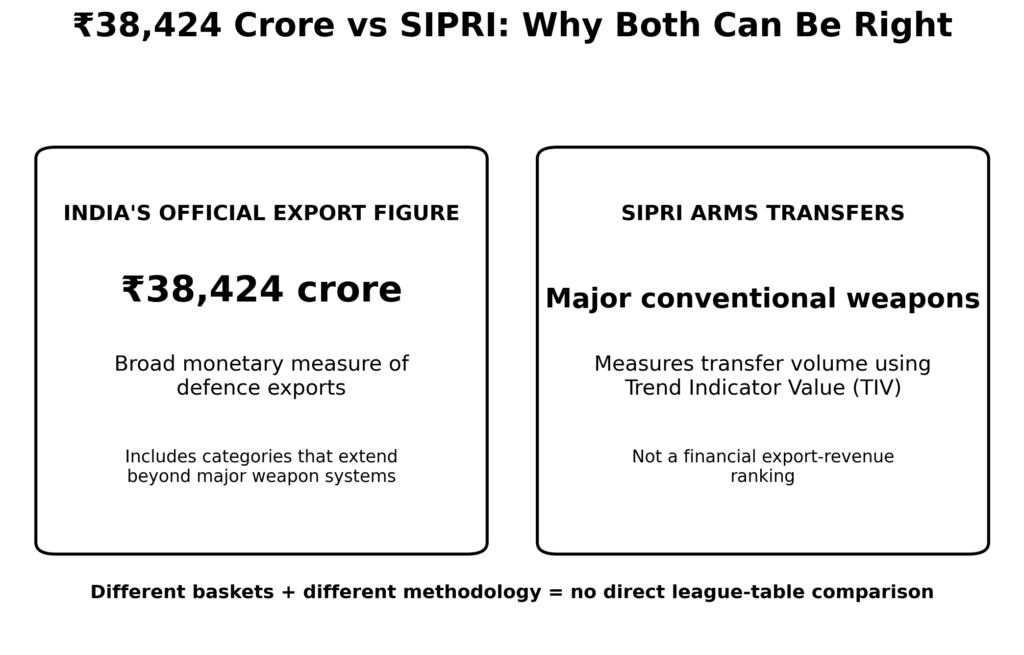
Figure 5. India’s financial export figure and SIPRI’s major-arms transfer measure answer different questions. Original infographic.
| India is already a substantial exporter of defence goods. It is not yet a substantial global exporter of major complete weapon systems. |
India can remain an importer and exporter at the same time
There is no contradiction in India remaining one of the world’s largest importers while its exports rise. Defence technology is highly specialised, and countries can be strong exporters in some categories while importing systems or technologies they cannot produce economically or do not control.
India therefore appears to be undergoing a more subtle transition: it is still purchasing sophisticated systems from abroad, diversifying where those imports come from, and simultaneously selling an increasing range of defence products to other countries.
That is more useful than either of the simplistic descriptions sometimes heard in political debate — that India has suddenly become completely self-reliant, or that nothing has changed because it still imports weapons. Neither captures what is actually happening.
The ₹50,000 crore question
The government’s ₹50,000 crore export target for 2029 is arithmetically achievable from the FY2025–26 base, but the quality of the export business will matter more than crossing a single annual threshold. [Ministry of Defence]
Five tests will be more revealing. Do existing customers return with second and third orders? Do complete systems reach a wider group of countries? Can India deliver on time and support equipment overseas for years afterwards? Can it package financing competitively? And can more Indian systems be sold without critical foreign-origin technology limiting re-export or upgrades?
From customer to competitor
India should not exaggerate where it stands. The United States alone accounted for 42% of global exports of major arms in 2021–25, according to SIPRI. India is nowhere near that scale. [SIPRI]
But something important has changed. Fifteen years ago, an article about India in the international arms market would overwhelmingly have been about what India intended to buy. Today it is legitimate to ask who will buy BrahMos next, whether Pinaka can establish an overseas customer base, whether Armenia will return with repeat orders, and whether Indian companies can move further up global supply chains.
India remains one of the world’s largest arms importers. But it has begun to acquire another identity alongside it: an emerging defence exporter.
The ₹38,424 crore record tells us that the transition is real. The next few years will tell us whether it becomes durable.
References and source links for readers
1. Ministry of Defence / PIB — FY2025–26 defence exports
Headline export value, annual growth and public/private split. [Open source]
2. Ministry of Defence / PIB — The Defence Decade, June 2026
Historical export series, exporter base, destination count and 2029 target. [Open source]
3. SIPRI — Trends in International Arms Transfers, 2025
India’s importer position, global arms-transfer growth, US export share and comparative data. [Open source]
4. SIPRI — Arms Transfers Database: Sources and Methods
Definition of major arms and Trend Indicator Value methodology. [Open source]
5. SIPRI — Financial Value of the Global Arms Trade
Why national financial arms-export figures are not directly comparable. [Open source]
6. Ministry of Defence / PIB — BrahMos Philippines contract
Official confirmation of the January 2022 shore-based anti-ship missile contract. [Open source]
7. PIB — BrahMos Philippines contract value
Government summary recording the US$375 million value. [Open source]
8. Government of India — India–Indonesia outcomes, July 2026
Official wording on BrahMos missile-system cooperation. [Open source]
9. Ministry of External Affairs — Annual Report 2022
Records contracts worth more than US$350 million signed with Armenia in September 2022. [Open source]
10. Ministry of Defence / PIB — Guided Pinaka rockets to Armenia, January 2026
Official confirmation of the first tranche being flagged off. [Open source]
11. PIB — Defence export destinations and representative products
USA, France and Armenia as top FY2023–24 destinations; examples of exported products. [Open source]
12. Boeing India — Tata Boeing Aerospace 300th Apache fuselage
Corporate primary source for Apache fuselage production and Indian supplier network. [Open source]
13. Lockheed Martin — Tata C-130J partnership
Corporate primary source for Indian C-130J empennage production. [Open source]
14. DGFT — Updated SCOMET List
Primary regulatory source for Category 6 Munitions List and licensing authority. [Open source]
15. Ministry of Defence / PIB — 2029 export target
Official statement of ₹50,000 crore annual defence-export target. [Open source]
16. Ministry of Defence / PIB — Defence Export SOP and OGEL simplification, August 2026
Latest procedural reforms to the export-authorisation framework. [Open source]

An excellent analysis sir, as always. It’s heartening to note the great strategic transition from importer to exporter. However we are still by far a major NET IMPORTER. we cannot rest in our laurels because major defense items like Fighter Aircraft, High altitude Drones, Tanks,are imported. Regarding Aircraft Carriers, we haven’t built a major class yet. The world has observed how critical the above things are in a conflict.
On the positive side, geopolitical mistrust has developed between some countries and the US . This augurs well for India’s exports
On the negative side, India’s imports of helicopters from the US, and fighter aircraft from Russia and France clearly state one problem – they cannot be integrated, software of helicopter will not speak to the software on the plane and do on ….we will severely lack a Unified Software, a Unified Battlefield System.
This aspect must be tackled in a very careful manner. It must be kept in mind that no country has really agreed to give their Software to India.
On the other hand, the US 6thGen fighter aircraft F35 is software Integrated with Satellites, Drones, as well as their own homegrown helicopters and ground equipment. That’s what makes technically a Unified Battlefield System.
We are nowhere close.
India just doesn’t need to export blindly. India needs to develop an Integrated Software Synced Defense system which in turn defines what to import and from whom. Then only our security will become 6th Gen security.