India Is Funding BatteriesBut Not the Grid They Need
One-page summary | Updated through 30 August 2026
India’s clean-energy transition has reached an important turning point. By 31 July 2026, the country had crossed 300 GW of installed non-fossil-fuel power capacity. But adding solar and wind generation is only part of the task. India’s electricity network still lacks the transmission capacity and flexibility needed to move renewable power from where and when it is generated to where and when it is required.
The consequences are already visible. During the first quarter of 2026, an estimated 470 GWh of renewable electricity was curtailed on the interstate grid—about 300 GWh because of transmission constraints and another 170 GWh because the system could not absorb large volumes of daytime generation. Battery storage can help capture some of this electricity and release it when demand or network capacity improves.
India has begun supporting batteries through viability-gap funding, manufacturing incentives and other policy measures. Two central programmes together cover about 43.8 GWh of storage. Yet the country had only an estimated 8.5 GWh of operational battery capacity in the first half of 2026, compared with the Central Electricity Authority’s projected requirement of 236 GWh by 2031–32.
The challenge, however, is not simply to finance more battery containers. Storage must be installed at the right substations and transmission corridors, connected on time and given a clearly defined role. A battery designed to shift afternoon solar power into the evening is different from one providing frequency support, congestion relief or operating reserves. Contracts must specify the service required, who controls dispatch, how performance will be measured and who will pay.
Low auction prices are encouraging, but they matter only when projects reach financial closure, are commissioned on schedule and continue performing throughout their contracted life. Safety systems, battery degradation, replacement costs, recycling obligations and emergency preparedness must also be included from the beginning.
India has started funding battery hardware. The next step is to build the grid planning, dependable purchasing arrangements, bankable contracts, safety systems and domestic technical capability that allow those batteries to deliver real value.
India’s storage challenge is no longer simply about subsidies. It is about putting batteries in the right places, connecting them on time, giving them a dependable buyer – and paying them for the services the electricity system actually needs.
India’s storage challenge is no longer simply about subsidies. It is about putting batteries in the right places, connecting them on time, giving them a dependable buyer – and paying them for the services the electricity system actually needs.
On 30 March 2026, India’s electricity system left an estimated 34 gigawatt-hours of clean electricity unused. The power had been generated, but transmission corridors serving renewable-rich parts of Rajasthan and Gujarat did not have enough room to carry all of it.
That was one afternoon. Across the first quarter of 2026, renewable-energy curtailment on the interstate system was estimated at roughly 470 GWh. About 300 GWh was attributed to transmission constraints; another 170 GWh reflected the limited flexibility of a grid trying to absorb large volumes of solar generation within a narrow band of daytime hours. These are estimates from Ember’s analysis rather than an official national curtailment series, but the pattern they reveal is difficult to ignore.
Four months later, on 31 July, India crossed 300 GW of installed non-fossil-fuel power capacity. Solar accounted for 164.59 GW, wind for 58.14 GW, hydro for 57.24 GW, bio-power for 11.75 GW and nuclear power for 8.78 GW. It was an important milestone: India had passed 60% of its 500 GW target for 2030.
Those two developments belong in the same story.
India is becoming very good at adding clean generating capacity. What has not kept pace is the grid flexibility needed to move that electricity from where and when it is produced to where and when it is needed.
Battery storage is one part of the answer. But simply subsidising more batteries will not solve the problem. A battery becomes a useful grid asset only when it is installed at the right point in the network, connected on time, given a clearly defined job and supported by a contract that can be financed.
That is where India’s storage policy still has unfinished business.
The ₹200-crore cut is a clue, not the crisis
The number that first drew attention was a reduction in the Union Budget allocation for transmission and energy storage – from ₹800 crore to ₹600 crore, according to IEEFA’s budget analysis.
The cut is real and worth questioning. Transmission and storage are the connective tissue of a renewable-heavy electricity system, and reducing support for them while generation is expanding so quickly sends an odd signal. But describing this ₹200-crore reduction as the event that could derail India’s renewable transition gives one relatively small budget line more importance than the evidence supports.
The wider budget was not hostile to batteries. The allocation for viability-gap funding for battery storage increased to ₹1,000 crore from ₹100 crore, while customs-duty relief was extended to capital goods used in BESS manufacturing. The proposed Infrastructure Risk Guarantee Fund could also provide partial credit guarantees to lenders, addressing some of the financing risk attached to new storage projects.
Beyond the annual budget, the Ministry of Power is supporting a total of about 43.8 GWh through two viability-gap-funding programmes. One covers 13.8 GWh with budgetary support of ₹3,760 crore; the other provides ₹5,400 crore through the Power System Development Fund for 30 GWh of storage across participating states and NTPC.
So the deeper problem is not that Delhi has stopped funding batteries. It has not.
The problem is that India is treating storage primarily as a class of project to be subsidised, when it must also be treated as an operating part of the electricity system. Funding the hardware is necessary. Deciding where it should go, how it will be dispatched and who will pay for its services is just as important.
A large national gap – but a very local first problem
The scale of India’s long-term storage requirement is formidable.
The Central Electricity Authority’s planning numbers indicate a requirement of 47.24 GW and 236 GWh of battery storage by 2031-32. Pumped-storage hydropower is expected to contribute another 26.69 GW and 175 GWh. Together, that amounts to approximately 73.9 GW and 411 GWh of storage.
The estimated investment requirement is about ₹3.49 lakh crore for batteries and ₹1.29 lakh crore for pumped storage – roughly ₹4.78 lakh crore in all.
India is still at an early point on that curve. An India Energy Storage Alliance market review, as reported by Power Peak Digest, put operational BESS capacity at about 8.5 GWh in the first half of 2026, after approximately 7.9 GWh was added during the six-month period. Because this is an industry estimate rather than an official national stock count, it is best read as a current market snapshot. Even so, it shows both how quickly the sector has begun to move and how much ground remains to be covered.
Moving from around 8.5 GWh to 236 GWh within roughly six years would require average additions approaching 38 GWh a year. And that is before allowing for construction delays, battery degradation, augmentation requirements or possible revisions to the country’s future storage needs.
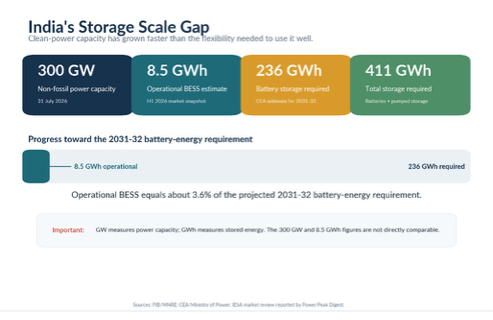
Figure 1. India’s storage scale gap. Power capacity and stored energy use different units; the chart compares only the 8.5 GWh operational estimate with the 236 GWh projected battery-energy requirement.
Yet the first question should not be, “How do we build all 236 GWh?”
It should be, “Where would the next few gigawatts produce the greatest value?”
Curtailment is not spread evenly across the country. In Ember’s analysis of the first quarter of 2026, the Northern region accounted for approximately 178 GWh of transmission-related curtailment and the Western region for 122 GWh. The Southern region recorded essentially none in the dataset examined.
That makes India’s immediate storage challenge partly a matter of geography.
Put the first batteries where the grid is already failing
Ember estimated that roughly 3-4 GW of two-hour batteries, installed at the right pooling stations, could have absorbed most of the electricity curtailed because of transmission constraints during the first quarter of 2026. It also identified about 236 GW of approved or available BESS connectivity headroom at major pooling stations.
That does not mean a few two-hour batteries can replace India’s entire transmission programme. They cannot.
A two-hour battery will not carry electricity across the country, cover a prolonged wind or solar shortfall, or provide seasonal balancing. India will continue to need new interstate lines, stronger state networks, pumped storage, flexible generation, demand response and better forecasting.
But the analysis does make one point rather powerfully: a relatively small amount of storage in the right place can be more useful than a much larger amount installed where the grid does not urgently need it.
A battery at a congested pooling station can charge when a transmission corridor is full and release that electricity after the constraint has eased. A similar battery installed somewhere else may still earn money through market trading, but it cannot relieve that particular bottleneck.
This is why storage procurement should be guided by substation-level and corridor-level needs, not merely divided among states in administratively convenient blocks.
The electricity system does not care whether every state receives an equal allocation. It cares whether the asset is connected to the part of the network that needs help.
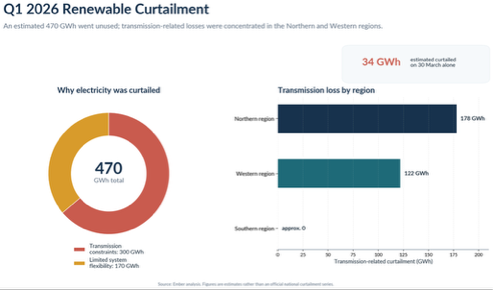
Figure 2. Estimated Q1 2026 renewable curtailment. Transmission-related losses were concentrated in the Northern and Western regions in Ember’s analysis.
The missing middle: from tender to operation
India now has no shortage of storage announcements.
The harder journey is from tender to award, from award to a bankable contract, from contract to financial closure – and finally from construction to commercial operation.
The reported IESA market review counted about 281 GWh of storage capacity at different stages of the tender pipeline in the first half of 2026. Of this, around 105 GWh was described as under execution, 110 GWh as still in the tendering stage and 53 GWh as cancelled. Those figures come from industry tracking and should not be confused with commissioned capacity, but they reveal how wide the gap can be between ambition and operation.
Projects fall out of that pipeline for several reasons. Some do not attract enough qualified bidders. Some are awarded at prices that prove difficult to finance. Others wait for land, grid connectivity, regulatory approval or a signed storage-purchase agreement.
The buyer is often the most important missing piece.
In February 2026, the Ministry of New and Renewable Energy acknowledged the need to accelerate power-purchase-agreement signing and described coordination with states and renewable-energy implementing agencies to clear pending contractual issues. Storage projects face the same basic reality as renewable plants: a letter of award is not a bankable revenue stream until someone has made a credible commitment to pay.
A developer cannot raise long-term debt on the basis of an expected buyer who has not signed. A lender cannot rely comfortably on a tariff that may be revisited. A manufacturer will not build a domestic supply chain around projects that remain indefinitely between announcement and financial closure.
Viability-gap funding improves project economics. It cannot, by itself, create a dependable purchaser, secure a delayed connection or resolve every contractual ambiguity.
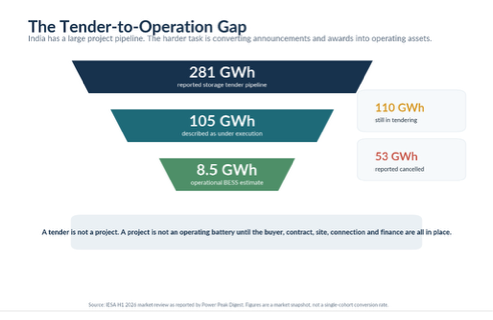
Figure 3. The tender-to-operation gap. Pipeline figures are a market snapshot rather than a single cohort moving through a strict funnel.
Cheap bids are encouraging. Bankable projects matter more.
The fall in storage costs has been striking.
According to the Ministry of Power, the cost discovered through competitive bidding was about ₹10.18 per kWh in 2022-23 when calculated on the basis of two cycles a day. More recent bids brought the corresponding figure down to approximately ₹2.10 per kWh without viability-gap funding.
But the same government statement estimated a cost of around ₹2.80 per kWh if the battery were used for 1.5 cycles a day rather than two.
That difference matters.
A storage tariff depends on how often the battery is expected to charge and discharge, how deeply it cycles, what happens to capacity as the cells age, who pays for charging electricity and system losses, and whether the developer must add new cells later to maintain the contracted energy capacity.
Two projects with the same headline MW and MWh can therefore have very different economics.
Low bids are welcome when they reflect falling equipment prices, stronger competition and cheaper finance. They are less reassuring when they depend on optimistic assumptions about utilisation, degradation, augmentation or future battery prices.
The real test is not how impressive the auction number looks on the day it is announced. It is whether the project reaches financial closure, is commissioned on time and continues meeting its contracted availability throughout its operating life.
Give every battery a job – and a buyer
A grid-scale battery can do several useful things. It can move afternoon solar power into the evening, respond quickly to frequency deviations, provide operating reserves, reduce demand on a congested corridor and support the grid during sudden changes in generation or consumption.
These are different services, delivered over different time periods. They should not all be bundled vaguely under the label “storage.”
India’s policy framework has begun to recognise this. Energy-storage systems can participate across generation, transmission and distribution functions. They are eligible, subject to applicable rules, to provide secondary and tertiary reserve services. Stored electricity can also participate in the High-Price Day-Ahead Market, while recent changes allow consumers to own, lease or operate storage systems under a wider range of business models.
The next step is to turn those possibilities into dependable revenue.
A battery built under a long-term availability contract behaves differently from one relying mainly on short-term price differences in the power exchanges. Both can be useful, but they will not necessarily operate in the same place or at the same time.
The IESA review reported that about 6.9 GWh of the estimated 8.5 GWh operational fleet was running in merchant mode. That is commercially understandable: batteries charge when electricity is cheap and discharge when prices rise. But market prices do not always identify the same locations or services that a transmission planner considers most urgent.
India therefore needs to move from paying mainly for battery capacity to paying for clearly defined outcomes: evening-peak availability, congestion relief, reserve response, renewable firming or another measurable grid service.
Once the job is clear, the contract, operating rules and tariff can be designed around it.
Put storage inside transmission planning
Transmission planning has traditionally asked how many kilometres of line, how many substations and how much transformation capacity will be required.
Storage adds another option.
Where a constraint appears for only a few hours a day, a battery may defer part of a network expansion. It can absorb electricity during the congested period and release it later, allowing the existing corridor to carry more usable energy over the course of the day.
This is sometimes described as a non-wires alternative or “transmission as a service.” Ember’s analysis argues that batteries at selected pooling stations could provide a relatively fast response to some of India’s emerging transmission bottlenecks.
That does not make batteries automatically cheaper than new lines. Batteries have finite duration, lose some energy during charging and discharging, and degrade with use. Transmission assets generally last much longer.
The point is not that storage should replace transmission. It is that planners should compare the two.
Every seriously delayed or congested corridor should be tested against three questions:
Could a battery relieve the near-term constraint? Could demand response reduce the peak? Could a hybrid solution postpone part of the capital expenditure until the permanent line is ready?
The Ministry of Power has already taken some steps in this direction, including allowing separate connectivity during non-solar hours so that existing substations can accommodate additional renewable capacity and storage-based shifting. What remains is to make this kind of comparison routine rather than exceptional.
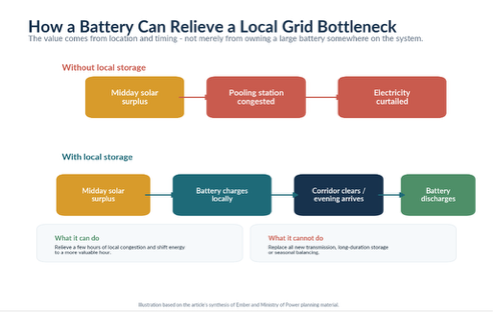
Figure 4. How local storage can relieve a constrained pooling station. A battery can defer a few hours of congestion but does not replace all transmission or long-duration flexibility.
Execution problems need execution money
Much of the attention still goes to capital subsidies because they produce visible numbers: so many crores sanctioned, so many megawatt-hours supported, so much private investment expected.
The less visible work is often more important.
Projects require timely network studies, prepared sites, substation bays, land coordination, standard contracts, regulatory approvals and clear responsibility for delays. Transmission projects also encounter right-of-way disputes, environmental clearances, litigation and repeated tendering when bidder participation is weak.
These are not side issues. They determine whether the subsidised asset ever becomes operational.
A larger capital grant cannot compensate indefinitely for weak project preparation. In some places, the highest-return public expenditure may not be another subsidy per MWh. It may be a stronger land and clearance team, better locational data, a completed grid study or a standardised contract that lenders are willing to accept.
Nobody cuts a ribbon for a well-run project-preparation office. But without one, there may be no project at which to cut the ribbon.
Safety and end-of-life are part of the economics
The discussion around battery storage tends to focus on cost, capacity and commissioning dates. Safety is often added near the end, as though it were a technical annex.
It belongs at the beginning.
India’s regulatory framework has moved forward. The Central Electricity Authority notified BESS-specific safety requirements in March 2026 and now lists the CEA’s Measures Relating to Safety and Electric Supply Amendment Regulations, 2026. Construction standards for battery systems have also been introduced.
The framework addresses matters such as thermal management, hazard detection, fire suppression, ventilation, emergency shutdown, physical security and fire-safety audits. In August 2026, the CEA also published training guidelines for fire-service personnel dealing with BESS installations – an important recognition that emergency response requires battery-specific knowledge.
The regulations are welcome. Their value will depend on implementation.
Tender documents must assign responsibility among the cell manufacturer, system integrator, engineering contractor, project owner and operator. Local fire services need site information and appropriate training. Emergency access, isolation systems and incident-reporting procedures should be settled before commissioning, not after the first serious event.
End-of-life responsibility deserves the same attention.
Battery degradation is normal. A project may need additional cells during its contracted life to maintain the promised energy capacity. At the end of service, some modules may be suitable for less demanding uses; others will require recycling or controlled treatment.
India’s Battery Waste Management Rules, 2022, together with subsequent amendments including those issued in 2025, provide the wider regulatory framework for producer responsibility, registration and battery-waste management. Grid-storage contracts must still translate that framework into project-level obligations.
Who owns the battery at the end of the concession? Who pays for augmentation? Who transports damaged or spent modules? Who receives any residual value from recovered materials?
These questions affect the tariff. Leaving them unanswered does not remove the cost; it merely pushes it into the future.
Build capability, not just factories
Domestic manufacturing is another essential part of the storage story.
The Production-Linked Incentive programme for advanced-chemistry cells has an outlay of ₹18,100 crore and targets 50 GWh of manufacturing capacity. Of that, 10 GWh is earmarked for grid-scale stationary storage.
That is an important start. But manufacturing capacity is not the same as technological independence.
India may initially manufacture cells using imported process equipment, licensed designs, imported active materials or foreign intellectual property. There is nothing unusual about that. Most successful manufacturing economies have climbed the value chain in stages.
The danger lies in stopping at assembly.
India also needs domestic capability in cell chemistry, battery-management systems, power electronics, system integration, independent testing, safety validation and recycling. Developers, lenders and insurers must be able to verify that a storage system will perform under Indian heat, dust, humidity and grid conditions.
ORF’s assessment of the 2026 budget similarly noted that support for domestic technology development, chemistry research and testing infrastructure remains thinner than the support for manufacturing equipment and project deployment.
The goal should not be to insist that every component is indigenous immediately. It should be to ensure that India gradually acquires the ability to test, improve and eventually design the systems it is deploying at scale.
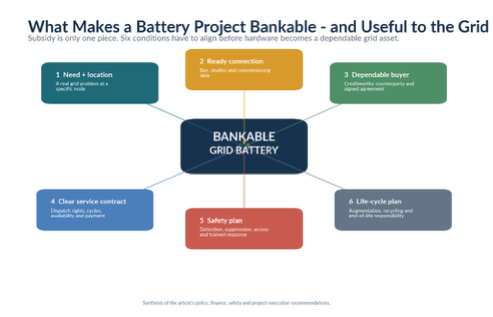
Figure 5. Six conditions for a bankable and useful grid battery. Subsidy is only one part of project viability.
What India should do now
The next stage of storage policy needs to become more selective and more integrated.
First, buy storage where the grid needs it. Curtailment records, congestion studies and renewable-connection queues should guide the location and order of procurement. State allocations may remain part of the programme, but substation-level need should decide which projects move first.
Second, procure services rather than containers. Tenders should specify what the battery must deliver: peak availability, frequency response, congestion relief, renewable firming or another clearly measured service. MW and MWh describe the equipment; they do not fully describe its value.
Third, compare storage with transmission and demand response. Batteries should become a formal option in network planning, especially where transmission construction is delayed or a constraint occurs for only a few hours a day.
Fourth, fix the contracting chain. A storage award without a signed purchase agreement, a credible buyer and clear dispatch rights is not yet an investible project. Procurement agencies, regulators and distribution companies must resolve these issues earlier.
Fifth, fund project preparation. Grid studies, land coordination, clearances, standard documentation and substation readiness deserve dedicated resources. Better preparation may achieve more than repeatedly increasing the capital subsidy.
Finally, include safety, augmentation and recycling in the first tender. These are not costs to be discovered later. They are part of the project from the day the tariff is calculated.
What to watch next
The first test is straightforward: how much of the 43.8 GWh covered by the two central viability-gap-funding programmes is actually commissioned – and how much remains at the award, agreement or financial-closure stage.
The second is whether India begins publishing timely, location-specific curtailment and congestion data. It is difficult to procure storage intelligently when the most valuable locations cannot be identified from public information.
The third is implementation of the Energy Storage Obligation trajectory. The obligation runs through 2029-30, but its success should be judged by contracted and operating storage, not simply by compliance filings or renewable-energy certificates.
The fourth is the conversion rate from tender to operation. Falling bid prices mean little if cancellations, delayed agreements or financing failures continue to remove projects from the pipeline.
And the fifth is safety. A rapidly growing fleet needs transparent incident reporting and disciplined emergency preparation. One serious event handled badly could raise insurance costs, slow local approvals and provoke restrictions far beyond the project concerned.
The real risk is fragmentation
The reduction from ₹800 crore to ₹600 crore is worth reporting. It is not large enough, on its own, to decide India’s renewable-energy future.
The deeper risk is that generation, transmission, storage, electricity procurement and domestic manufacturing continue to be planned in separate compartments.
In that world, India could keep adding impressive quantities of solar and wind capacity. Storage tenders would continue to be announced. Battery factories would continue to be proposed. Yet renewable electricity would still be curtailed at congested substations, while batteries elsewhere followed whatever market opportunity happened to be available.
The headline capacity numbers might look excellent even as the economic quality of the system weakened.
India does not simply need more batteries. It needs batteries with a defined job, a dependable buyer, a usable grid connection, a credible safety plan and a location chosen by system need rather than administrative convenience.
The country has begun funding the hardware.
It must now build the grid arrangements, contracts and institutions that allow the hardware to matter.
References
The links below are live in both the Word document and the text-based PDF. Access dates should be added at publication if required by your house style.
1. Ministry of New and Renewable Energy, Press Information Bureau. India Achieves Landmark 300 GW Non-Fossil Fuel Power Capacity. 9 August 2026. Provides India’s non-fossil capacity and technology-wise breakdown as of 31 July 2026. Open source
2. Ember. Transmission Gaps Are Beginning to Constrain India’s Rapid Renewables Integration. 19 May 2026. Full analysis of interstate renewable curtailment, transmission delays, pooling-station constraints and the potential role of strategically located battery storage. Open source
3. Ember. India Lost 300 Million Units of Renewable Energy Owing to Transmission Constraints in Q1 2026. 19 May 2026. Summary of the 470 GWh curtailment estimate, the 34 GWh event on 30 March and the 3-4 GW battery-storage estimate. Open source
4. Ministry of Power, Press Information Bureau. Grid Stability and Energy Storage. 27 July 2026. Provides the CEA’s 2031-32 battery and pumped-storage requirements, estimated investment, current policy measures, VGF support and the ACC manufacturing programme. Open source
5. Institute for Energy Economics and Financial Analysis. Union Budget 2026: Strong Fiscal Signals, Fragmented Support for India’s Energy Transition. 4 February 2026. Source for the ₹800-crore-to-₹600-crore transmission-and-storage allocation comparison and wider budget-policy assessment. Open source
6. Observer Research Foundation. Budget 2026 and India’s Energy Storage Transition: Gains and Gaps. 16 February 2026. Analysis of BESS viability-gap funding, customs-duty relief, financing risk, execution constraints, technology development and testing gaps. Open source
7. Ministry of Power, Press Information Bureau. Per kWh Cost of Battery Energy Storage System Falls Steeply: VGF Schemes, ISTS Charges Waiver Boosts Affordable Battery Storage. 15 December 2025. Source for recent competitively discovered storage costs and their sensitivity to assumed daily cycling. Open source
8. Ministry of Power, Government of India. Lok Sabha parliamentary reply on implementation of the two BESS viability-gap-funding schemes. 23 July 2026. Provides the structure and implementation framework for the combined 43.8 GWh programme. Open source
9. Ministry of New and Renewable Energy, Press Information Bureau. Government Takes Multi-Pronged Steps to Scale Up Energy Storage Capacity in the Country; MNRE Implements Several Proactive Measures to Facilitate PPA Signing. 3 February 2026. Covers storage-promotion measures and efforts to resolve delayed power-purchase agreements. Open source
10. Ministry of Power, Press Information Bureau. Development and Deployment of Energy Storage Capacities to Power Reliable Renewable Future. 18 December 2025. Covers resource-adequacy planning, ancillary services, market participation and government storage policy. Open source
11. Power Peak Digest. India’s BESS Capacity Grows 11-Fold to 8.5 GWh in a Year: IESA Report. 2026. Secondary report on the India Energy Storage Alliance’s H1 2026 market review, including operational capacity, merchant deployment, tender pipeline and cancellations. Open source
12. Central Electricity Authority. Central Electricity Authority (Measures Relating to Safety and Electric Supply) Amendment Regulations, 2026. 2026. Official regulatory listing for the BESS-specific safety amendments. Open source
13. Central Electricity Authority. Guidelines for Training of Fire Safety Officials under CEA Measures Relating to Safety and Electric Supply Amendment, 2026 for BESS Installations. August 2026. Covers fire-service training and emergency-response preparation for battery-storage installations. Open source
14. Central Electricity Authority. Report of the National Workshop on Renewable-Energy Integration through Energy Storage Systems-Phase II. 2026. Discusses battery safety, fire suppression, thermal management, system services and recommendations for grid integration. Open source
15. Ministry of Environment, Forest and Climate Change. Battery Waste Management Amendment Rules, 2025. 2025. Amends the Battery Waste Management Rules, 2022, and provides the regulatory framework relevant to producer responsibility, registration and end-of-life battery management. Open source
16. Ministry of Power, Government of India. Renewable Purchase Obligation and Energy Storage Obligation Trajectory till 2029-30. 2025. Official trajectory and related parliamentary references for energy-storage obligations. Open source
Excellent analysis and recommendations, sir, as always. This article points out a very important lacuna for India’s Renewable Power Generation and throttling of the distribution to the ultimate consumer – the common man and industry. While we still suffer from power cuts every week, it is alarming to learn that as high as 320GW renewable power was indeed generated but died at the point of generation. The case for Battery storage and geographical optimization has been beautifully emphasized. The INR 200 crores reduction in central budget is disappointing, and an eye opener for Policy makers to revisit the same. The Battery storage has to be planned much like Hydraulic Dams in various places, small and big, where energy like water, should be able to be released at the appropriate time, in the right quantity, and to the right users such as industrial and households. Once india achieves real power surplus at the user destination, not merely a surplus in generation, then only we can become a developed country