Quantum Computing in India: From Research Labs to Real-World Applications
By Amulya Charan | Blog 120 | Updated 11 November 2026
Introduction
Computing power has been at the heart of human progress for the past half-century. From mainframes to desktops, and now cloud and mobile devices, classical computing has transformed how we live, work, and think. Yet, there are limits. Even the fastest supercomputers cannot solve certain problems in a reasonable amount of time — problems that involve too many variables, too much uncertainty, or too much complexity.
This is where quantum computing enters the stage. Rooted in the counter-intuitive principles of quantum physics, quantum computing promises a revolution in problem-solving capacity. For India, entering this field represents both an enormous challenge and a tremendous opportunity. With its large pool of scientific talent, growing digital economy, and national security imperatives, India cannot afford to lag in the quantum race.
This article explains quantum computing in simple terms, outlines its applications, explores India’s journey so far, compares it with global leaders, and highlights what India needs to do to unlock its potential.
1. Classical vs. Quantum Computing – The Basics
Most people are familiar with classical computers — from smartphones to supercomputers — which work on bits. A bit can take only one value at a time: either 0 or 1. Everything we do digitally — from playing a video to running a bank transaction — is based on billions of these bits switching rapidly.
Quantum computers, on the other hand, use qubits. A qubit can be 0, 1, or a combination of the two (thanks to the principle of superposition). When we measure it, however, we get just one result: 0 or 1.
- Classical computer analogy: Solving a maze by testing routes using ordinary computing rules; modern computers can also work on several routes in parallel.
- Quantum computer analogy: Using wave-like behaviour to make useful answers more likely and others less likely. It does not instantly see every route and pick the best one.
This is why a carefully designed quantum algorithm can solve some problems much faster than the best known classical methods. For certain problems, the expected speed-up is exponential; for many others, no advantage is established. [1]
Classical and quantum computing at a glance
| Classical computing | Quantum computing |
| Bits represent 0 or 1. | Qubits can combine 0 and 1 before measurement. |
| Uses ordinary logic and can process tasks in parallel. | Uses quantum gates and wave-like interference. |
| Runs everyday digital services. | May speed up particular problems with suitable algorithms. |
| Produces ordinary digital answers. | A measured qubit gives one result, 0 or 1. [1] |
2. Key Quantum Terms Explained Simply
Quantum computing comes with a vocabulary that sounds intimidating. Here are the most important terms in plain English:
- Qubit: The quantum version of a bit; can be in a combination of 0 and 1 before measurement.
- Superposition: A qubit’s ability to be in such a combination; measuring it gives one result.
- Entanglement: A property where qubits share a linked quantum state, so their measurement results are connected. It cannot send messages instantly across a distance.
- Quantum Gate: The operations that manipulate qubits, like logic gates in normal computers.
- Quantum Algorithm: A set of instructions designed to use qubit properties to solve a particular problem.
- Quantum Decoherence: The tendency of qubits to lose their delicate quantum behaviour due to noise or environmental disturbance.
With these concepts, one can begin to understand why quantum computers are so different. [1, 2]
Quantum terms at a glance
| Term | Plain meaning |
| Qubit | The basic unit of quantum information. |
| Superposition | A combination of 0 and 1 before measurement. |
| Entanglement | Linked measurement results; no instant messaging. |
| Quantum gate | An operation that changes qubit states. |
| Quantum algorithm | Instructions designed for a particular problem. |
| Decoherence | Loss of delicate quantum behaviour through disturbance. [1, 2] |
3. Where Quantum Computing is Needed
Quantum computing is not meant to replace all classical computing. Your emails, streaming videos, and Excel spreadsheets will continue to run on traditional machines. But quantum computers can make a difference in areas where complexity explodes beyond classical limits. Most of the applications below remain areas of research, rather than routine commercial services.
Key Application Areas:
1. Drug Discovery and Healthcare
- Simulating how molecules interact — important for researching new medicines.
- Could help parts of drug research, but claims of cutting years from development are not yet established. [3]
2. Cryptography and Cybersecurity
- Threat: A sufficiently powerful, reliable quantum computer could break widely used public-key systems such as RSA. This does not mean all encryption would fail.
- Opportunity: Quantum-resistant encryption can run on ordinary computers; it does not require buying a quantum computer. [4]
3. Finance and Risk Management
- Research into complex simulations of market behaviour.
- Testing portfolio optimisation under multiple constraints.
4. Artificial Intelligence and Machine Learning
- Researchers are testing whether quantum algorithms can improve particular AI tasks; faster or more accurate training is not a general guarantee.
5. Climate and Weather Modeling
- Research into methods that might eventually help weather and climate calculations.
- More accurate monsoon forecasts remain an aspiration, rather than a proven quantum service. [5]
6. Logistics and Supply Chains
- Testing ways to optimise delivery routes or manufacturing schedules; an advantage over the best classical tools must still be demonstrated for each use case.
Potential applications at a glance
| Area | What to expect |
| Medicines | Research into molecular simulation; development gains still need proof. |
| Cybersecurity | Prepare ordinary computers for quantum-resistant encryption now. |
| Finance and logistics | Test specific simulation and optimisation tasks. |
| AI and weather | Research opportunities, without a general promise of better results. [3–5] |
4. Hardware, Software, and Skills – How It Differs from Normal Computing
Hardware
Quantum hardware is radically different from classical chips:
- Superconducting qubits require cryogenic temperatures close to absolute zero; other types have different cooling and operating needs.
- Uses superconducting circuits, trapped ions, or photons to create qubits.
- Machines are highly sensitive — environmental noise can introduce errors and disrupt calculations. [1]
Software
- Frameworks like IBM’s Qiskit and Google’s Cirq help developers program quantum computers.
- Familiar languages still matter: Qiskit and Cirq use Python. Quantum programming adds specialised knowledge of quantum operations and algorithms. [6, 7]
Skills
- A combination of physics, mathematics, and computer science.
- Workforce needs training in quantum mechanics + coding.
- India needs to expand its pool of trained researchers, engineers and technicians.
5. India’s Journey into Quantum Computing
India is developing research systems, prototypes and pilot applications; large-scale practical quantum computing remains a goal.
- On 19 April 2023, the Union Cabinet approved the National Quantum Mission (NQM) with an outlay of ₹6,003.65 crore for 2023–24 to 2030–31. The earlier ₹8,000 crore proposal was announced in Budget 2020, not 2021. [8, 9]
- Four mission hubs: IISc Bengaluru for computing; IIT Madras with C-DOT for communication; IIT Bombay for sensing and metrology; and IIT Delhi for materials and devices. [10]
- Private sector: Startups like QuNu Labs in quantum cybersecurity, alongside quantum-computing hardware ventures.
- DRDO and IIT Delhi have demonstrated an experimental secure quantum communication link. [11]
Potential for India
- Stronger cybersecurity for Aadhaar, UPI and digital banking through migration to quantum-resistant encryption.
- Potential boost to the pharmaceutical industry in drug research.
- Longer-term research into climate modeling for agriculture.
- Potential national security benefits from quantum communication and sensing.
But compared to global leaders, India’s progress is modest.
6. How Other Major Economies Have Approached Quantum Computing
United States
- National Quantum Initiative Act (2018): authorised about $1.2 billion over its initial five-year funding period, rather than a statement of money already spent. [12]
- Companies like IBM, Google, Microsoft and Amazon are major participants.
- Cloud access through IBM Quantum and Amazon Braket allows developers to experiment, subject to platform access conditions.
- Federal agencies, including NIST and DARPA, support quantum research.
- Model: Public–private partnership, research collaboration and efforts towards commercialisation.
China
- Treats quantum as a national strategic asset.
- Large public research programmes; widely circulated investment estimates are not directly comparable with other countries’ mission budgets.
- Launched the Micius quantum communication satellite in 2016. [13]
- Reported photonic quantum advantage on a specialised sampling task, rather than general superiority over classical computers. [14]
- Model: Strong state support, strategic research and infrastructure investment.
European Union
- Quantum Flagship: launched in 2018 with an expected EU budget of €1 billion over ten years. This is a programme budget, not the total of all European quantum spending. [15]
- Collaborative model linking universities, startups, and companies.
- Focus not just on computing but also on sensing and communication.
- Model: Cross-border academic–industry ecosystem.
Japan
- Integrated into industrial strategy.
- Industry participation includes Fujitsu, NEC and Toshiba.
- The Moonshot programme targets a fault-tolerant universal quantum computer by around 2050 — a research goal, not an assured delivery date. [16]
- Applied research areas: automotive, materials and logistics.
- Model: Industry-centric, applied problem solving.
Canada
- Home to D-Wave Systems, an early commercial quantum company.
- Research hubs at University of Waterloo.
- Model: Early start, academic depth, and commercialization.
Australia
- Strengths include silicon-based qubits, alongside other quantum approaches.
- Adopted a National Quantum Strategy in 2023. [17]
- Aim: Build scalable, fault-tolerant machines — able to keep calculating reliably despite individual qubit errors.
- Model: Specialist strengths within a broader quantum ecosystem.
Singapore
- Investment in university research and national programmes.
- Focus on quantum-safe communications, computing and talent.
- Announced a National Quantum Strategy in 2024, with close to S$300 million over five years. [18]
- Serves as a regional hub for Asia-Pacific.
7. Lessons for India from Global Experience
1. Sustained Funding
- India’s ₹6,003.65 crore mission is a start. Overseas funding figures cover different periods and activities, so simple league tables can mislead.
- India needs long-term (10–15 year) commitments, not short-term projects.
2. Public–Private Partnerships
- The U.S. and Japan show how private companies can help turn research into applications.
- India must involve Infosys, TCS, Wipro, Reliance Jio, HCL in R&D.
3. Cloud Democratization
- IBM allows global students to code on quantum machines.
- India should expand “India Quantum Cloud” access for IITs, startups, and researchers.
4. Strategic Priorities
- China links quantum with national security.
- India must secure defense and financial systems against quantum threats.
5. Academic–Industry Collaboration
- Canada and EU excel here.
- India should encourage IIT–industry partnerships and specialized PhD programs.
6. Talent Development
- Developing quantum expertise requires sustained training.
- India should expand graduate courses and online certification programs in quantum.
7. Niche Leadership
- Specialist strengths can help smaller research ecosystems compete.
- India could lead in quantum cybersecurity, climate modeling, or quantum AI.
Global approaches and lessons for India
| Programme or approach | Lesson for India |
| United States — public and private research | Connect laboratories, industry and startups. |
| China — strategic research and infrastructure | Invest in shared research facilities. |
| EU — expected €1 billion Flagship over ten years | Build collaboration across institutions. |
| India — ₹6,003.65 crore approved NQM outlay | Deliver the 2023–24 to 2030–31 mission and measure progress. |
| Japan — industrial research and long-term goals | Involve companies in applied research. [8, 12–16] |
8. Challenges Facing India
- High Costs: Specialist equipment and research facilities require substantial investment.
- Talent Gap: A larger pool of experts in quantum mechanics and computing is needed.
- Infrastructure Needs: Depending on the technology, cryogenic labs, vacuum chambers and advanced fabrication units.
- Global Competition: India must build on its capabilities while major international programmes advance.
- Brain Drain: Retaining and attracting researchers requires good facilities and career opportunities.
9. The Road Ahead – India’s Future in Quantum Computing
Over the next 10–15 years, India should aim to
- Move from early prototypes to more reliable, useful systems.
- Test quantum computing in finance and weather research, while separately upgrading cybersecurity with quantum-resistant encryption.
- Form global partnerships for shared infrastructure.
- Expand the talent pool through education and training.
- Consider PPP models for large-scale R&D.
If done right, India can leapfrog into a position of strength, not just as a user but as a global contributor to quantum technologies.
India’s quantum roadmap at a glance
| Stage | Priority |
| Already under way | Mission hubs, research facilities, early systems and pilots. |
| Approved mission through 2030–31 | Target 50–1,000 physical qubits by the end of the mission; a target, not an achieved result. |
| Longer-term recommendations | Improve reliability, test useful applications and develop talent. |
| Timing | Wider commercial use depends on research progress; no assured delivery date. [8, 10, 11] |
10 Quantum India 2025–2035: Policy Brief
Context
Quantum computing is moving from theoretical physics towards practical applications across the globe. Nations such as the U.S., China, and the EU are making substantial investments. India’s approved baseline is the ₹6,003.65 crore National Quantum Mission for 2023–24 to 2030–31, but much more remains to be done. The priorities below are recommendations for India, not a statement of officially approved targets. [8]
Vision (2025–2035)
Position India as a leading hub for applied quantum technologies, with a focus on cybersecurity, climate modeling, pharmaceuticals, and financial services — sectors directly tied to national security and economic growth.
Five Strategic Pillars
1. Funding Expansion
- Build on the approved ₹6,003.65 crore mission with sustained 10–15 year funding.
- Create public–private R&D funds to co-invest with industry.
2. Talent Development
- Expand graduate and doctoral programs in quantum science + computing at IITs, IISc, and IISERs.
- Incentivize faculty exchanges and joint labs with global leaders.
3. Industry Collaboration
- Mandate partnerships between IT majors (TCS, Infosys, Wipro, HCL, Reliance Jio) and research labs.
- Support quantum startups in cryptography, AI, and simulation.
4. Quantum Cloud Access
- Develop an “India Quantum Cloud” platform to democratize access for startups, universities, and students.
- Reduce dependence on foreign cloud platforms for sensitive data.
5. National Security Focus
- Prioritize quantum-safe encryption for Aadhaar, UPI, and defense communication.
- Develop quantum sensors and communication satellites for defense applications.
Immediate Priorities (2025–2030)
- Expand shared national quantum testbeds, building on the four mission hubs.
- Train a much larger pool of students, researchers and technicians, with progress measured against published targets.
- Extend secure quantum communication pilots for defence and banking, while preparing wider systems for quantum-resistant encryption.
Longer-Term Goals (2030–2035)
- Develop more capable Indian quantum computers for applied research.
- Work towards global competitiveness in quantum cybersecurity.
- Position India as a hub for skilled applied quantum talent, building on its experience in IT services.
Key Message
India cannot afford to stay a spectator in the quantum race. The next decade must be about bold funding, talent creation, and industry partnerships. If pursued with urgency, India can convert its digital advantage into quantum leadership, securing both economic growth and national security.
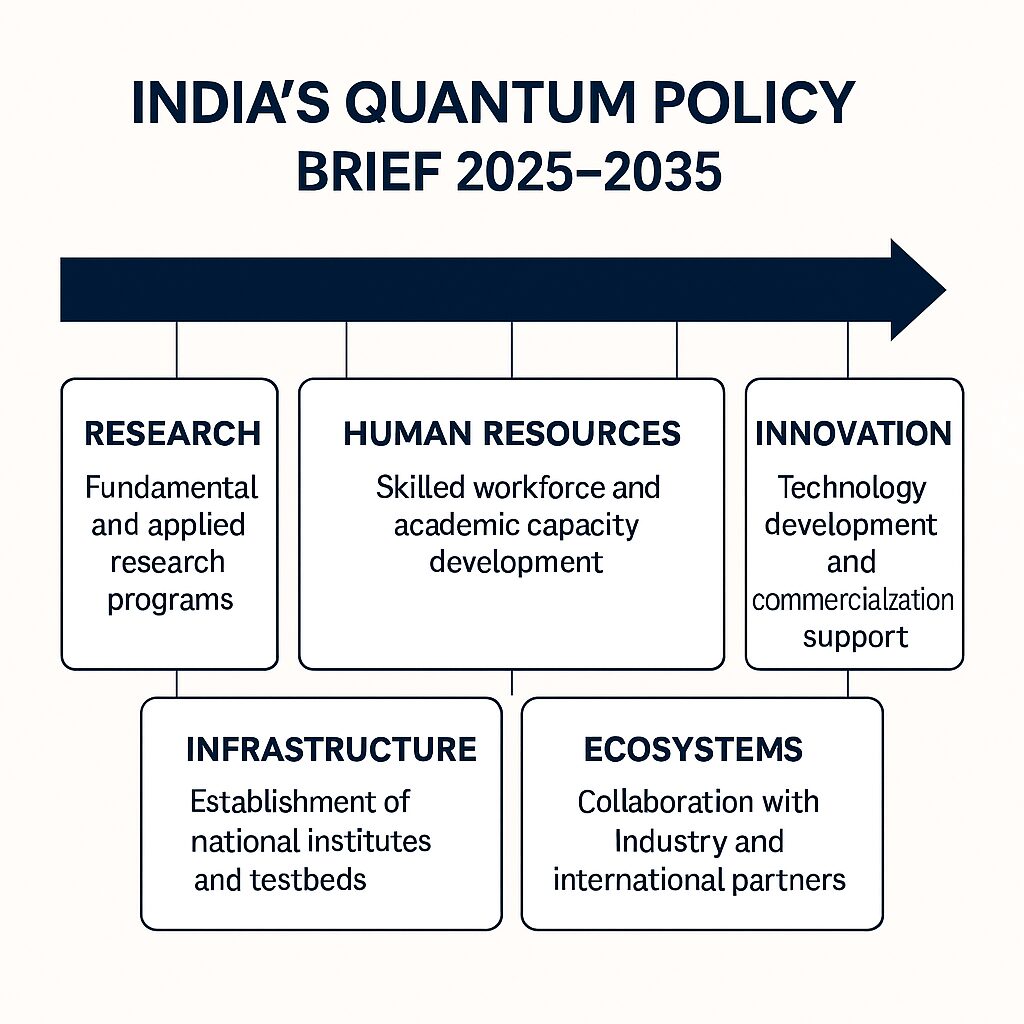
Policy recommendations for 2025–2035
11 Conclusion
Quantum computing is not science fiction anymore. It is the next frontier of computing power, with the potential to transform industries, economies, and national security. India has made a promising start but needs to act fast and decisively to avoid being left behind. With focused investments, partnerships, and education initiatives, India can move from research labs to real-world applications, and play a leadership role in this transformative technology.
12 References
1. IBM. What is quantum computing
2. University of Waterloo Institute for Quantum Computing. Entanglement teaching resource
3. Nature Physics. Drug design on quantum computers 2024
4. NIST. First three finalised post quantum encryption standards 13 August 2024
5. C-DAC. Quantum machine learning use cases and applications for weather forecasting
6. IBM Quantum. Qiskit SDK documentation
7. Google Quantum AI. Cirq Python framework
8. Government of India PIB. Cabinet approval of National Quantum Mission 19 April 2023
9. Government of India PIB. Budget 2020 quantum mission proposal
10. Government of India PIB. Parliament question National Quantum Mission 4 February 2026
11. Government of India PIB. Parliament question Achievements under NQM 12 February 2026
12. US Government. National Quantum Initiative Act 2018 original enacted text
13. China National Space Administration. Launch of Micius 16 August 2016
14. Science. Quantum computational advantage using photons 2020
15. European Commission. Quantum Technologies Flagship
16. Cabinet Office Japan. Moonshot Goal 6
17. Australian Government. National Quantum Strategy 2023
18. Centre for Quantum Technologies Singapore. National Quantum Strategy announcement 30 May 2024Quantum Computing in India: From Research Labs to Real-World Applications