Fertiliser Fuel and Food
How the Hormuz crisis affects India’s household budget
What readers need to know now
Amulya Charan | Updated – Original Blog 140 |
The risk discussed in June is easier to understand if we begin with the kitchen. Gas helps make fertiliser. Fertiliser helps grow food. Fuel takes it to market. Trouble in the Gulf can make this chain more expensive, even when India’s farms and factories are undamaged.
Food inflation has risen. India also has substantial fertiliser stocks and government support to cushion the pressure. Both facts matter. The latest inflation figures do not tell us how much of the increase Hormuz caused. [1,5]
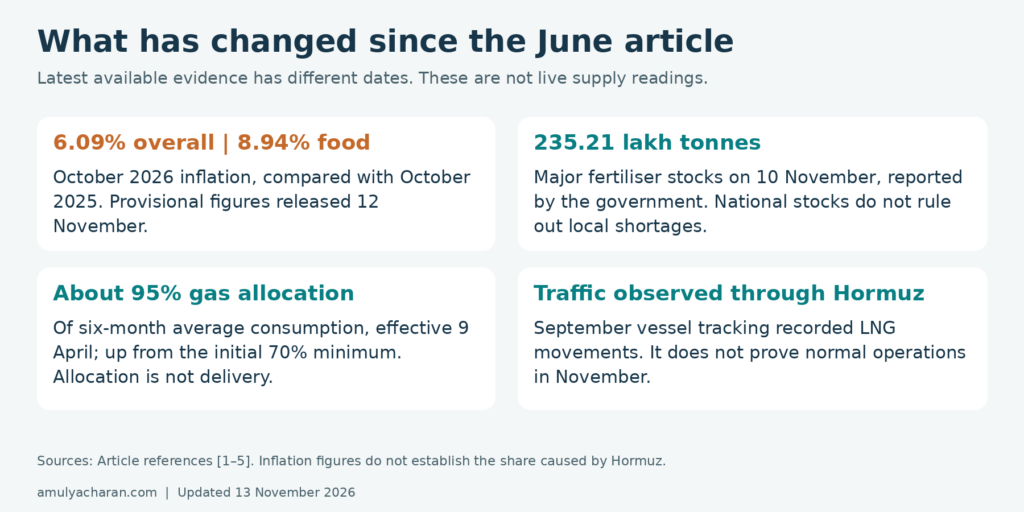
The October figures mean that the measured food basket cost 8.94% more than a year earlier. They do not mean every food item rose by that amount, or that every family faced the same increase. Weather, harvests and other influences also affect prices. [1]
The June article should therefore be read as a warning about a possible chain of events. It is not a description of an unchanged emergency continuing into November. Ships have been observed passing through Hormuz, although the available September report does not establish present-day normality. [4]
Why a gas problem becomes a food problem
Natural gas supplies both raw material and energy for conventional ammonia production. Ammonia is then used to make urea. A gas shortage can leave a fertiliser factory short of what it needs; dearer gas can raise costs even if production continues. [7]
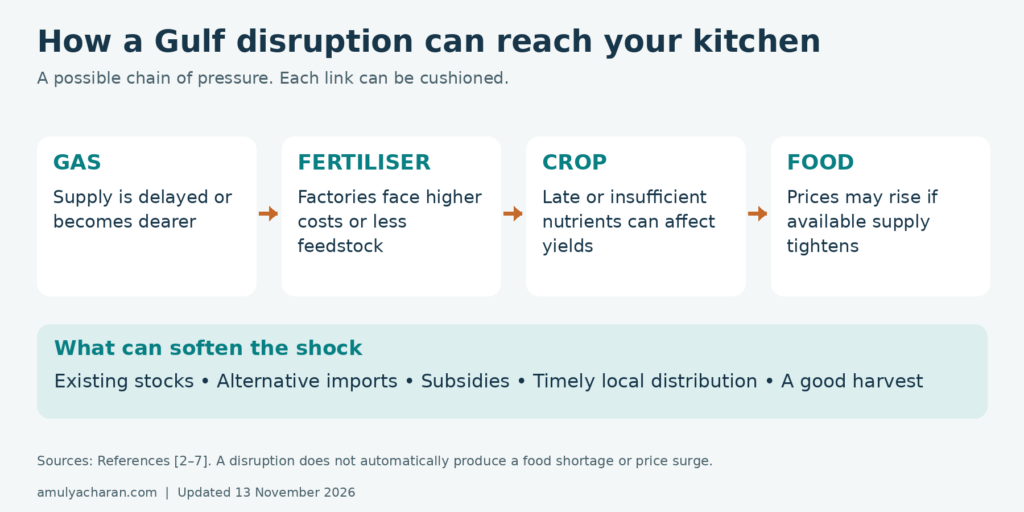
Building more fertiliser factories helps, but a factory using imported gas still depends on supplies from abroad. The useful question is whether it can keep producing at a manageable cost when a cargo is delayed.
The Qatar agreement in plain language
Petronet signed its new QatarEnergy agreement on 6 February 2024, not in early 2025. It covers about 7.5 million tonnes of liquefied natural gas, or LNG, a year, with supplies scheduled from 2028 to 2048. These are future supplies under the new agreement, not additional volumes already arriving under it during 2026. [6]
A long-term contract helps arrange purchases. It cannot keep a shipping route open or prevent disruption at an export plant. India needs workable alternatives as well as signed agreements.
Future factories must also be kept separate from current production. A March 2026 parliamentary answer scheduled Talcher’s commissioning for December 2027. That evidence does not justify counting it as an operating source of fertiliser today. [8]
Who pays when fertiliser becomes dearer
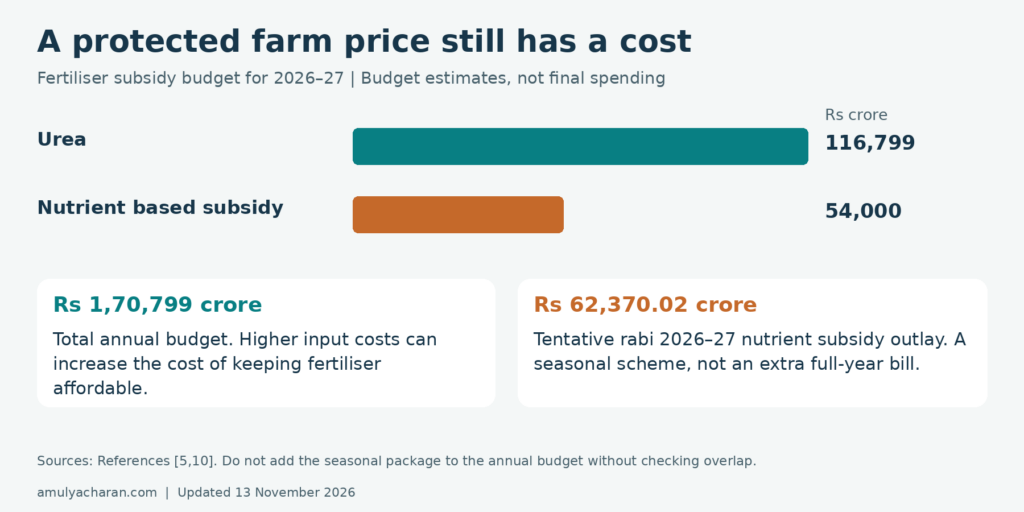
The farmer does not necessarily pay the full increase. Government support can hold down the price at the shop while the public subsidy bill rises. The protection is valuable, but somebody still pays for it.
The published base price of a 45 kg urea bag is Rs 242, before neem-coating charges and applicable taxes. It is not a universal final price at every counter. Support also extends beyond urea: the government says special assistance continues to maintain DAP at Rs 1,350 per bag. [5,9]
The annual budget is a starting allocation. The rabi package covers a particular seasonal scheme. Neither is the final account of the year’s spending, and adding the two would risk double counting. [5,10]
For readers, the point is simple. A steady shop price does not mean India has escaped the higher cost. Some pressure may have moved to the government’s accounts. Whether that raises borrowing depends on tax receipts and other spending decisions.
National stocks must reach the village
The government reported 235.21 lakh tonnes of major fertiliser stocks on 10 November. That is a useful cushion. But a national total cannot tell a farmer whether the right fertiliser will reach the local dealer before the crop needs it. [5]
Availability and affordability must be watched together. An affordable bag arriving too late cannot fully protect the harvest.
Why there is no single date for the price impact
A gas disruption does not set a countdown to a particular month of food inflation. Transport costs and market expectations can move sooner; crop effects depend on sowing, nutrient needs and harvests.
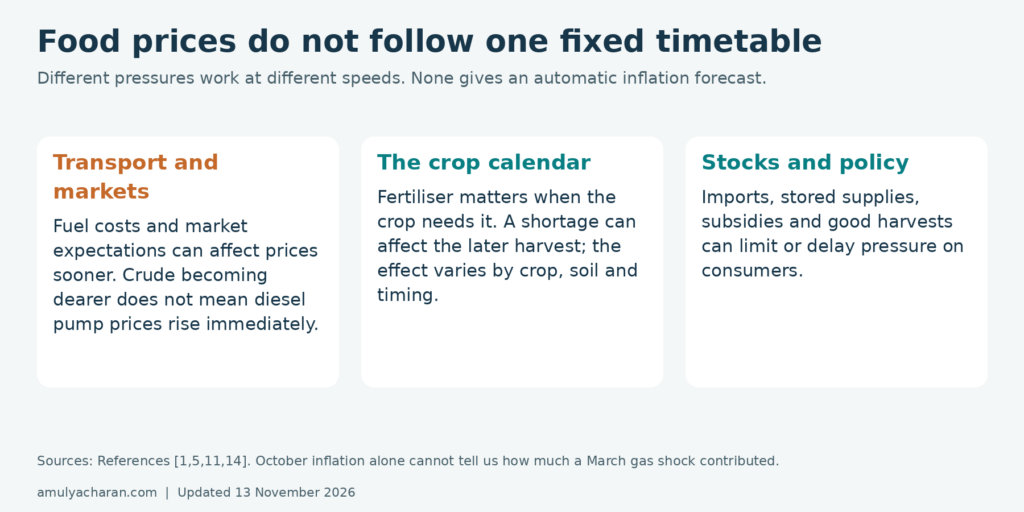
Nor does a higher crude price automatically mean an immediate diesel-price increase. On 27 March, the government cut excise duty while keeping retail petrol and diesel prices unchanged. Taxes and company finances can absorb part of the pressure. [11]
What would help people on the ground
Farmers need reliable local information about stocks, expected deliveries and authorised prices. They should obtain receipts and seek local agricultural advice before changing fertiliser use. Substituting one nutrient for another without regard to the crop and soil can create another problem.
Governments should track district deliveries as closely as national stocks, arrange alternative supplies and report budget allocations separately from actual spending. A comfortable national total is no substitute for timely delivery.
Families with little room in their budgets feel sustained food-price increases most sharply. The household survey shows that food takes a larger average share of rural spending than urban spending. Those survey shares are different from the weights used to calculate inflation. [12,13]
The RBI can influence demand and inflation expectations. It cannot supply missing gas or grow a replacement crop. Its response depends on whether price pressure persists and spreads. [14]
India’s protection will be judged at two places: the village fertiliser counter and the household kitchen. Keeping supplies moving and prices manageable is what turns an international crisis into a disruption people can live through.
References
[1] MoSPI via PIB. Consumer Price Index for October 2026. Released 12 November 2026; October figures provisional. Source
Numbered sources correspond to the citations in the article and graphics. Dates attached to stock, allocation and shipping figures identify the evidence period; they are not live readings.
[2] Department of Fertilizers via PIB. Natural gas priority allocation and fertiliser stocks. 10 March 2026. Source
[3] Government of India via PIB. Energy supply briefing reporting approximately 95% fertiliser gas allocation effective 9 April 2026. Source
[4] Directorate General of Maritime Administration. Monthly report for September 2026, LNG Route Assessment, printed page 138. Vessel observations have explicit limitations. Source
[5] Government of India via PIB. Rabi 2026–27 nutrient-based subsidies, special support and fertiliser stock position. 12 November 2026. Source
[6] Petronet LNG. Stock-exchange announcement and press release on the QatarEnergy SPA. 6 February 2024. Source
[7] International Energy Agency. Ammonia Technology Roadmap. 2021. Background on ammonia and nitrogen fertiliser production. Source
[8] Rajya Sabha. Unstarred Question 2745 on commissioning of Talcher Fertilizer Plant. Answered 17 March 2026. Source
[9] Department of Fertilizers via PIB. Clarification on urea pricing and bag size. March 2026. Source
[10] Union Budget 2026–27. Expenditure Profile, Statement 7, Statement on Subsidies and Subsidy Related Schemes, printed page 101. Source
[11] Ministry of Petroleum and Natural Gas via PIB. Excise-duty reduction with retail pump prices unchanged. 27 March 2026. Source
[12] MoSPI via PIB. Household Consumption Expenditure Survey 2023–24 release and factsheet. Source
[13] MoSPI via PIB. New CPI series technical explanation, division-wise weights, base 2024. Source
[14] Reserve Bank of India. Governor’s discussion of monetary policy and supply shocks. RBI Bulletin, 2026. Source