Fertiliser, Fuel, and Food: How the Hormuz Crisis Could Trigger India’s Next Inflation Wave
Amulya Charan – June 2026
By early June 2026, the Strait of Hormuz has been shut for three months. The oil story is the one everyone is reading. The one worth worrying about runs through natural gas, into a sack of urea, into the cost of this year’s monsoon crop — and may not reach India’s food prices until the year is nearly out.
At its narrowest the Strait of Hormuz is about 33 kilometres across, a sleeve of water between Iran and Oman that looks, on a map, like nothing much. It is not nothing much. Close to a fifth of the world’s seaborne oil passes through it, and a comparable share of its liquefied natural gas. For India the exposure is worse than the global average: by the reckoning of agencies such as ICRA, somewhere between 54 and 60 per cent of the gas the country imports, and roughly half its crude, comes through that one gap in the map.[5]
Since late February, the gap has been closed. An air war between Iran on one side and the United States and Israel on the other turned, over a matter of weeks, into sea mines, missile strikes on Gulf energy plants, an Iranian shipping ban and then an American blockade.[1] By the middle of April, the number of ships crossing on a normal day had fallen by more than ninety-five per cent, and the few still willing to try were paying war-risk premiums and unofficial “tolls” reported north of a million dollars a vessel.[2] One of the early casualties was Ras Laffan in Qatar, the single most important node in the global LNG trade. It was hit, output dropped hard, and QatarEnergy fell back on force majeure to wriggle out of some of its long-term commitments.[3]
Most people read a Hormuz crisis as a story about petrol pumps. Fair enough — that part is real, and it is also the part the government rushes to cushion first, because everyone can see it. The slower danger is the one nobody photographs. It does not come up the fuel line at all. It comes up the fertiliser line, and it arrives late, quietly, and on the doorsteps of the households with the least room to take it. Each stage of that journey has its own delay built in, and its own way of absorbing a blow. Whether this stays a contained energy scare or becomes India’s next bout of inflation depends on which of those buffers hold.
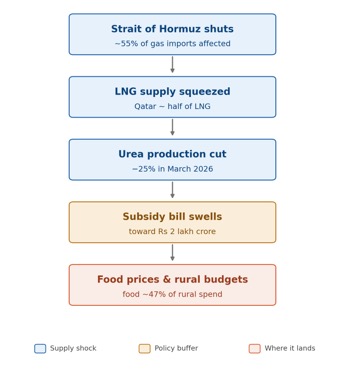
Figure 1. The five-link chain — how a blocked strait reaches the rural kitchen.
1. The chokepoint: one strait, half the gas
Begin with the gas, because nothing further down the chain happens without it.
India burns far more natural gas than it pulls out of its own ground. Home production covers about half of demand; the balance arrives as LNG, chilled to liquid and shipped in specialised tankers. In 2024-25 that came to roughly 27 million tonnes, worth getting on for fifteen billion dollars.[6] Qatar is the supplier that matters — depending on whose series you trust, between 40 and 47 per cent of India’s LNG, and close to half by value.[3][6] Almost all of it, plus the cargoes from the Emirates and Oman, has to thread through Hormuz before it reaches terminals like Dahej on the Gujarat coast.[4]
This is not a casual, shop-around relationship. It is written into decades-long contracts. Petronet’s deal with QatarEnergy — 7.5 million tonnes a year, first inked in 1999 and quietly renewed in early 2025 for another twenty — is the spine of it, with GAIL holding more.[5] You cannot replace cargoes like these with a phone call to Australia or Texas. The alternatives sit farther away, cost more by the time they dock, and in some cases add a week or more of sailing. The terminals were built for Gulf gas, the contracts assume Gulf gas, the ships sail the Gulf route. That, in a phrase the analysts keep repeating, is why the supply is hard to replace.
So the two blows in early March landed together: Ras Laffan knocked out part of India’s biggest source at the same moment Hormuz strangled the road that source travels. Within days, Indian gas companies were trimming what they sent to industrial buyers, and the government had started deciding, sector by sector, who would get the gas that was left.[6]
And this is the point where the story stops being about oil and starts being about dinner. Because one of the hungriest, and most politically delicate, consumers of natural gas in the country is not a power plant or a chemicals complex. It is the business of making urea.
2. Why urea is essentially solidified natural gas
Fertiliser and fuel feel like different worlds. They are very nearly the same substance.
Urea — the white pellets Indian farmers spread by the tens of millions of tonnes every season — is built out of ammonia. Ammonia is nitrogen and hydrogen, bonded under heat and pressure. The nitrogen is free; it makes up most of the air. The hydrogen is the costly half, and almost all of it is stripped out of natural gas, whose methane is dense with the stuff. Worldwide, gas supplies close to seventy per cent of the feedstock that goes into ammonia. The leftover carbon gets folded back in to make the urea itself. Strip away the chemistry and a urea plant is a device for turning natural gas into a form of nitrogen you can bag, stack and scatter on a field.
Which explains why India’s urea industry is shaped almost exactly like its gas problem. Of the country’s 32-odd urea units, 30 run on natural gas; only two still limp along on naphtha.[8] And gas is not some line item you can shave. A parliamentary standing committee has pegged it at close to ninety per cent of the cost of making urea.[9] Sit with that number for a second, because it is the hinge the whole story swings on. It means urea prices and urea supply do not merely track the gas market — they are the gas market, wearing a different coat. Starve a plant of gas and it makes nothing. Make it pay double and it cannot make anything cheaply.
The damage came quickly. When fertiliser was added to the gas-priority list on 10 March, the plants were promised a floor of seventy per cent of their recent average draw — a deliberate decision to feed the food system before, say, factories, but a floor that still leaves three-tenths of the requirement missing.[9] Short of feedstock, producers reacted the way you would expect. Several, the giant cooperative IFFCO among them, simply shut units down or pulled forward their annual maintenance to coincide with the squeeze.[10] The reasoning was bleak but sound: if you cannot run flat out, you may as well take the plant apart for servicing now rather than waste scarce, pricey gas running it badly. The catch is the restart. Bringing a paused urea plant back is not a flick of a switch; industry people put it at up to a month once the gas returns.[10] The shortage, in other words, comes with a tail.
Add it up and Crisil reckons the gas crunch lopped about a quarter off domestic urea output in March alone.[11] A 25 per cent hole in something India already has to import is not a statistical footnote. It shoves the country out into the world market for the difference — and the world market picked a terrible week to be expensive.
3. The world’s largest urea buyer, the worst possible market
No country imports more urea than India. The decade-long drive to build at home has helped — capacity has climbed from about 20.8 million tonnes a year in 2014-15 to roughly 28 million now, with fresh plants at Gorakhpur, Ramagundam, Talcher and Barauni.[9] Even so, India still buys somewhere between a fifth and thirty per cent of the urea it uses, against annual consumption near 35 million tonnes.[10][11] And the Gulf is not just a gas supplier; it is a fertiliser supplier too. The government’s own figures have the region sending something like 20 to 30 per cent of India’s urea and around 30 per cent of its DAP.[11]
So the crisis hits the fertiliser system from three sides at once. It cuts the gas the home plants run on. It clogs the sea lanes the finished product travels, pushing up freight and backing up containers at ports like Mundra and Nhava Sheva. And it tightens the global market India has to lean on to cover the shortfall, where the other big Asian buyers are elbowing for the same tonnes. Count the imported inputs — the LNG, the chemicals — and ICRIER puts India’s real dependence on this trade at 68 to 70 per cent.[11]
The prices went where you would fear. By April, Indian buyers were reporting imported urea at 935 to 959 dollars a tonne, give or take a doubling.[11] Urea was not alone: sulphur, which feeds the complex fertilisers, leapt about half to 630 dollars, and DAP took its own beating.[11] For a country that brings in tens of millions of tonnes of crop nutrients, a doubling of the import price is not an inconvenience. It is a multi-billion-dollar bill.
None of which, yet, has touched the farmer at the counter. The urea bag costs what it cost last year. That is not luck. It is policy — and the policy is where the inflation actually goes to hide.
4. The subsidy that turns a price shock into a deficit
India simply refuses to let the world price of urea reach the farm. A 45-kilogram bag has carried the same maximum price — 242 rupees, before a little for neem-coating and tax — since March 2018.[8][12] What it actually costs to make or import that bag, the government has admitted, is closer to 2,200 rupees.[12] The state eats the gap and hands it to the manufacturers and importers as subsidy.
For the household standing at the dealer’s, the shield is real. Gas can triple in the Gulf and the farmer in Vidarbha or Bihar still pays 242 a bag. But the shock does not evaporate. It just moves house — out of the field and into the Union budget. Every extra dollar on gas, ammonia, urea or freight gets converted, almost automatically, into a fatter subsidy line. The price shock becomes a fiscal one.
The arithmetic was tight before the first missile flew. PRS Legislative Research, reading the budget papers, had the total fertiliser subsidy for 2025-26 set at about 1.68 lakh crore rupees and then revised up by some eleven per cent to around 1.86 lakh crore.[11] The 2026-27 budget pencilled in roughly 1.71 lakh crore — 1.17 lakh crore or so for urea by itself, about 54,000 crore for the nutrient-based subsidies on phosphate and potash.[12] That single head already swallows more than three per cent of everything the central government spends.[13]
Those numbers were written for a world without a Hormuz blockade. Crisil’s Pushan Sharma expects the West Asia shock to push the 2026-27 fertiliser bill up by a fifth to a quarter, and the prospect of the total clearing 2 lakh crore rupees again is now openly discussed.[11][12] We have watched this film recently: during the energy and fertiliser spike of 2022-23, the subsidy swelled from about 80,000 crore in 2020-21 to roughly 2.25 lakh crore.[13] The escalator is built and tested. The only live question is how high it climbs this time.
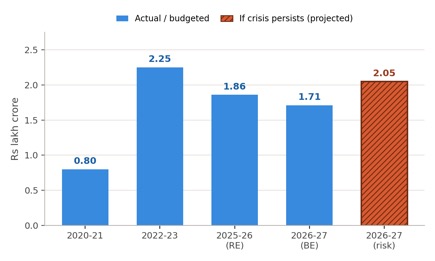
Figure 2. India’s fertiliser subsidy bill (Rs lakh crore). The 2026-27 “risk” bar is a projection implied by Crisil’s 20–25% estimate, not an official figure.
This is the first place the strain actually surfaces nationally — not as costlier rice, not yet, but as a hole in the accounts. A bill that runs 30,000 or 50,000 crore over plan has to be paid out of something: spending cut elsewhere, extra borrowing, or a wider deficit. None of those is free. A wider deficit can stir inflation expectations and lean on the rupee, which the oil spike has already weakened, which in turn lifts the rupee cost of every imported barrel and every imported tonne of fertiliser. The loop feeds itself.
The shield, then, costs a fortune. It is also full of holes. And the holes are where the shock starts leaking onto the plate.
5. Where the shield leaks: the field, the fuel, the season
The frozen urea price protects the farmer’s wallet on two conditions: that the urea turns up when it is needed, and that everything else on the farm does not get dearer. The crisis leans on both.
Timing. Indian farming keeps a tight calendar. Kharif — the big monsoon crop of rice, pulses, oilseeds, cotton and coarse grains — wants sowing through June and July, and urea dressed on top in the weeks after. A bag in March is worth less than a bag in mid-July, when the crop is calling for nitrogen and there is no swapping the date. That is the trap in this year’s timing. The plant shutdowns and output cuts hit in March, exactly when the warehouses should have been filling for the season. India did go in with a decent cushion — total fertiliser stocks around 18 million tonnes, of which roughly 6 million was urea, both above the year before, and credit to whoever planned ahead for that.[9] But a cushion is not a refill. Let the gas crunch drag on, keep home output a quarter light while imports crawl in late and expensive through jammed ports, and the buffer drains faster than it tops up. The likeliest failure is not a dramatic, nationwide dry spell of urea. It is scrappier than that: a stockout in this district, a queue at that depot, a farmer here or there who cannot get enough at the one week his crop is asking. Short or late nitrogen shows up a few months on as a thinner harvest. A thinner harvest is, by definition, a push on food prices.
The other half of the bag. Here is the part the urea headlines miss: urea is the sturdy bit. India imports most of its DAP and effectively all of its potash, and neither of those is pinned at the till the way urea is.[12] They run on the nutrient-based subsidy and have needed repeated emergency top-ups — a special 3,500-rupee-a-tonne crutch for DAP, for one — just to keep the shelf price from jumping.[11] When DAP, sulphur and potash spike abroad, the farmer feels it sooner and the government can do less about it. The cheap, ubiquitous urea bag gets all the attention; the rawer exposure sits in the sacks beside it.
Diesel. And then there is the word in the middle of this article’s title. Diesel is where the chain loops straight back to the oil it began with. Indian agriculture drinks the stuff — tube-well pumps, the tractor on the plough and the seed drill, the thresher at harvest, the truck to the mandi. Diesel and pumped power are about the heaviest cash costs a cultivator carries. A crude spike out of Hormuz lands on the pump price at once, and diesel has no 242-rupee shield to hide behind; the weak rupee just turns the screw, since the fuel is priced off dollar crude.[15] Costlier diesel raises the price of every pass across the field and every kilometre to market — which feeds the retail price of food even if the harvest itself never wobbles.
So the shield holds at precisely one spot, the headline price of a urea bag, and the shock walks around it: through the diesel, through the un-frozen nutrients, through the simple question of whether the urea is in the right godown in the right week.
6. Where it lands: food prices and the central bank’s blind spot
For now the numbers look calm enough. Headline CPI in April ran at about 3.48 per cent, a thirteen-month high but still under the Reserve Bank’s four-per-cent target.[14][15] Food inflation came in at 4.20 per cent, up from 3.87 in March, and what nudged it up was the usual cast — tomatoes, cauliflower, coconut — not anything you could trace to a fertiliser plant.[14][16] Rural inflation, at 3.74 per cent, sat above urban’s 3.16, which always bears watching, because the countryside spends more of its money on food.[14]
Read it straight: the fertiliser-to-food channel is loaded and has not gone off. That is the mechanism behaving exactly as it should. Getting from a March gas shortage to a December price tag takes time. The gas is squeezed in March; plants cut in March and April; the kharif crop’s fate is settled between June and September; and only in the last months of 2026, into 2027, does any of that reach the price of rice or tuvar dal in the index. This kind of inflation does not arrive with a bang. It seeps.
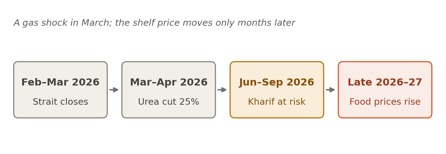
Figure 3. The transmission lag — a March gas shock reaches food prices only late in the year.
When it seeps, it runs into something awkward about the way Indian inflation is built. Food still carries enormous weight in the basket — even after the 2024-base revision trimmed it, food is about 47 per cent of what rural India spends and nearly 40 per cent for the towns.[17] Lean that hard on one category and a sustained climb in food prices can hold the headline up even when demand everywhere else is limp. And the central bank’s main lever is close to useless against it. Rate hikes work by cooling demand. They do nothing for a supply shock that started in a gas shortage and ended in a smaller crop. You cannot raise the repo rate and grow more tomatoes.[17] Past food spikes have forced the RBI to sit tighter than the demand picture alone deserved, taxing every borrower in the country for a problem in the fields. With the four-per-cent target and its two-to-six band locked in through 2031, a food-driven overshoot would corner the bank whatever the rest of the economy was doing.[15]
That is the moment a fertiliser shock stops being agriculture’s problem and becomes everyone’s — saver, borrower, governor. But it reaches the rural poor first, and it reaches them hardest.
7. The rural household, squeezed from both sides
The last link comes to rest on a budget with no slack, and it presses from two directions at once.
Look at the money. Average monthly spending per head in rural India was about 4,122 rupees in 2023-24, against nearly 7,000 in the cities.[18] Pull out the households that live mainly off farming and it is lower still, around 3,783 a head.[19] Of that thin budget, roughly 47 per cent goes on food, and for the poorest the share runs higher.[17][18] Which is the whole cruelty of food inflation in a village: when the staples climb, a family with almost nothing discretionary has nowhere to fall back to. There is no holiday to cancel, no second car to sell. The extra rupees come straight out of the dal, the doctor, or the little that was being saved.
That is the household as a buyer. But out here the household is usually the seller too, and on that side the same crisis shows up as costlier inputs and a shakier crop. Dearer diesel for the pump and the tractor. Dearer DAP for the soil. The risk that thin or late urea quietly trims the yield. If the harvest comes in short, the family earns less from it — in the same season the food it has to buy for its own kitchen costs more. A salaried family in the city, hit by the identical food inflation, at least keeps its pay packet whole. A farming family can watch its income fall and its grocery bill rise at the same time, off the same shock.
That is the real reason a blockade in the Gulf belongs in a conversation about Indian inflation and not just Indian energy. The line that runs from a shut strait through a starved urea plant to a lighter harvest does not share its pain out fairly. It pools it at the bottom of the ladder, in the months a poor household can least afford a knock.
8. What could blunt it — and what to watch
None of this is fated. The same dials that could set the wave going can also damp it.
The biggest is simply how long the strait stays shut. The argument above assumes the disruption rides through kharif and beyond. Open Hormuz again, get Qatari gas flowing, and the squeeze eases, the idle plants come back, the global price comes off the boil — though even then relief is not instant, what with the month-long restart and Ras Laffan’s reported multi-year repair job.[3][10] India also has room to manoeuvre: it went in with stocks above normal, it has been hunting alternative LNG in Australia, Africa, Russia and the United States, and it has tilted further toward Russian crude to take the sting off the oil side.[5][6] None of that fully stands in for Gulf supply, but all of it buys time. The subsidy is buying time of a different sort, holding the urea price still at the counter however ugly the bill behind it gets. And presiding over the lot is the monsoon: a generous, well-spread one can lift yields enough to wash out much of the fertiliser drag. Indian food inflation has always been a weather story before it is anything else. The fertiliser channel rides on top of that; it does not replace it.
For anyone who wants to see the wave forming before the headline does, a few gauges will move first:
- The monthly food-inflation print from about August on, the earliest window for any kharif-yield effect to show.
- Urea and DAP import-tender prices, which lead both domestic supply and the subsidy bill.
- How much gas the fertiliser plants actually get against that 70 per cent promise.
- The southwest monsoon against its long-period average, and crucially how evenly it falls.
- Port congestion and freight at Mundra and Nhava Sheva, a read on how smoothly imports are landing.
- The next revised subsidy estimate, the plainest measure of how much shock the exchequer has quietly swallowed.
So the verdict has to be conditional, not apocalyptic. As things stand in mid-2026 the wave has not broken: food inflation is near target, the buffers are intact, the harvests so far adequate. What has happened is that the mechanism is now live. The gas is cut. Urea output is down a quarter. Import prices have doubled. The subsidy is creeping toward 2 lakh crore. Whether that tips into a genuine inflation wave turns on how long the strait stays shut, how deep the buffers run, how much red ink the government will wear, and whether the rains show up on time. The durable point sits underneath all of it: in an economy where fertiliser is basically natural gas in solid form, and that gas comes in through one contested channel, the distance from a Gulf crisis to the price of rice in a village kitchen is a good deal shorter than it looks.
9. References
- “2026 Strait of Hormuz crisis,” Wikipedia — timeline of the conflict, Iranian shipping ban, mining and the US blockade. en.wikipedia.org/wiki/2026_Strait_of_Hormuz_crisis
- “Strait of Hormuz Crisis 2026: Full Timeline & Ocean Freight Impact,” SeaVantage — collapse in daily crossings, transit “tolls,” port congestion. seavantage.com/blog/strait-of-hormuz-crisis-2026-shipping-disruption-timeline
- “Missile attacks cut Qatar LNG output by 17%; India faces risk with 47% import dependence,” The Statesman, Mar 2026 — Ras Laffan damage, force majeure, Qatar’s ~47% share of India’s LNG. thestatesman.com
- “Why India will look at Australia, Russia over US for LNG,” Business Today, Mar 2026 — ~60% of India’s LNG transiting Hormuz; delivery times and alternative sources. businesstoday.in
- “Russian crude flows set to rise despite low discounts,” Business Standard, Jun 2025 — ICRA estimate that 54–60% of inbound gas and 45–50% of crude cross Hormuz; Petronet’s 7.5 MMTPA Qatar contract; Qatar and UAE supplying ~56% of $14.8bn LNG. business-standard.com
- “How West Asia conflict threatens LNG supply chain powering India’s economy,” Business Standard, Mar 2026 — FY25 LNG imports of ~27 MT, Qatar’s 40–45% share, cuts to industrial gas supply. business-standard.com
- “India May Prioritise Gas for Critical Sectors After Qatar LNG Disruption,” Outlook Business, Mar 2026 — Qatar’s ~50% share; India importing ~55% of its gas needs. outlookbusiness.com
- “Urea Policy and Administration,” Department of Fertilizers, Government of India — 32 urea units (30 gas-based, 2 naphtha); statutory MRP of ₹242 per 45-kg bag. fert.nic.in/urea_policy_administration
- “West Asia conflict raises concerns over urea supply in India,” Mongabay-India, Mar 2026 — gas at ~90% of urea cost (standing committee); Oxford Institute for Energy Studies analysis; 10 March priority-listing at 70%; ~18 MT fertiliser / ~6 MT urea reserves; capacity growth from 20.8 to 28 MT. india.mongabay.com
- “Indian Urea Producers Shut Plants as Iran War Cuts LNG Flows,” Bloomberg / Energy Connects, Mar 2026 — IFFCO and other shutdowns, ~70% of gas requirement, up-to-a-month restart, India as top urea importer. energyconnects.com
- “Supply shock at sea, subsidy strain at home,” Business Today, Apr 2026 — ICRIER’s 68–70% supply-chain dependence; Gulf supplying 20–30% urea, 30% DAP, 50% LNG; subsidy ₹1.68 → ₹1.86 lakh crore (RE) and ₹1.71 lakh crore (FY26); Crisil’s Pushan Sharma on a 20–25% subsidy surge and a 25% March production cut; imported urea at $935–959/MT and sulphur up ~50% to $630/MT. businesstoday.in
- “Why fertiliser subsidy reform is vital for Indian agriculture,” Policy Circle, 2026 — FY27 allocation of ₹1.71 lakh crore (₹1.17 lakh crore urea, ₹54,000 crore NBS); MRP unchanged since March 2018; real cost ~₹2,200/bag; risk of crossing ₹2 lakh crore; potash and rock-phosphate import dependence. policycircle.org
- “Fertiliser Subsidy in India” (PRS-based summary), PMF IAS / PRS Legislative Research — subsidy at ~3.3% of Union expenditure; rise from ~₹80,000 crore (2020-21) to ~₹2.25 lakh crore (2022-23). prsindia.org; pmfias.com
- “CPI Press Release, April 2026,” Ministry of Statistics & Programme Implementation — headline CPI 3.48%, CFPI 4.20%, rural 3.74% vs urban 3.16%. mospi.gov.in
- “Retail inflation rises to 13-month high of 3.8% in April as food prices climb,” Business Today, May 2026 — 13-month high; RBI’s 4% target and 2–6% band retained for 2026–2031. businesstoday.in
- “India Inflation, April 2026,” India Infoline / ChartForest — food-item movers (tomato, cauliflower, coconut); rural-above-urban pattern. indiainfoline.com
- “India’s New CPI Series: Food Weight Cut, Housing Gains,” Vajiram & Ravi, Jan 2026 — 2024-base food weights of 47.04% (rural) and 39.68% (urban); the RBI’s limited reach over supply-side food prices. vajiramandravi.com
- “Household Consumption Expenditure Survey 2023-24,” MoSPI / PIB — rural MPCE ₹4,122, urban ₹6,996; rural food share ~47%. mospi.gov.in; pib.gov.in
- “Survey: monthly expenditure of farm households below rural average,” The Tribune — agricultural-household MPCE of ~₹3,783. tribuneindia.com
- “Strait of Hormuz de-escalation is urgent, says UN chief,” UN News, May 2026 — Secretary-General’s appeal as oil prices climbed. news.un.org
A note on the figures: the ranges — Qatar’s 40–47% of LNG imports, the 54–60% of gas crossing Hormuz, the fifth-to-thirty-per-cent urea import share — reflect genuinely different official and agency series (PPAC, the commerce ministry, ICRA, ICRIER, Crisil), not loose estimating. Hard data are current to early June 2026; every forward-looking line about food prices and the subsidy bill is conditional on how the crisis runs from here.
——————————————————————————————————————————————
Amulya Charan writes on energy systems, infrastructure economics, and development policy at amulyacharan.com