What the Hormuz Crisis Means for Logistics Policy in India
Amulya Charan | amulyacharan.com | 17 October 2026
The container has reached the port. The paperwork is in order. The customer is waiting. Then the forwarder calls: the route has changed, the cargo may have to wait, and there will be another bill.
For businesses trading with the Gulf, this is where a distant conflict becomes a very local problem. A delayed shipment ties up cash. A refrigerated consignment needs power while it waits. Someone has to explain the revised delivery date to the buyer.
India has spent years improving the journey from the factory gate to the port. Hormuz has exposed how much of the next leg depends on ships, crews, insurance and access to a sea lane. The National Logistics Policy already recognised resilience as an objective. The question now is what India must put behind that promise. [1]
The domestic gains still matter
Launched in September 2022, the National Logistics Policy set goals for costs comparable with global benchmarks by 2030, a top-25 position in the Logistics Performance Index and better use of data. It draws on the Empowered Group of Secretaries established under PM Gati Shakti to coordinate implementation. [1]
The cost debate gained firmer ground in 2025. A DPIIT-sponsored NCAER assessment estimated India’s logistics costs at ₹24.01 lakh crore, or 7.97% of GDP, for 2023–24. That gives policymakers a useful baseline. It does not establish a fall from the widely repeated 13–14% estimate: a reliable comparison needs consistent methods and coverage. [2]
NCAER’s modal averages help explain the interest in rail and coastal transport. Rail bulk cargo averaged ₹1.96 per tonne-kilometre, coastal transport ₹1.80 and road ₹3.78. Whether a particular business can capture those savings depends on its cargo, route, terminal costs and the connections at either end. [2]
India’s 38th place in the 2023 LPI remains a historical marker. The World Bank has since introduced Logistics Performance Indicators 2.0, based on shipment-level operational data, so future assessments must account for the change. [3, 4]
None of this work becomes less valuable because a war disrupts shipping. But a cheaper domestic journey offers limited comfort if the next vessel cannot complete its voyage.
A passage through Hormuz is only part of the journey
Before the conflict, Hormuz carried more than a quarter of global seaborne oil trade, according to the US Energy Information Administration’s assessment of 2024 and early-2025 flows. That concentration explains why disruption in a narrow waterway can travel so widely through the economy. [5]
Since the conflict escalated in late February 2026, conditions have changed repeatedly. Tanker traffic, container services and the willingness of owners and insurers to support a voyage have not moved together. Calling the strait simply open or closed tells a shipper too little.
The EIA’s 6 October outlook reported a slight increase in oil shipments through Hormuz in September, helped by transfers between tankers. Yet attacks continued. On 16 October, India’s shipping minister reported that MT ST 3, carrying 15 Indian seafarers, had been struck by a projectile. All 15 were reported safe. [6, 7]
A shipment can be permitted to pass and still be difficult to arrange. Maersk’s advisory of 17 September put a price on some of that difficulty: emergency freight charges of US$1,800 for a 20-foot dry container, US$3,000 for a 40-foot dry container and US$3,800 for reefer, special and dangerous-goods containers on specified Gulf cargo. A further US$1,000 applied where the vessel transited Hormuz. A reefer could therefore face US$4,800 under those two charges where both applied. These were dated terms from one carrier, with conditions attached. [8]
The same notice described routing some cargo through Salalah or Khor Fakkan, then by landbridge to Sharjah and onward through feeder services. Every extra leg makes the itinerary worth examining closely. Storage, refrigeration and onward transport can eat into the margin; a longer journey keeps cash out of the business for longer. [8]
Even the workarounds need workarounds. October reporting described transfers between tankers spreading towards the Gulf of Kutch as established transfer areas became congested. Some cargo had already crossed Hormuz before being moved onto another vessel farther east. India can develop this role, but it needs the permissions, navigation safeguards and pollution-response capacity to do so responsibly. [20]
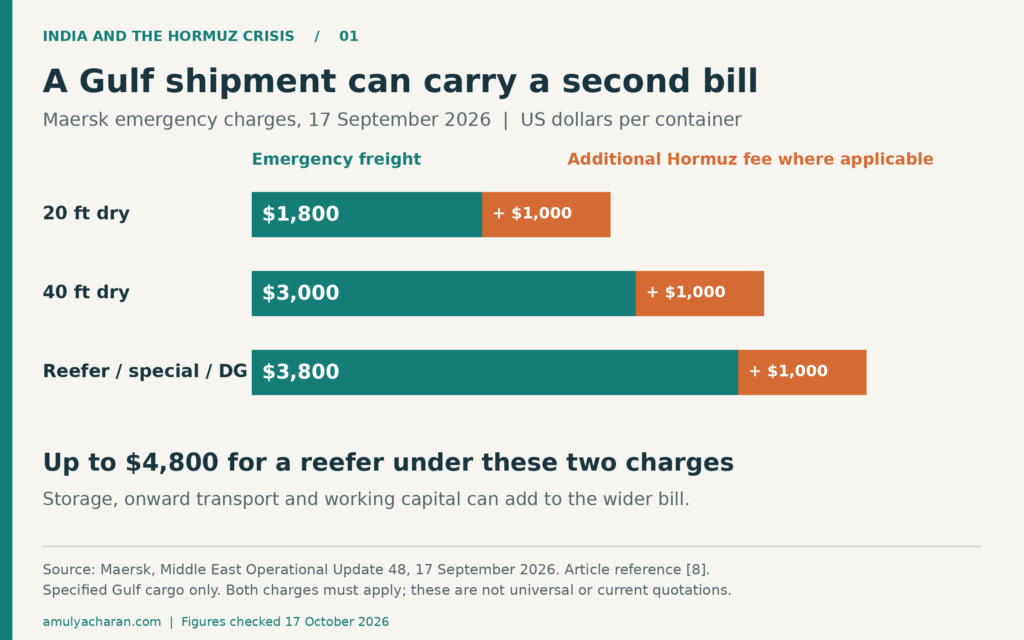
Figure 1 Emergency Gulf freight charges under Maersk’s dated advisory. Both charges must apply for the combined amount. Source [8].
The weak point changes with the product
Crude oil and LPG show why India needs to examine exposure product by product. In March, the government said crude was being sourced from more than 40 countries and about 70% was arriving through routes outside Hormuz, compared with roughly 55% before the conflict. Those figures describe the position reported then, rather than a verified October sourcing mix. [9]
LPG began with a much tighter dependence on the strait. Before the conflict, India imported about 60% of its LPG consumption, and roughly 90% of those imports passed through Hormuz, according to the government. Taken together, those approximate shares imply that around 54% of total consumption depended on imports through that route. It is a calculation from the pre-conflict shares, not the present supply mix. [9]
Finding another supplier can keep fuel coming without protecting the buyer from higher prices. CREA estimated about US$22 billion in gross additional Indian fossil-fuel import costs for March–August 2026 against pre-war futures-price expectations. The calculation includes modelled August arrivals and partial August prices and excludes freight and war-risk premiums. It measures part of the burden, rather than a final audited bill. [10]
Fertiliser brings the problem closer to the sowing season. On 8 June, the government reported stocks of 197.56 lakh tonnes against an assessed kharif requirement of 383.9 lakh tonnes, more than 51% of seasonal needs. Production and import arrivals were continuing. Advance stocks had bought time. [11]
For a farmer, though, the national total is only the beginning. The right fertiliser has to reach the local market before the sowing window closes. A serious review would follow product-wise stocks, state allocations and delivery times, along with the inputs needed to keep factories producing. That is the level at which a supply chain succeeds or fails.
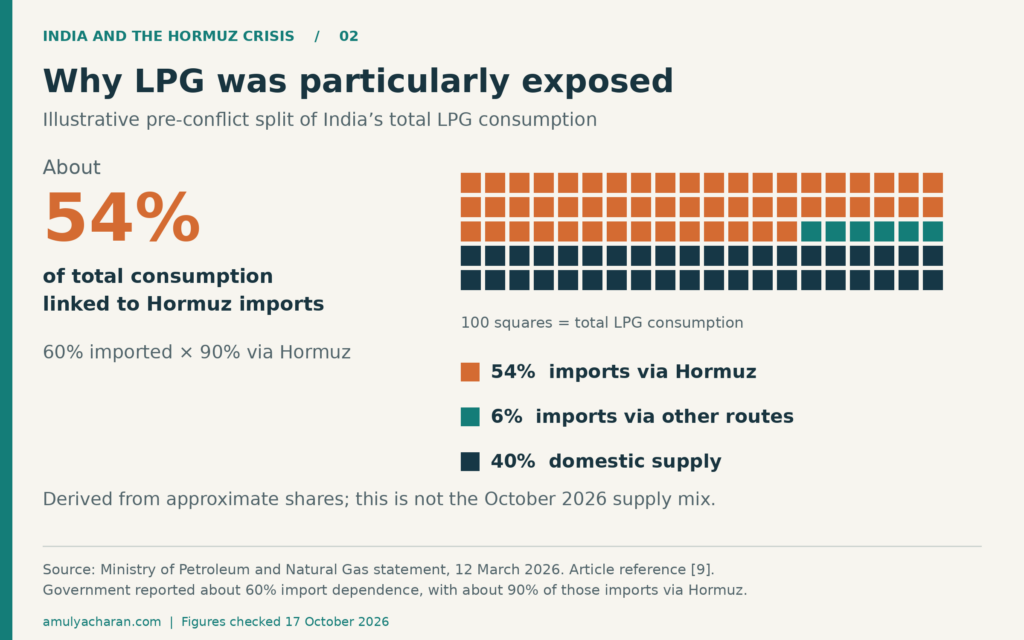
Figure 2 An illustrative calculation from approximate pre-conflict LPG shares, not the October supply mix. Source [9].
Follow the support through to the exporter
The first response was necessarily practical. An Inter-Ministerial Group on Supply Chain Resilience was operationalised on 2 March and began daily reviews the next day. The government reported procedural relaxations for stranded cargo, port coordination and waivers of storage and dwell-time charges for affected consignments. [12]
RELIEF followed on 19 March, with an approved outlay of ₹497 crore and ECGC as implementing agency. It supports eligible insured shipments and prospective exports, while offering partial reimbursement of specified extraordinary costs to eligible MSMEs without ECGC cover. What an exporter can claim depends on the component, shipment window and conditions. [12]
Egypt and Jordan were added in April. Component II was subsequently extended through Notification 37/2026–27 of 30 September. The government’s 2 October announcement confirms continued insurance support for specified container cargo, excluding energy shipments. The operative notification and ECGC terms remain the starting point for an application. [13, 14]
There is now a public record of what has reached claimants. ECGC’s dashboard, dated 13 October, recorded 1,997 claims lodged, 1,234 settled and 824 paid. Payments totalled ₹23.8 crore against the ₹497 crore approved outlay, with most disbursements by value under Component III. [15]
It would be premature to judge the scheme from expenditure alone. Insurance commitments, claims and cash payments run on different schedules. But the figures invite useful questions. How long does a claim take? Why is it rejected? Can a small exporter get help before a cash-flow problem becomes a lost order? Publishing those answers would tell us more than another announcement of the allocation.
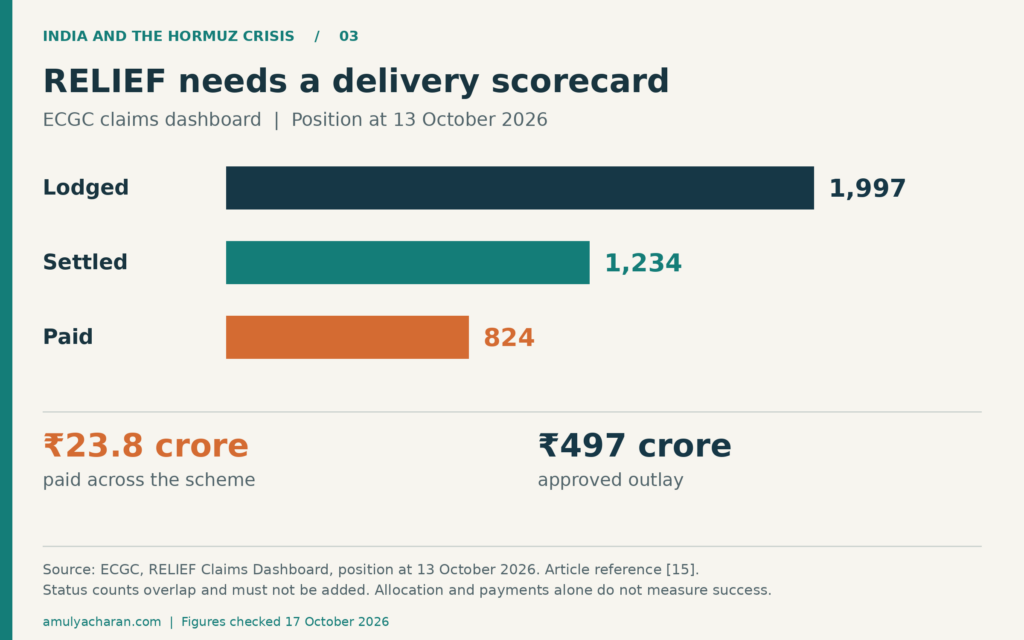
Figure 3 Claims status and payments at 13 October 2026. Status counts overlap; allocation is not a measure of claims performance. Source [15].
Build capacity that businesses can rely on
The crisis has also pushed India towards measures whose value will be tested over years. Marine insurance and access to ships deserve that longer view.
Insurance needs to work when a claim arrives
The Bharat Maritime Insurance Pool, approved in April and launched on 12 May, has announced capacity of US$1.5 billion, including a ₹12,980 crore sovereign guarantee. GIC Re administers the pool. Its scope includes hull and machinery, cargo, protection and indemnity, and war risks for eligible vessels linked to Indian trade. [16]
The guarantee is a conditional backstop. The launch announcement describes its use for claims beyond US$100 million as a last resort, after exhaustion of accumulated reserves, member contributions and reinsurance arrangements, with the prescribed governance process. Individual cover still rests on the issued policy. [16]
With a stated duration of ten years, extendable to fifteen, the pool has time to build specialist expertise. Businesses will judge it by the cover they can obtain, its acceptance for their voyages and what happens when they claim. Operators still have to meet safety, contractual and port requirements. [17]
Count ships when they enter service
On 29 April, the Shipping Ministry announced a roadmap to add 62 vessels in FY2026–27, involving ₹51,383 crore and another 2.85 million gross tonnes. It identified needs across container shipping, LPG and crude carriers, tankers, dredging vessels and green tugs. The review also discussed an SCI–oil PSU venture to acquire 59 vessels. [18]
Before adding those counts together, the government should clarify whether they overlap. More useful still would be a delivery record: contracts signed, vessel types, expected arrival dates and ships actually deployed.
Greater access to vessels under Indian ownership or control could give buyers more room to arrange shipments. The benefit depends on having the right ships, financing and trained crews available when they are needed. Fleet expansion should be measured against the supply risks it is meant to reduce.
Make the data useful before trouble reaches the factory
India already has more visibility than the old port-gate picture suggests. LDB 2.0, launched in September 2025, introduced high-seas tracking of export containers and multimodal visibility, including integration through ULIP APIs. The next step is to connect that information with decisions. [19]
A location on a screen matters when someone can act on it. A procurement manager needs to know whether a delay will exhaust stocks. A transport team needs time to book an alternative. Government needs to see where several essential supply chains depend on the same vulnerable corridor.
Linking shipment and port data with security warnings, freight movements, insurance availability and critical-stock information would help. It also needs clear responsibility: who updates the information, who receives an alert and who can authorise a response? Commercially sensitive data will need protection. The test is whether the warning arrives early enough to change the outcome.
Before the next booking
For shippers, some of the most useful changes begin with ordinary questions. Get the full itinerary in writing, including the storage allowance, onward connections and likely extra charges. Establish who arranges each leg and where custody changes. For temperature-sensitive cargo, check that the longer journey is compatible with storage conditions and remaining shelf life.
Read the sale contract, transport contract and insurance together. Under FOB, risk generally passes when goods are on board at the named shipment port. For containers handed to a carrier at a terminal before loading, ICC guidance points to FCA as the more appropriate rule. Choose the terms that fit the transaction. [21]
Force-majeure, delay and surcharge clauses also deserve a fresh reading. Their effect depends on the wording, notice requirements, governing law and circumstances. The existence of a war does not automatically decide who pays.
Extra stock may be sensible for a critical input, but calculate the cost of holding it against the loss from interruption. Finance, storage, shelf life and safety restrictions all matter. And test the alternative supplier: a name on a contingency list offers little reassurance if it has never filled an order.
Crew protection belongs in the schedule as well. DGMA Circular 47 of 2026, dated 5 August, requires individual Indian seafarer consent for Hormuz voyages, notification to the DG Communication Centre and prescribed security precautions. Operators must check subsequent advisories before sailing. [22]
Give resilience a test that can be repeated
India still needs competitive logistics costs and dependable domestic transport. The events of 2026 make a case for adding a more demanding test of preparedness.
For essential products, a public resilience scorecard could track days of cover, dependence on individual corridors, the time needed to activate another source and access to suitable ships and insurance. It would make vulnerabilities visible while there is still time to address them.
The government should apply the same discipline to its response: publish claims performance, track fleet deliveries and assign responsibility for acting on warnings. Contingency plans need exercises that reveal where the arrangements break down.
That is the unfinished work Hormuz has brought into view. The next logistics-policy review should leave businesses with a clearer answer to the question behind every disrupted booking: what can we do now, and who can make it happen?
References
Numbered references correspond to the citations in the article. Sources checked on 17 October 2026. Government statements are attributed as such; recommendations and assessments are the author’s. Rolling dashboards and carrier advisories may change after this date.
[1] Cabinet, Government of India. National Logistics Policy approval and objectives. 21 September 2022.
Policy vision, 2030 targets and implementation framework.
[2] NCAER. Logistics Dashboard and Assessment of Logistics Cost in India. 2025; reference year 2023–24.
National cost estimate and modal averages; estimates are not identical door-to-door quotations.
[3] World Bank. India Country Economic Memorandum. 2025.
Historical LPI position of 38 in 2023.
[4] World Bank. Logistics Performance Indicators 2.0. 2025 edition.
Redesign from survey-based rankings to shipment-level operational indicators.
[5] US Energy Information Administration. Amid regional conflict the Strait of Hormuz remains critical oil chokepoint. 2025.
Pre-conflict shares of seaborne oil trade and global consumption.
[6] US Energy Information Administration. Short Term Energy Outlook Global oil markets. 6 October 2026.
September flows, workarounds and disruption assessment. This is a rolling publication page.
[7] The National. Oil tanker struck in Strait of Hormuz says Indian ports minister. 16 October 2026.
Minister’s account of MT ST 3 and the safety of its 15 Indian crew.
[8] Maersk. Middle East Operational Update 48. 17 September 2026.
Carrier-specific charges, storage provisions and alternative routing; terms may change.
[9] Ministry of Petroleum and Natural Gas, PIB. Government statement on energy supplies and diversification. 12 March 2026.
Crude sourcing and pre-conflict LPG dependence. These are dated government figures.
[10] Luke Wickenden and Lauri Myllyvirta, CREA. What the Hormuz crisis has cost fossil fuel importers March to August 2026. 26 August 2026.
Model-based additional import-cost estimates and methodology, including partial and modelled August data.
[11] Ministry of Petroleum and Natural Gas, PIB. Inter Ministerial Briefing on Recent Developments in West Asia. 8 June 2026.
Fertiliser stocks, kharif requirement, production and arrivals.
[12] Ministry of Commerce and Industry, PIB. Government approves RELIEF under the Export Promotion Mission. 19 March 2026.
Coordination arrangements, ₹497 crore outlay and original scheme components.
[13] Ministry of Commerce and Industry, PIB. Government Expands Coverage of RELIEF Scheme. 17 April 2026.
Addition of Egypt and Jordan and clarification concerning fresh whole-turnover policies.
[14] Ministry of Commerce and Industry, PIB. Government Extends Operational Timelines of RELIEF. 2 October 2026.
Confirms extension through DGFT Notification 37/2026–27 of 30 September; describes Component II cover, cargo scope and premium protection.
[15] ECGC. RELIEF Claims Dashboard. Position at 13 October 2026.
Claims lodged, settled and paid; disbursements and sanctioned allocation. Figures are a dated snapshot.
[16] Department of Financial Services, Ministry of Finance, PIB. Launch of Bharat Maritime Insurance Pool. 12 May 2026.
Capacity, guarantee, eligible risks, administration and conditions for invoking the backstop.
[17] Press Information Bureau. Bharat Maritime Insurance Pool Strengthening India’s Maritime Sovereignty. 27 September 2026.
Duration, policy issuance and governance. Use policy wording for the terms of individual cover.
[18] Ministry of Ports Shipping and Waterways, PIB. India Sets Course for Atmanirbhar Shipping. 29 April 2026.
Announced 62-vessel roadmap, investment and gross tonnage; discussion of the 59-vessel venture.
[19] Ministry of Commerce and Industry, PIB. Launch of Logistics Data Bank 2.0. 20 September 2025.
High-seas export-container tracking, multimodal visibility and ULIP integration.
[20] Jennifer Gnana, The National. Oil transfers off India’s west coast surge as Gulf shipping congestion worsens. 15 October 2026.
Transfer arrangements and congestion. Exact cargo counts are omitted because the report gives inconsistent totals and cites differing counting methods.
[21] International Chamber of Commerce. Incoterms 2020 Rules for sea and inland waterway transport. 2020 edition.
FOB delivery and risk transfer; FCA guidance for containers handed over before loading.
[22] Directorate General of Maritime Administration. Circular 47 of 2026 Precautionary measures for Indian seafarers in the Gulf region. 5 August 2026.
Individual consent, transit notification and security precautions; supersedes Circular 36 of 2026.