The SHANTI Act, Explained
ENERGY · NUCLEAR · POLICY
How India tore up sixty years of nuclear law in a single winter session, and what it means for the country’s energy future.
For most of independent India’s life the atom was government business and nobody else’s. The state dug the fuel out of the ground, built the reactors, ran them, and quietly carried the risk if anything ever went badly wrong. That was the arrangement, and for sixty-odd years almost nobody thought to question it.
Then last December it changed, and quickly. Inside a single winter session Parliament passed the Sustainable Harnessing and Advancement of Nuclear Energy for Transforming India Act, the SHANTI Act as everyone immediately shortened it, scrapping two foundational laws and letting private money into a business that had been shut to it since the beginning.[1]What follows is an attempt to say what the new law actually does, why India took this long to write it, and the places it could still come unstuck.
1. The law, in plain terms
Underneath the legalese, five things are going on. Private companies and joint ventures can build and run nuclear plants now, which they never could before. The rules on who pays after an accident have been rewritten to look more like everybody else’s. The safety regulator has been handed real legal independence. There is a cleaner path for fighting out disputes and paying victims. And a lot of research has been let off the leash. One thing the Act is careful not to go near is the dangerous end of the business, the enrichment and reprocessing and anything touching fissile material, all of which stays exactly where it was, with the government.[2] Everything below is detail on those five moves.
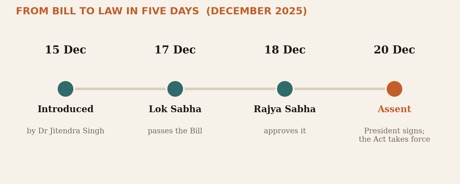
From introduction to presidential assent in under a week, December 2025.
2. Two laws that stalled an industry
Why replace anything at all? Because the two laws being thrown out had each, in their own way, turned into the problem.
The 1962 monopoly
The older one dated to 1962, when the word atomic still meant the bomb as much as the power station and the Cold War shaded every decision. So the Act it produced was built around control. Section 3 simply handed the whole field, making atomic energy, using it, getting rid of it, to the government and the bodies it set up.[2] For a long stretch that suited India well enough. The country grew its own scientists, kept its technology close, and played a patient, idiosyncratic long game with the fuel it happened to have. Control of that kind buys you something. What it cost, here, was growth. Private firms were locked out. Big money had nowhere useful to sit. Reactors went up at a trickle while the targets on paper kept climbing.
The 2010 liability trap
The younger law did the greater damage. Passed in 2010, it was written by people who still had Bhopal in mind, and you can feel that in the drafting, the conviction that when an industrial disaster kills people somebody solvent had better answer for it. The impulse is hard to fault. The trouble was a single clause that took the impulse somewhere strange.
Almost every other country runs nuclear liability the same way. The operator of the plant pays if it fails, and that is the end of it. The firms that supplied the parts, the pumps and valves and the great steel vessel at the core, are kept clear of the firing line, because funnelling all the risk onto one insurable operator is what makes the sums work for everyone. India chose to do it differently. Under its law an operator could turn around and bill its suppliers even when nobody had done anything wrong, even for a flaw buried in a component that no one had spotted.[2][3]
To a foreign vendor that clause was radioactive in its own right. Build something in India and you might find yourself paying for a disaster you neither caused nor could have prevented, with no ceiling on the bill. So they stayed away. A decade of handshakes and headline agreements, the big one with Washington among them, somehow produced almost no new reactors.[3]
Which brings you to the gap between what India has and what it now says it wants.
3. From 3% to a hundred-gigawatt bet
Right now nuclear keeps the lights on for about three per cent of the country, some 8.78 gigawatts, which next to India’s mountain of coal barely registers.[2] The ambition is to make it count. On paper the climb runs to 22 gigawatts by 2032, 47 by 2037, 67 by 2042, and then a round 100 by 2047, the year India turns a hundred and the deadline pinned to nearly every grand plan in Delhi.[6][2] You do not get from nine to a hundred in twenty years by leaving a state monopoly to its own devices. The arithmetic forbids it, and the arithmetic is really what forced the question.
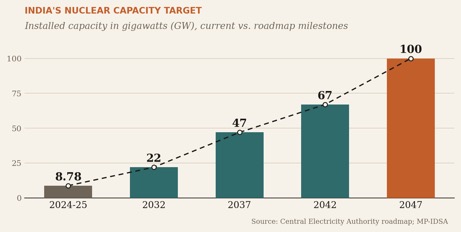
The roadmap turns a three-percent sliver into a hundred-gigawatt pillar by 2047.
There is a second reason, newer than the laws being torn up. Everything the world is suddenly racing to build, the data centres behind artificial intelligence, the chip fabs, the quantum machines, runs on power that cannot be allowed to flicker. That is nuclear’s particular gift: electricity that is there at three in the morning, in a heatwave, when the wind drops, and that puts no carbon in the air while it waits. Solar and wind, for all they do, cannot quite make that promise alone. A good part of the case for the Act leaned on exactly this.
And it does not stop at the grid. Written into the law is the use of nuclear technology in hospitals, on farms, in food and water, the isotopes that shrink tumours, sterilise equipment, trace a contaminant through a supply chain.[5] Whoever drafted it was thinking about nuclear science in the round, not just about kilowatt-hours.
4. The five pillars of the reform
Most of the Act’s weight rests on five changes. They are worth taking one at a time.
Pillar 1: Opening the gate to private capital
This is the one the headlines ran with. The old law kept the atom for the state; the new one opens the gate. Any other company, the text says, or for that matter any other person, may now apply for a licence to put up a nuclear facility, with the regulator looking over their shoulder the whole way.[2]
The interesting part is the fine print. Company here means what the Companies Act of 2013 says it means, with one pointed exception: nothing incorporated outside India counts.[2][5] A foreign reactor-maker, in other words, cannot simply own a plant on Indian soil. It has to come in beside an Indian partner, a shareholder in a joint venture rather than the owner of the thing. The door is genuinely open. It just has a frame around it.
Hold a licence and there is plenty you can do. Put up a plant, run it, one day take it apart. Make fuel up to set limits. Move and store fuel and spent fuel. Bring in equipment, technology and software with official sign-off. Wherever radiation is involved, a separate safety clearance sits on top.[2]
The list of what you still cannot touch is the more telling one. Accounting for fissile material, reprocessing spent fuel, enriching uranium, making heavy water, everything that edges toward weapons capability, none of it leaves government hands.[2] There is the whole compromise in miniature: private players on the power stations, the state’s grip still tight around the fuel.
Assuming it works, the prize is capital and pace, money the treasury was never going to find on its own and builders who treat a deadline as more than a suggestion. Set NPCIL, which knows reactors cold, next to a private firm that knows how to finance and finish a megaproject, and you have a pairing neither half could manage alone. It also clears room for Small Modular Reactors, India’s own among them, the 200-megawatt Bharat SMR and a 55-megawatt design still on the bench.[2]
| What is a Small Modular Reactor?A reactor small enough, usually under 300 megawatts, to be built in a factory from standard modules rather than poured in concrete on-site over a decade. That makes SMRs quicker to deploy, cheaper to start, and easy to add one unit at a time as demand grows. They can sit where a full-size plant cannot, and they carry less fuel, so less can go wrong in an emergency. For investors wary of decade-long megaprojects the economics are far friendlier, which is why they sit at the centre of India’s plans. |
Pillar 2: Fixing the liability problem that scared off suppliers
If opening the sector is the engine, this is the key in the ignition, because it pulls out the one clause that had kept the suppliers home.
A ready-made answer was sitting on the shelf, the 1997 Convention on Supplementary Compensation for Nuclear Damage, which India had actually signed.[7] It stacks the responsibility in layers. The operator carries it first, strictly and exclusively, up to a floor of 300 million Special Drawing Rights, insurance behind it. Run past that and an international kitty filled by member states picks up the slack. And the bit India had been quietly ignoring: suppliers are largely off the hook, reachable only where a contract spells it out or where someone caused harm on purpose.
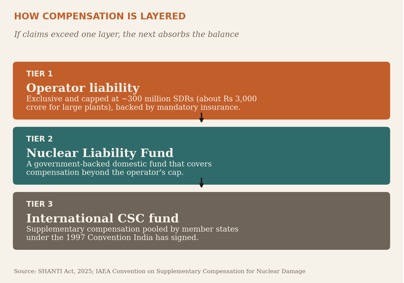
Compensation stacks in three layers — the model India adopted from the international Convention.
That is the shape the SHANTI Act has now taken on. Operator liability is exclusive and capped, the ceiling tied to that 300-million figure or whatever the government sets later, scaled to the size of the reactor and topping out near 3,000 crore rupees for the largest.[2][7] The new Nuclear Liability Fund sits behind the operator, and the international pool behind that. The part the vendors cared about: their exposure is now hemmed into the same narrow exceptions everyone else uses. The blank cheque has been cancelled.
Industry noticed that one change above all the others. Maria Korsnick, who runs the Nuclear Energy Institute in the United States, reckoned the law had “opened the door now for a new day” for cooperation between the two countries, and listed advanced reactors, private investment and SMRs as what lay on the far side of it.[8]
The Act keeps a little give in the system too. Penalties and liability caps can be moved over the years, but only by editing the schedules tacked onto the end, not by cracking open the law itself, adjustable at the hem and fixed through the middle.
Pillar 3: A regulator with teeth
Nobody wants to back a referee who shares a locker room with one of the teams. That, more or less, was the trouble with India’s nuclear regulator.
The Atomic Energy Regulatory Board has been around since 1983, but only ever as something a government order conjured up, never a creature of Parliament, even though people had been pushing for exactly that since 1981.[2] For four decades it lived inside the very establishment it was meant to keep honest, answering up a chain that also happened to run the reactors. It did not look independent, and it was not especially.
The Act fixes that at the root. The Board has statutory standing now, its remit and shape written into law. It licenses, inspects, signs off on safety, enforces; it can pull a licence or hand down a fine; it can search and seize where it has to.[2]That puts India in roughly the company of the Nuclear Regulatory Commission in America or France’s ASN, regulators that take their authority from statute and stand at arm’s length from the industry they watch. Which is the precise reassurance the overseas partners had been holding out for.
Pillar 4: Who settles disputes, and who pays victims
Open the field to private operators and complicated money and disputes are bound to follow. The Act would rather they did not all land in an ordinary courtroom, so it lays out a sequence.
Unhappy with something the regulator decided, you can take it to the Atomic Energy Redressal Advisory Council, a panel of experts that advises rather than rules. Still unhappy, and you move up to the Appellate Tribunal for Electricity, the specialist body the 2003 Electricity Act set up, which knows the law and the engineering both. Beyond that there is only the Supreme Court.[2] Ordinary civil courts are shut out, and the Act overrides any law that contradicts it, clearing away the murk the old set-up left lying around.
Compensation runs on its own track. Once an incident is notified the government has thirty days to name a Claims Commissioner, a clock that reads like an apology for how long the victims of earlier disasters were left waiting. For something large there is a fuller Nuclear Damage Claims Commission, a chair and as many as six others.[2]
Pillar 5: Room to research and invent
The quietest of the five may matter most in the end. Genuine research and design work no longer needs a licence, the sensitive areas aside, so long as safety is accounted for, and there is now a patent regime for peaceful nuclear inventions.[2] The idea is to make India a place where nuclear ideas actually start, not just a showroom for other people’s reactors, which is the whole point if those homegrown SMRs are ever to come off the bench.
| India’s long game, and why the fuel cycle stays lockedIndia is short on uranium but sits on some of the planet’s largest thorium reserves, much of it in the monazite sands of Kerala and Odisha. Decades ago the physicist Homi Bhabha sketched a way to turn that geological hand into energy independence, in three stages. It is the reason control of reprocessing and the fuel cycle stays a strategic priority even as power generation opens to private players. |
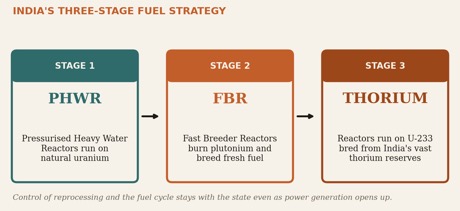
Bhabha’s three-stage strategy: from natural uranium, through breeder reactors, to a thorium endgame.
5. Old regime versus the SHANTI Act, at a glance
| Before (1962 + 2010 laws) | After (SHANTI Act, 2025) | |
| Who runs plants | The state only | Private firms and joint ventures under licence; foreign players only through Indian entities |
| Supplier liability | Operators could pursue suppliers even without fault | Limited to express contract or intentional wrongdoing; no automatic exposure |
| Operator liability | Capped, but the regime deterred suppliers | Exclusive; ~300 million SDRs; graded by size; ~Rs 3,000 crore for large plants |
| Backstops | Thin | Nuclear Liability Fund, plus the international CSC pool |
| Regulator (AERB) | Born of a 1983 executive order, inside the operator’s house | Full statutory status and independence |
| Disputes | Murky; civil courts in play | AERB to Advisory Council to Appellate Tribunal to Supreme Court |
| Compensation | Slow, ill-defined | Claims Commissioner within 30 days; Commission for major incidents |
| Scope | Mostly power and weapons control | Power, plus medicine, food, water, agriculture; research largely freed |
6. Where the Act is vulnerable
A law this consequential earns its critics, and a fair account of the SHANTI Act has to make room for them.
Money first. Three thousand crore rupees, the operator’s cap for a large plant, is not much set against what a real accident does; Fukushima’s tab ran past 18,000 crore.[2] The defenders have answers. Fukushima was a once-in-a-generation quake and the wave behind it. India is fussy about where reactors go and how many layers of oversight sit on them. And the operator’s cap is only the first of three tiers in any case. All reasonable. Still, drain all three and the bill ends up with the government, and after that with whoever pays tax, which is not a thought experiment.
Grading liability by size is shakier ground. A reactor’s megawatt rating tells you very little about how bad an accident gets; where it happens and how many people live nearby tell you far more. That schedule may need another look, which is presumably why the drafters left themselves the option to revise it.
Security is the question that keeps you up. More reactors, some of them small and parked nearer to where people live, is more to worry about once a shooting war starts. Ukraine has had the Zaporizhzhia plant in the crosshairs more than once, and history is not short of strikes on half-finished nuclear sites. The law of war says you do not attack a nuclear plant; wars break that law along with the rest. The reassurances, India’s air defence, tougher modern designs, the smaller fuel load an SMR carries, even the far-fetched notion of burying them, are not nonsense. They simply do not make the worry disappear.
Waste is the oldest problem in the business, and hardly India’s alone. On this the Act keeps the burden public: writing waste policy and seeing to safe disposal stay government jobs, with nothing of the sort offloaded onto private operators.[2]
Then there is consent, which no clause can manufacture. India has had real fights over nuclear power, the years-long standoff at Kudankulam in Tamil Nadu, the resistance at Jaitapur in Maharashtra, driven by fear, by arguments over land and livelihood, by a distrust that official assurance has never quite dissolved. Build faster and bigger, with private names attached, and you still have to bring people along, not merely collect the paperwork. The Act can write the rules. It cannot talk a village into living next to a reactor.
7. A recalibration, not a revolution
Calling the SHANTI Act a revolution overstates it. Better to read it as the third entry in a series, each one a reply to whatever the country feared most at the time. The 1962 law was about security and sovereignty, the anxieties of a republic barely out of its teens. The 2010 law was about never again letting a Bhopal go uncompensated. This one answers something quieter and more bureaucratic, the worry that the rules themselves had stiffened into a thing that no longer let the sector move. In that light it is a correction, not a renunciation.
What it genuinely shifts is the terrain. Defuse the liability clause and the vendors suddenly have a reason to turn up. Give the regulator its own statute and the partners have someone credible to deal with. Private money covers ground the state was never going to cover alone. And somewhere beneath all of it, by writing medicine and farming and the coming wave of power-hungry industry into its scope, the Act has quietly stopped treating the atom as a guarded secret and begun treating it as ordinary infrastructure. Whether any of this ends in reactors actually poured and switched on is the one thing the text cannot promise on its own.
8. What happens next
Passing a law is the easy part. A fair amount has to happen before any of it turns into electricity.
The government still owes everyone the rulebook underneath the Act, the actual licensing process, the thresholds, the safety standards the regulator will hold people to, and the regulator has to stand up the new machinery the law calls for. After that the things to watch are concrete: who files the first licence applications, which joint ventures form, and how large a part NPCIL ends up playing as the steady anchor the newcomers tie up to. Some of the groundwork is already down. The 2026-27 budget knocked customs duties off imported nuclear inputs through 2035, shaving project costs at about the moment the law landed.[2][9] If the indigenous SMRs start to move, and if the foreign tie-ups the liability fix was meant to unlock actually materialise, that is when you will know the reset took.
The rules are different now, and for the first time in sixty years they tilt toward building rather than holding back. That, more than any single clause, is why December 2025 will probably read in hindsight as the moment the direction changed, even if the reactors it is meant to summon are years from casting a shadow.
9. Glossary
AERB — The Atomic Energy Regulatory Board, India’s nuclear and radiation safety regulator, given full statutory status by the Act.
Baseload — The steady, round-the-clock electricity that meets a grid’s minimum constant demand, a role nuclear suits well.
CSC — The 1997 Convention on Supplementary Compensation for Nuclear Damage, whose liability model the Act adopts.
Fissile material — Material such as certain uranium and plutonium isotopes that can sustain a chain reaction; controlling it carries proliferation significance.
NPCIL — Nuclear Power Corporation of India Limited, the state company that has built and run most of India’s reactors.
Reprocessing — Chemically treating spent fuel to recover usable material, a sensitive activity the Act reserves for the state.
SDR — Special Drawing Right, an IMF reserve asset; the Act denominates its liability ceiling in SDRs.
SMR — Small Modular Reactor, a factory-built reactor, typically under 300 MWe, designed for faster, scalable deployment.
10. References
1. President grants assent to the SHANTI Bill, News on Air / PIB, 22 December 2025. https://www.newsonair.gov.in/president-murmu-gives-assent-to-shanti-bill
2. Oak, N. C. & Budhwar, B., “SHANTI Act and India’s Nuclear Energy Governance Framework,” MP-IDSA Issue Brief, February 2026. https://idsa.in/publisher/issuebrief/shanti-act-and-indias-nuclear-energy-governance-framework
3. “India’s nuclear-focused SHANTI Bill completes legislative process,” World Nuclear News, December 2025. https://www.world-nuclear-news.org/articles/indias-shanti-bill-completes-legislative-process
4. The Sustainable Harnessing and Advancement of Nuclear Energy for Transforming India Bill, 2025 (Bill text), PRS Legislative Research. https://prsindia.org/billtrack/the-sustainable-harnessing-and-advancement-of-nuclear-energy-for-transforming-india-bill-2025
5. “SHANTI Act, 2025: Calibrated Liberalization in Nuclear Energy,” JSA Law, December 2025. https://www.jsalaw.com/energy-power-hydrocarbon/shanti-act-2025-calibrated-liberalization-in-nuclear-energy-to-secure-innovation-decarbonization-diversification-of-energy-sources/
6. Roadmap for Achieving 100 GW of Nuclear Capacity by 2047, Central Electricity Authority, Ministry of Power. https://cea.nic.in/wp-content/uploads/notification/2025/10/Roadmap_Final_30062025.pdf
7. Convention on Supplementary Compensation for Nuclear Damage (INFCIRC/567), IAEA. https://www.iaea.org/sites/default/files/infcirc567.pdf
8. “SHANTI Act has opened door for a new day: NEI chief on India-US civil nuclear ties,” The Tribune / ANI, May 2026. https://www.tribuneindia.com/news/world/shanti-act-has-opened-door-for-new-day-nuclear-energy-institute-chief-on-india-us-civil-nuclear-ties/amp
9. The SHANTI Bill, 2025: explainer note, Press Information Bureau, Government of India, December 2025. https://static.pib.gov.in/WriteReadData/specificdocs/documents/2025/dec/doc20251219739001.pdf
10. “India’s nuclear turning point: how the SHANTI Act is redefining clean energy plans,” WTW, February 2026. https://www.wtwco.com/en-gh/insights/2026/02/indias-nuclear-turning-point-how-the-shanti-act-is-redefining-clean-energy-plans
11. Key facts
| The SHANTI Act, 2025Sustainable Harnessing and Advancement of Nuclear Energy for Transforming India Act, 2025. 15 December 2025, by Dr Jitendra Singh. Lok Sabha 17 December, Rajya Sabha 18 December 2025. 20 December 2025 (presidential assent). Atomic Energy Act, 1962; Civil Liability for Nuclear Damage Act, 2010. ~8.78 GW today (~3% of generation). 100 GW by 2047. |
——————————————————————————————————————————————
Amulya Charan writes on energy systems, infrastructure economics, and development policy at amulyacharan.com. This analysis draws on reporting from Business Standard, ThePrint, Business Today, and the Press Information Bureau, and on policy research from the Takshashila Institution and the Observer Research Foundation.