India’s BBB Moment: Can the S&P Upgrade Survive the Hormuz Shock?
25 September 2026 · Amulya Charan
S&P lifted India’s sovereign rating from BBB− to BBB in August 2025, its first upgrade in eighteen years. When it affirmed BBB with a stable outlook on 27 August 2026, the setting had changed: war in West Asia had disrupted Hormuz, energy costs had climbed and the rupee was under pressure. Can the upgrade withstand that shock? [1, 2]
For now, it has. India kept crude arriving, the current-account deficit was just 0.5% of GDP in April–June, and real GDP grew 7.8% from a year earlier. Those are encouraging first-quarter readings, though. An energy shock can take longer to show up in prices, company accounts and the Budget. The real test is whether India can absorb the costs while preserving the fiscal discipline behind the upgrade. [5, 8]
Why S&P upgraded India
The move from BBB− to BBB put India one notch above the lowest investment-grade rating. S&P pointed to resilient growth, better anchored inflation expectations, fiscal consolidation and a stronger mix of public spending. Its 2025 projections envisaged net general-government debt falling from about 83% of GDP in FY2025 to 78% by FY2029, alongside central capital spending of roughly 3.1% of GDP. Those projections now have to survive a much tougher energy environment. [1]
S&P knew about the shock when it reaffirmed the rating a year later. It expected slower growth and allowed for the Union deficit to overshoot its Budget target, yet still saw a commitment to consolidation. The stable outlook rested on policy continuity and infrastructure investment. A bad oil year alone is therefore unlikely to decide the rating; what matters is whether the shock leaves a lasting mark on growth, debt or policy credibility. [2]
The energy shock, and who pays for it
The Strait of Hormuz matters because roughly a quarter of seaborne oil trade and about 19% of global LNG trade normally pass through it. Some Gulf exports have been rerouted, but the IEA estimated total Gulf oil exports at around 13 million barrels a day in August, nearly half the pre-war level. Oil, refined products and LPG have recovered at different speeds. [3, 4]
Indian refiners have adapted by buying crude elsewhere. That keeps fuel moving, but a longer voyage can still mean a higher oil, freight or financing bill. LPG follows a different supply chain, so crude availability tells us little about cooking-gas costs. From the rating perspective, the next question is simple: how much of the higher bill falls on households, oil-marketing companies and the government?
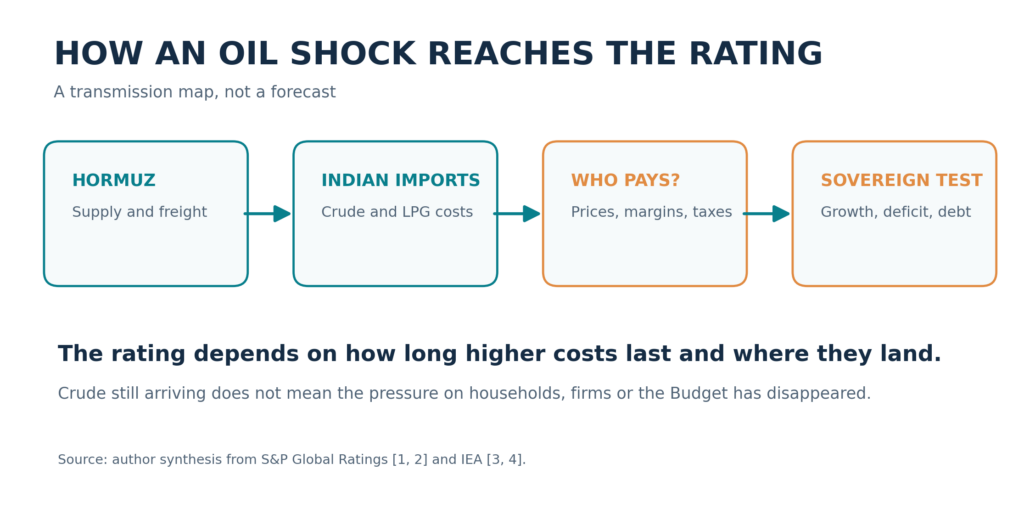
Figure 1 From Hormuz to the sovereign balance sheet. The links show channels of pressure, not an automatic downgrade.
The external account held up, but financing weakened
Start with the current account. In Q1 FY2027 its deficit was $4.2 billion, or 0.5% of GDP, up only slightly from $3.4 billion, or 0.4%, a year earlier. Beneath that modest change, the goods deficit widened by $17.2 billion to $86.1 billion. Net services receipts rose by $3.7 billion to $51.6 billion; remittance-related receipts increased and the primary-income deficit narrowed. Services helped, but they did not absorb the import bill on their own. [5]
Financing gives the quarter a less comfortable feel. Portfolio investment swung from a $1.6 billion inflow to a $9.6 billion outflow. Reserves fell $8.1 billion on a balance-of-payments basis; including valuation effects, the fall was $22.5 billion. The distinction matters: a change in the dollar value of existing assets is different from dollars spent to finance external payments. [5, 6]
It would be a mistake to turn one quarter into a full-year verdict. ICRA’s September baseline expects the current-account deficit to widen from 0.7% of GDP in FY2026 to around 0.9% in FY2027 as later quarters feel more of the shock. That is still manageable in its assessment, provided energy prices and financing flows do not deteriorate sharply. [7]
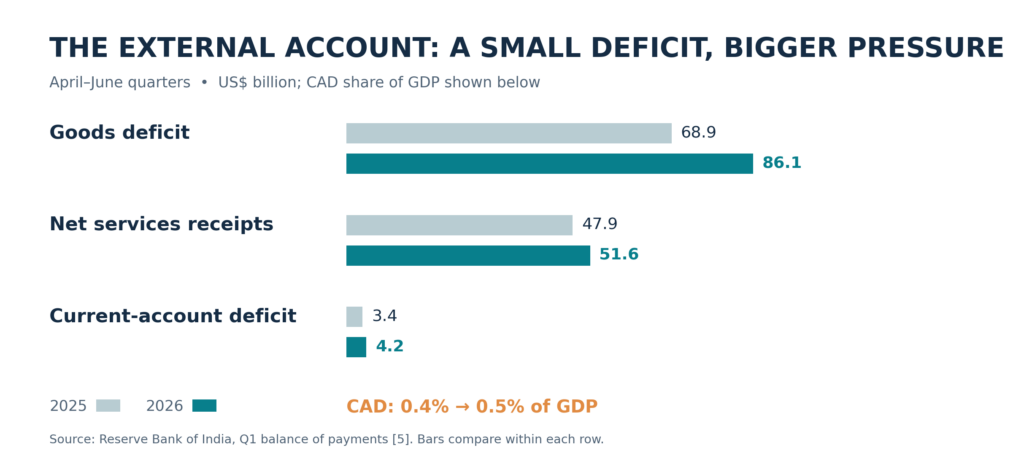
Figure 2 A wider goods deficit sat beside stronger services receipts in April–June; the current-account deficit stayed small.
Where higher energy costs show up in prices
The pressure is also visible at different points in the price chain. Consumer inflation reached 4.82% in August, with food inflation at 5.95%. Wholesale inflation was 9.92%, and the WPI fuel-and-power group rose 22.93%. These measures cover different baskets, stages of production and base years. Their gap cannot be read as a government subsidy bill; for that, we need to look at retail prices, oil-company margins, taxes and explicit support. [9, 10]
The RBI held the repo rate at 5.25% on 5 August. It projected FY2027 CPI inflation of 5.0%, with the quarterly peak at 5.9% in October–December, and said price pressure had yet to become broadly generalised. India’s target is 4%, within a 2–6% tolerance band. A monthly print above 6% would be worrying, but it would not, by itself, mean a formal breach of the inflation framework. [11, 21]
Meanwhile, the Centre has already used some room to cushion fuel prices. On 27 March it cut excise duty on petrol and diesel by ₹10 a litre, saying the measure helped offset public oil-marketing companies’ losses while keeping retail prices stable. Repeating that response at the same scale would be harder. Any further protection would require another choice among taxes, company margins, retail prices and Budget spending. Export levies on petroleum products serve a different purpose: protecting domestic supply. [12]
What this means for the Budget
Those choices lead straight to the fiscal target. The FY2027 Budget aims for a deficit of 4.3% of GDP. An earlier estimate of 4.7% captured the risk, but ICRA’s September baseline is closer to 4.5%, around 0.2 percentage point above target, with expenditure savings potentially offsetting some pressure. Its higher-oil scenario puts the deficit at roughly 4.5–4.7%. The year’s oil bill will help decide where within that range India ends up. [13, 19]
Through July, there was no sign of a fiscal break: the deficit had reached 26.8% of the full-year Budget estimate after four months, while capital spending had risen sharply. Four months cannot settle the eventual subsidy, revenue and interest bill. If the target slips, the explanation and the medium-term debt path will matter as much as the size of the miss. [20]
Growth offers some room. Real GDP rose 7.8% year on year in Q1 FY2027, compared with 6.9% a year earlier, and nominal GDP rose 10.3%. A larger economy helps the debt ratio, but it cannot replace revenue or difficult spending decisions. Nor does a higher nominal figure spare households and businesses from the costs driving it. [8]
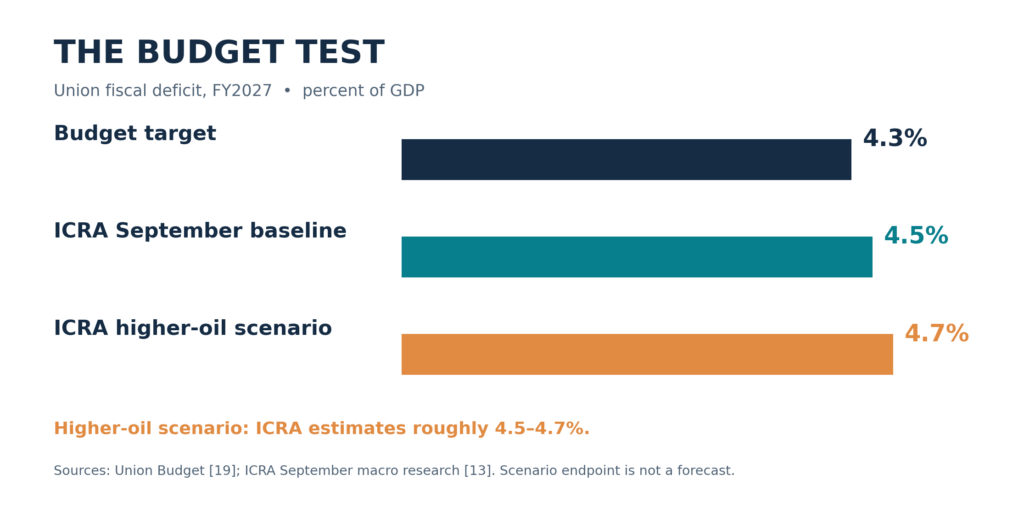
Figure 3 The fiscal target and ICRA estimates show the scale of possible slippage, not a settled year-end result.
How strong is the external buffer?
India’s reported foreign-exchange reserves reached a record in early September. The headline needs a little unpacking. Under its special dollar–rupee swap facility, the RBI reported $143.596 billion of foreign-currency inflows mobilised through 18 September, mainly from foreign-currency non-resident deposits. Those swaps come with terms and maturities that will have to be managed later. [14]
That does not mean the entire reserve stock is ‘rented’, or that every dollar mobilised added a dollar to reserves. Gross reserves, net forward obligations, valuation changes and future maturities tell different parts of the story. India has a substantial buffer; its composition deserves attention alongside its size. [6, 14]
The added risk from US tariff law
There is a second route through which energy could affect India’s credit picture: trade. The February US–India joint statement set out an 18% reciprocal tariff for specified Indian goods under its stated terms. It was never a universal rate on every Indian export. [15]
On 18 September, the US President signed H.R. 5334 into law. It expands sanctions and tariff authority related to Russian energy trade, including potential tariffs of up to 100% on certain large buyers. That authority does not mean such a tariff has already been imposed on Indian exports. What matters next is implementation: the use of waivers or exemptions, and the response of Indian refiners and exporters. [16, 17, 22]
Consider the combination rather than either risk alone. If refiners lose discounted or dependable barrels while exporters face new duties, the import bill, company earnings and growth could weaken together. That is a plausible credit stress scenario, not a prediction of an S&P downgrade.
Three ways the year could unfold
If energy flows improve and prices ease, India should have room to finance a modest external deficit and limit fiscal slippage. That broadly fits S&P’s stable outlook and ICRA’s September baseline. If disruption persists, transport and fuel costs may spread into consumer prices while subsidy demands and company losses accumulate. A harsher outcome would combine prolonged expensive oil with material US trade restrictions, testing growth and the debt path at the same time. [2, 13]
I would not put tidy probabilities on those paths. S&P’s oil-shock exercise tests balance-sheet resilience; it does not set a date for rating action. The evidence will arrive gradually, as external pressure feeds—or fails to feed—into fiscal decisions, debt dynamics and confidence in the policy path. [18]
The watchlist is manageable: the next two quarters of current-account and portfolio-flow data; CPI and signs of wider price pass-through; monthly Union receipts, subsidies and the deficit; RBI disclosures on swaps and forward positions; and actual US tariff implementation. The next Budget will show how the government plans to sustain investment in a costlier energy environment.
Will BBB hold?
India came into the shock with advantages S&P recognised in 2025: growth, mostly domestically financed rupee debt, a large external buffer and continued public investment. The August affirmation says those strengths still support BBB in S&P’s judgment. It does not promise a stable rupee or painless company earnings. A sovereign rating is a credit assessment, not insurance against every economic strain. [1, 2]
My reading is that BBB is more likely to hold than fall on the evidence available today. That depends on a manageable full-year external deficit, a credible response to fiscal pressure and no severe trade shock layered on top of expensive oil. The first quarter bought India breathing space. The next few will tell us how much of it remains.
References
2. S&P Global Ratings, “India BBB/A-2 Sovereign Ratings Affirmed; Outlook Stable,” 27 August 2026
3. International Energy Agency, Strait of Hormuz overview
4. International Energy Agency, Oil Market Report, September 2026
5. Reserve Bank of India, Balance of Payments, Q1 FY2026–27, 1 September 2026
7. ICRA, India’s CAD pegged at 0.5% of GDP in Q1 FY2027, 2 September 2026
8. Ministry of Statistics and Programme Implementation, Q1 FY2026–27 GDP estimates
9. Ministry of Statistics and Programme Implementation, August 2026 CPI release
10. Press Information Bureau, provisional August 2026 WPI estimates
11. Reserve Bank of India, Monetary Policy Committee resolution, 5 August 2026
12. Ministry of Petroleum and Natural Gas, excise reduction of ₹10 per litre, 27 March 2026
13. ICRA, Macro Research September 2026, fiscal and oil-price scenarios
14. RBI, forex inflows under special swap facility through 18 September 2026
15. The White House, United States–India Joint Statement, February 2026
16. The White House, H.R. 5334 signed into law, 18 September 2026
17. US Government Publishing Office, enrolled H.R. 5334, 18 September 2026
18. S&P Global Ratings, scenario analysis of an oil shock, 14 April 2026
19. Government of India, FY2026–27 fiscal policy statement
20. ICRA, Fiscal deficit at 27% of target in April–July FY2027, 1 September 2026
21. Reserve Bank of India, 2026 inflation-target framework explanation
22. S&P Global Energy, congressional sanctions and tariff bill, 17 September 2026