Green Hydrogen’s Chicken-and-Egg Problem
Why India Is Struggling to Turn Awards Into Projects
India’s green-hydrogen programme has no shortage of ambition. What it still lacks is enough operating capacity to make that ambition feel real.
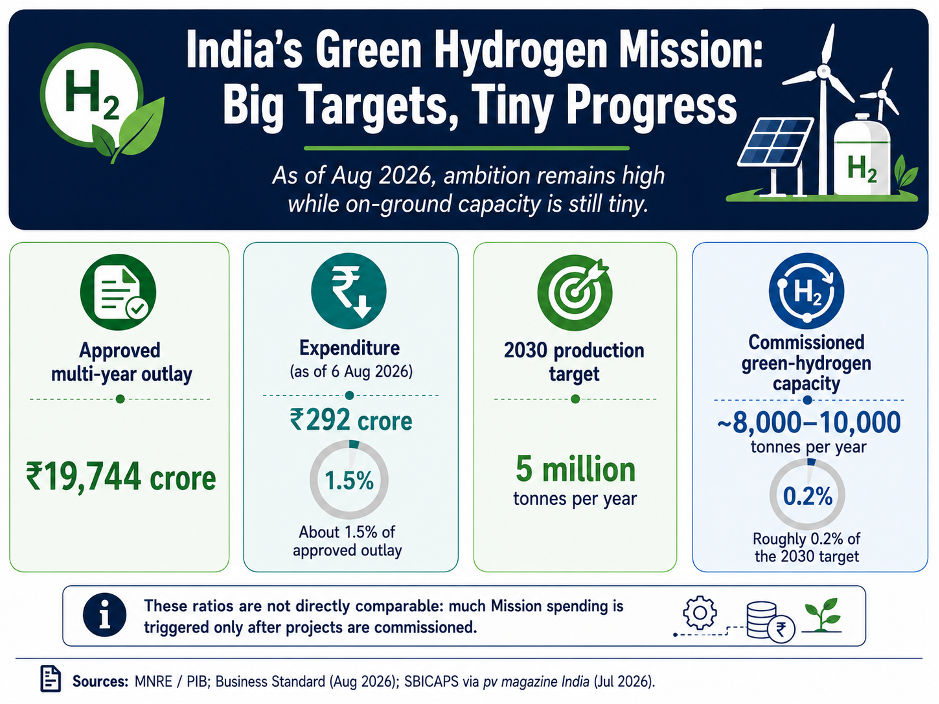
Three and a half years after the National Green Hydrogen Mission was approved, expenditure stood at ₹292 crore as of 6 August 2026. That is about 1.5% of the Mission’s ₹19,744 crore approved multi-year outlay. Commissioned green-hydrogen capacity, meanwhile, was roughly 8,000–10,000 tonnes a year—around 0.2% of the five-million-tonne target for 2030.
Those numbers are dramatic, but they are easy to misuse.
The ₹19,744 crore figure is not a pot of money that was made available in full on day one. Annual allocations have been much smaller, and some SIGHT incentives are paid only after projects are commissioned and start producing. Low expenditure is therefore partly a consequence of slow project development, not proof on its own that the programme has been sitting idle.
Still, the bigger problem is hard to miss.
India has awarded far more green-hydrogen capacity than it has managed to bring into operation.
That gap—between winning support and actually building a plant—is where the story becomes interesting.
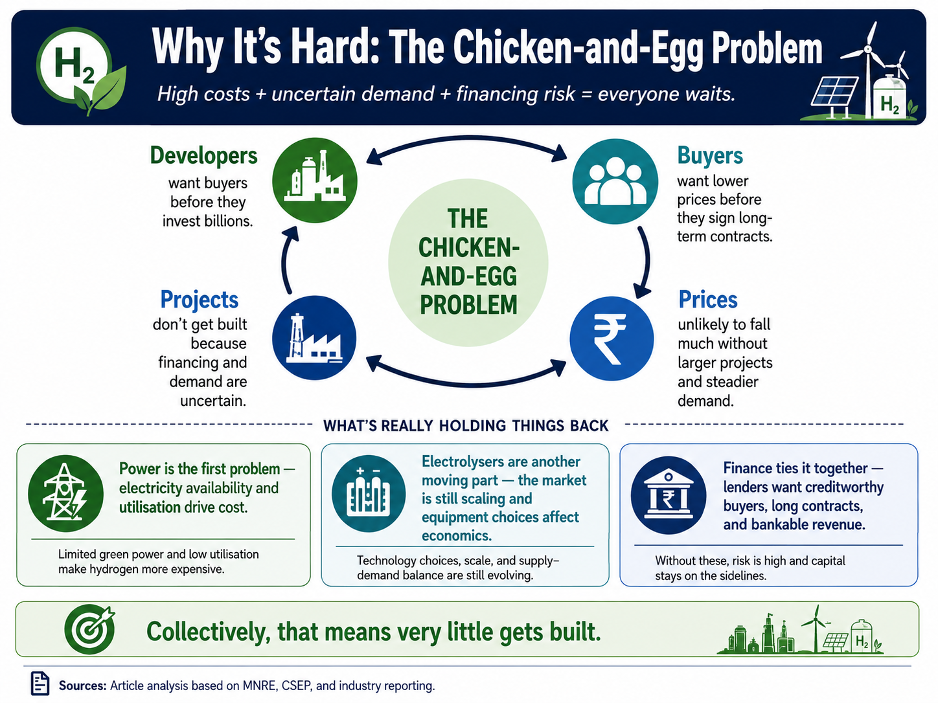
Developers want buyers before they commit billions of rupees to a project. Buyers want lower prices before they sign long-term contracts. Prices are unlikely to fall much without larger projects and steadier demand.
Everyone can wait. Collectively, that means very little gets built.
That is the chicken-and-egg problem.
Winning a tender is the easy part
India has spent the past few years putting the scaffolding of a hydrogen industry in place.
The Strategic Interventions for Green Hydrogen Transition programme, or SIGHT, supports hydrogen production and electrolyser manufacturing. Hydrogen hubs have been identified. Pilot schemes have been launched. India has introduced a Green Hydrogen Certification Scheme.
On paper, there is plenty happening.
The problem begins when different kinds of progress are bundled together.
An awarded project is not a commissioned project. A production incentive is not a purchase contract. A signed ammonia agreement is not the same thing as an equivalent volume of hydrogen. And a tender result says very little about whether a lender is prepared to finance the plant behind it.
The distinction matters because official figures have moved as projects have progressed.
The latest government status cited in the fact-check put green-hydrogen production capacity awarded under SIGHT at 756,100 tonnes per year across 16 companies. Separately, 30,000 tonnes per year had been awarded for refinery supply. Signed green-ammonia sale and purchase agreements covered 670,000 tonnes per year across 11 fertiliser units.
Earlier figures were higher in some categories. That does not necessarily signal failure; awards can be revised, projects can change and procurement rounds can move from allocation to signed agreements. But it does mean that every number needs a date and a label.
What is clear is that most awarded hydrogen capacity has not yet been commissioned.
That does not mean every project has stalled. Some may be arranging renewable power, negotiating financing, ordering equipment, clearing land or moving through construction. Public disclosure is not detailed enough to say exactly where each project sits.
But the conversion rate from award to operating plant remains low. That is the part that matters.
Green hydrogen is still expensive. Exactly how expensive depends on the project.
There is a temptation to reduce the economics to one ratio: green hydrogen costs three or four times as much as grey hydrogen.
The evidence is messier than that.
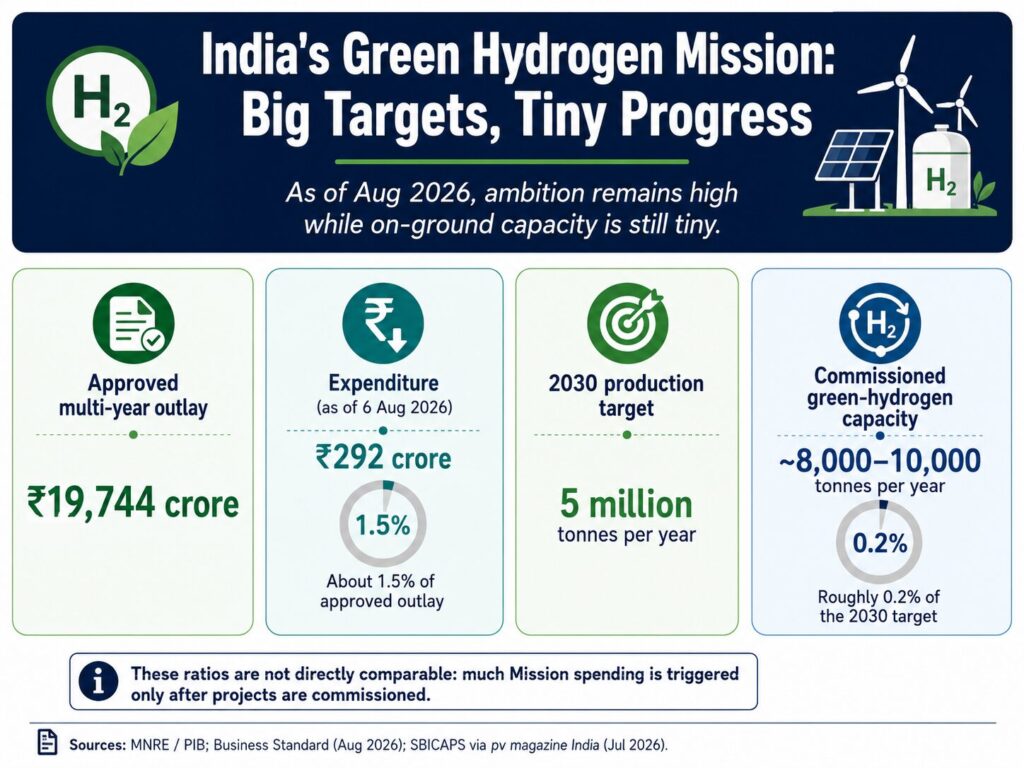
Current Indian green-hydrogen estimates vary with electricity prices, electrolyser utilisation, taxes, financing, delivery arrangements and where the accounting boundary is drawn. CSEP has estimated production costs in the range of roughly $4–6 per kilogram in current Indian conditions. Recent refinery procurement has produced green-hydrogen bids of roughly ₹387–₹397 per kilogram including GST, while conventional refinery hydrogen has been estimated at around ₹180–₹240 per kilogram.
That is still a large premium. In many cases, green hydrogen costs roughly twice as much as the incumbent product, or more.
For a refinery procurement committee, the exact multiple matters less than the basic fact: switching is expensive, and the commercial reason to absorb that cost remains weak.
Power is the first problem
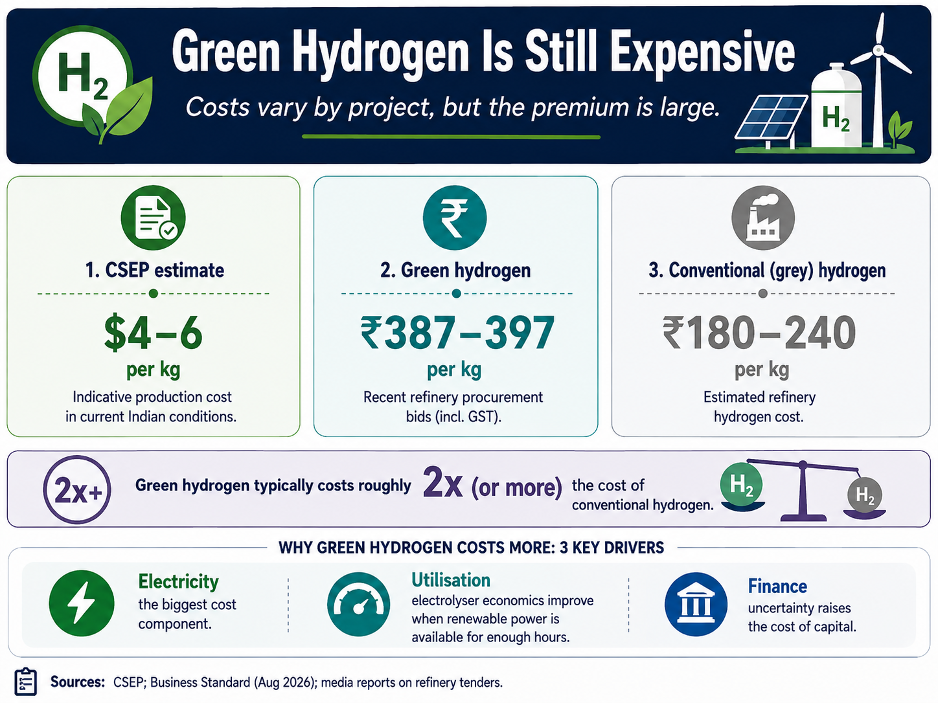
Most of the cost of green hydrogen comes back to electricity.
India is good at producing cheap solar power. What an electrolyser really values, though, is electricity that is available for enough hours to keep an expensive piece of equipment well used.
That is a different problem.
You can oversize solar and wind capacity. You can combine the two. You can add storage. You can use grid power or banking arrangements. Each helps utilisation; each also costs money.
The sweet spot is not necessarily to run an electrolyser continuously. CSEP’s work suggests that, under some assumptions, utilisation of around 50–60% may produce better economics than designing a system around near-constant operation.
In one scenario, renewable capacity roughly twice the electrolyser’s nameplate capacity pushed utilisation above 60%.
That is less a technical rule than a reminder: hydrogen cost is the product of a system, not a single machine.
Electrolysers are another moving part
India is also trying to build a domestic electrolyser-manufacturing industry while bringing down the price of hydrogen.
That is sensible industrial policy. It can also create tension in the early years of a market, when imported equipment may sometimes be cheaper.
The important thing is not to overstate the rule.
SIGHT supports domestic electrolyser manufacturing, but that does not prove that every green-hydrogen producer receiving Mission support is required to use a more expensive Indian stack. The production scheme is technology agnostic. Any claim about compulsory domestic sourcing needs to point to the specific procurement requirement.
There is a real debate here—cost reduction versus domestic manufacturing—but it is more nuanced than “India is forcing developers to buy expensive electrolysers”.
And then there is finance
Hydrogen projects bundle together several kinds of uncertainty: construction, equipment performance, renewable-power supply, utilisation, regulation and offtake.
That combination makes lenders cautious.
This is where the word bankable starts doing a lot of work.
A bank does not finance a plant because somebody might want green hydrogen five years from now. It wants a creditworthy buyer, a sufficiently long contract, clear purchase obligations, a price formula it can model and protection if the contract ends early.
An expression of interest is useful. A ten-year purchase agreement is something else entirely.
The article’s central problem is really this: India has created a considerable amount of prospective supply, but not enough demand that a lender can comfortably finance against.
The demand already exists. The green demand does not.
India does not need to invent uses for hydrogen.
Refineries and fertiliser plants already consume millions of tonnes of conventional hydrogen as feedstock. The customers are there. The facilities are there. In many cases, the molecule is already flowing every day.
What is missing is a strong reason to pay more for the green version.
Put yourself in the buyer’s seat.
A refinery has to ask whether the extra cost can be passed on. Whether regulation will eventually force the switch anyway. Whether carbon-market benefits offset part of the premium. Whether a new supplier can deliver reliably. Whether the price will stay predictable. Whether the company risks signing an expensive long-term contract just before green-hydrogen prices fall.
Waiting can be perfectly rational.
India has begun imposing emissions-intensity requirements through the Carbon Credit Trading Scheme, including on refineries. So it is no longer accurate to describe the carbon market as something that exists only on paper.
What India still does not have is a mature, predictable carbon-price signal large enough to bridge the hydrogen cost gap by itself.
Nor is there a broad requirement forcing large hydrogen users to source a defined share of their consumption from green production.
That leaves the market in an awkward middle ground: producers have incentives to build, but buyers often have no equivalent obligation to buy.
Green ammonia is the exception worth studying
The most useful part of India’s hydrogen programme may be the part that looks slightly different from the rest.
Green ammonia.
The initial procurement process allocated 724,000 tonnes per year across 13 fertiliser units. Later official reporting put signed sale and purchase agreements at 670,000 tonnes per year across 11 units.
Those are ammonia tonnes, not hydrogen tonnes.
Because hydrogen makes up about 17.6% of ammonia by mass, 670,000 tonnes of ammonia contains roughly 118,000 tonnes of hydrogen. That sounds like a technical correction, but it matters. Mixing those units creates the illusion of far more hydrogen demand than actually exists.
The more interesting point is why ammonia got further.
Buyers were identified.
Demand was aggregated.
Contracts were long enough to matter to lenders.
And ammonia, unlike pure hydrogen, already has a mature global system for storage, shipping and industrial handling.
That does not make it benign. Ammonia is toxic and requires serious controls around storage, pressure, corrosion, hazardous releases and emergency response.
Commercially, though, it is familiar.
That familiarity removes one layer of uncertainty from a project that already has plenty.
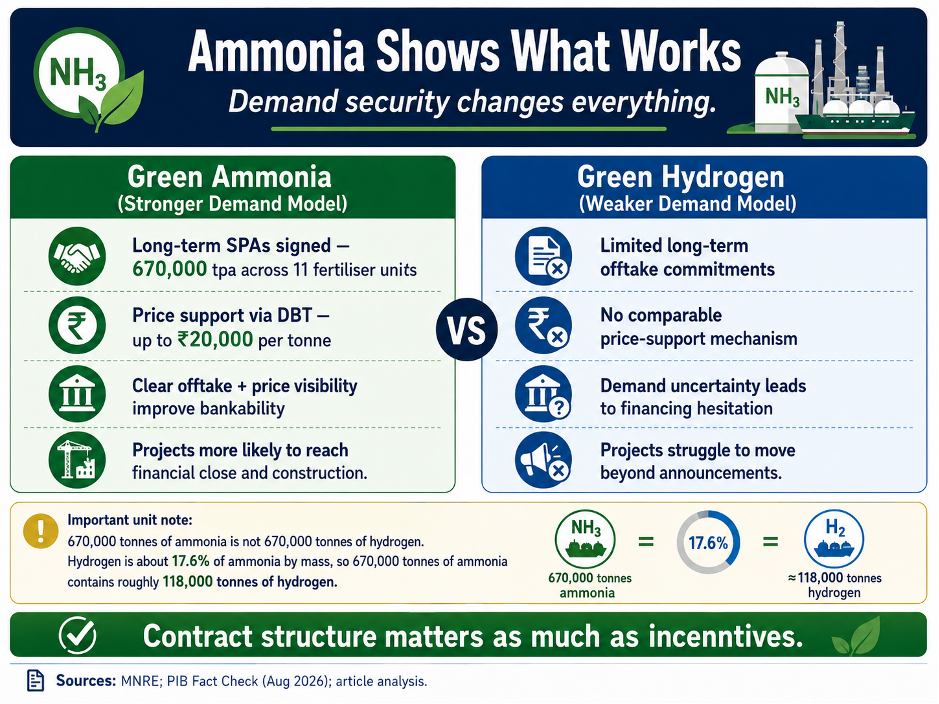
The ammonia programme therefore offers a useful lesson. Government did not simply subsidise production and hope customers would arrive later. It helped organise the buying side.
That may be more important than another round of capacity awards.
Refining is where the deadlock is clearest
Refineries ought to be an obvious early market.
They already consume hydrogen. They are large, sophisticated industrial buyers. They do not need to redesign an entire consumer market around a new fuel.
Yet disclosed refinery procurement remains small compared with the production capacity supported through SIGHT.
The reason is fairly straightforward.
For fertiliser, government already plays a large role in the economics of the sector. In refining, the question of who absorbs the green premium is harder.
A refinery cannot simply wish away a higher feedstock cost.
If there is no mandate, no sufficiently valuable carbon benefit and no mechanism for recovering the difference, the rational commercial decision may be to delay.
This is why supply-side support on its own reaches a limit.
You can help a developer build more cheaply. You cannot make a buyer indifferent to price.
Steel could be important. It is not a solved market.
Steel is often described as the next giant source of hydrogen demand, and the logic is understandable.
India is one of the world’s largest steel producers. The sector is expanding. Decarbonising iron and steel is difficult, particularly given India’s heavy use of coal-based production routes.
Hydrogen could have a role.
How large that role becomes is far from settled.
TransitionZero has modelled selected natural-gas DRI and electric-steel configurations in western India. In one scenario, moving to 70% hourly-matched clean electricity and a 20% hydrogen blend added roughly $13 per tonne of crude steel, or about 3%, to modelled production costs.
That sounds manageable.
But the result belongs to the specific plants and pathways being modelled. It cannot simply be transferred to India’s coal-based DRI fleet or blast furnaces.
A 3% premium in a model is not proof that the technological problem has disappeared.
Metallurgy matters. Furnace design matters. Retrofit costs matter. Hydrogen supply matters. Product quality matters.
Steel may eventually become one of India’s largest hydrogen markets. For now, it is more accurate to call it a promising but highly route-dependent one.
Transport is a weaker case
The Mission also supports hydrogen mobility.
Here the strategic case is less convincing.
Battery-electric vehicles have built much stronger momentum across passenger cars and light-duty transport. Batteries are also moving deeper into buses and heavy vehicles.
Hydrogen may still find a place in particular fleet operations, long-duty-cycle routes or niches where refuelling speed and utilisation matter more than they do for ordinary passenger vehicles.
That is a narrower proposition than the hydrogen-mobility story of a few years ago.
For a Mission with limited public resources, that matters.
Every rupee spent trying to create a road-transport market is a rupee not spent on applications where hydrogen may have fewer alternatives.
Exports could solve one problem and create another
Europe offers something Indian developers badly need: demand.
The Uniper–AM Green agreement, signed in January 2026, covers up to 500,000 tonnes a year of renewable ammonia from India, with first shipments expected as early as 2028.
That is not a pilot-scale customer.
For developers, export contracts like this can provide the sort of long-term demand signal that remains difficult to secure at home.
But the buyer sits inside another regulatory system.
European RFNBO rules include requirements around renewable-electricity additionality, temporal correlation, geographic correlation and lifecycle emissions. Indian certification can help establish the carbon intensity of hydrogen, but it is not automatically sufficient for European compliance.
Export projects therefore gain a customer and inherit regulatory exposure.
There is also a larger policy question.
A thriving Indian ammonia-export industry would be economically valuable. But exporting clean molecules to Europe does not, by itself, decarbonise an Indian refinery or steel plant.
Those are related ambitions, not identical ones.
The global hydrogen boom has cooled too
India is not uniquely struggling.
The IEA reported that global low-emissions hydrogen production reached almost one million tonnes in 2025—still roughly 1% of total hydrogen production.
Final investment decisions slowed. The 2030 project pipeline shrank. The agency has warned that more than 100 GW of announced electrolyser projects may no longer be capable of operating by 2030 unless investment decisions are made before the end of 2027.
That is not an Indian deadline.
It is a warning about how long these projects take to finance, build and commission.
The global slowdown is useful context because it rules out an easy explanation. India’s difficulties are not simply the product of one ministry moving too slowly.
High costs are real. Demand weakness is real. Financing is difficult. Certification and infrastructure add friction.
But global trouble does not make domestic policy irrelevant either.
A large part of hydrogen economics is policy.
Rules determine who buys. Who pays. Who carries risk. Which power costs apply. Whether carbon has a price. Whether infrastructure can be shared. Whether investors know what the regime will look like ten years from now.
Those are not side issues. They are part of the cost of the molecule.
So what would actually change the market?
The next phase of the Mission probably needs fewer announcements about capacity and more attention to contracts.
Start with modest, sector-specific demand obligations
A consumption requirement does not need to begin at 20% to change behaviour.
A small obligation, rising according to a schedule published years in advance, can matter because developers and lenders can plan around it.
The design should differ by sector.
Fertiliser has one set of economics. Refining has another. Steel presents a different technology problem again.
Treating all three as one hydrogen market would repeat the mistake the Mission is now trying to escape.
Test contracts for difference
A contract for difference could guarantee a producer an agreed strike price relative to a benchmark.
If green-hydrogen costs fall, public support falls with them. If the market price remains too low to finance production, the mechanism covers part of the gap.
It is not free money. The state takes on price risk.
But that risk already exists somewhere in the system. A CfD simply makes the allocation more explicit.
Use aggregation where it helps
The ammonia experience suggests that a central intermediary can solve problems that individual buyers and sellers struggle to solve bilaterally.
Aggregation can produce larger tenders, improve contract standardisation and reduce counterparty uncertainty.
It may be worth trying the same approach for refinery hydrogen, industrial derivatives and selected hub-based demand.
Not everywhere. But enough to see whether ammonia was a one-off or a transferable model.
Give projects rules they can finance against
Power policy is not background detail.
Transmission charges, open-access rules, banking treatment and eligibility for concessions all shape project economics.
A project financed over 15 years cannot be expected to assume that today’s favourable rule will still exist in year eight unless the policy says so.
Uncertainty eventually shows up in the discount rate.
And the discount rate eventually shows up in the hydrogen price.
Someone still has to pay
A mandate does not make the premium disappear. It tells somebody to absorb it.
This is the uncomfortable part of almost every green-hydrogen policy proposal.
A contract for difference moves part of it to government.
A carbon price puts more of the cost on fossil production.
An aggregated procurement scheme can move counterparty risk onto a public institution.
There is no clever instrument that makes those trade-offs vanish.
That is not an argument against intervention. It is an argument for being explicit about what intervention does.
India is trying to create an industry before market economics can fully support it. That always involves somebody carrying early risk.
The real choice is who.
The number to watch now is conversion
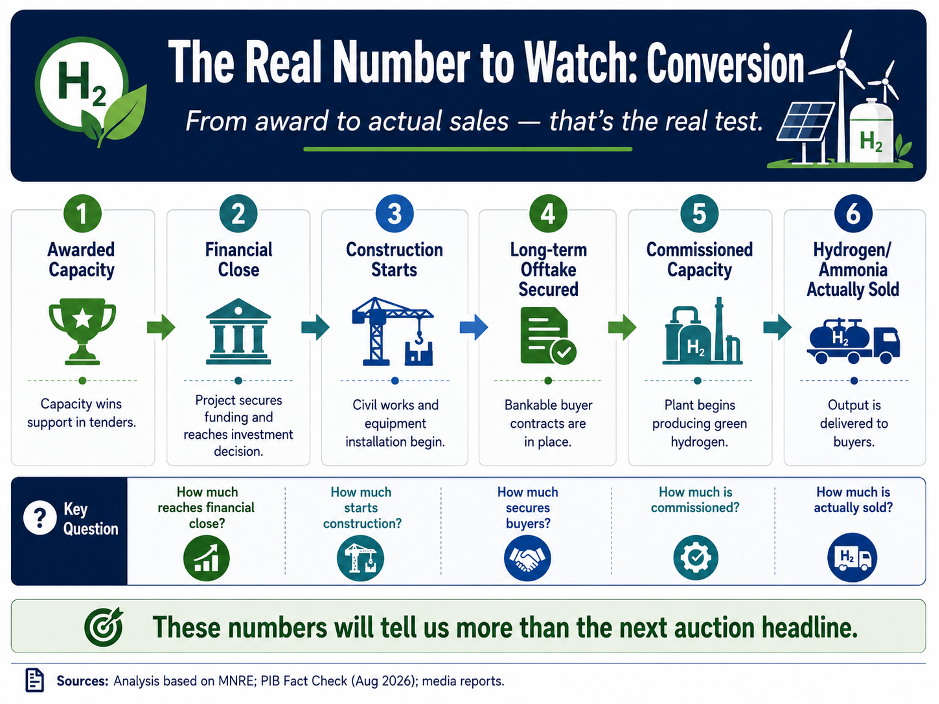
India probably does not need another spectacular hydrogen target.
It needs the existing pipeline to start turning into plants.
How much awarded capacity reaches financial close?
How much starts construction?
How much secures long-term buyers?
How much is commissioned?
And once it is commissioned, how much hydrogen or ammonia is actually sold?
Those numbers will tell us more than the next auction headline.
The National Green Hydrogen Mission has already shown that India can attract bidders and allocate incentives. The ammonia procurement programme suggests that it can also organise demand when the contract structure is right.
The next test is harder.
Can the same basic logic work in refining, steel and other industrial markets where the premium is harder to absorb and the technology pathway is less settled?
That is where the chicken-and-egg problem stops being a metaphor.
A developer can win an auction.
A ministry can announce capacity.
An electrolyser can be ordered.
But until somebody is prepared to sign a contract for the output, none of those things necessarily adds up to a hydrogen industry.
References
- Press Information Bureau, Government of India. National Green Hydrogen Mission targets, SIGHT awards, electrolyser manufacturing, hubs and programme implementation. The original draft cited PIB for Mission outlay, programme targets, certification and hub information.
- Business Standard. “Govt spends ₹292 crore under National Green Hydrogen Mission so far: MNRE,” August 2026. Source for Mission expenditure as of 6 August 2026.
- Business Standard. “India may miss 5 MMT green hydrogen output for 2030 target: MNRE Secy,” November 2025. Source for revised expectations around the five-million-tonne target.
- Business Today. “India’s green hydrogen ambitions face a reality check,” June 2026. Used in the original draft for operational capacity and refinery procurement prices.
- SBICAPS, reported by pv magazine India. July 2026. Used for the estimate of roughly 10,000 tonnes per year of operational green-hydrogen capacity and comparisons with awarded capacity.
- Centre for Social and Economic Progress (CSEP). Benchmarking Green Hydrogen in India’s Energy Transition: Expensive but Important for Some Uses. Used for hydrogen cost estimates, the importance of renewable electricity, electrolyser utilisation and the case for prioritising direct electrification where viable.
- International Energy Agency. Global Hydrogen Review 2026. Used for global low-emissions hydrogen production, final investment decisions, the 2030 pipeline and electrolysis capacity at risk of delay.
- Uniper. January 2026 announcement of the binding long-term agreement with AM Green for up to 500,000 tonnes per year of renewable ammonia from India, with shipments expected as early as 2028.
- IEEFA. Enabling sustainable demand for green hydrogen in India. Used for the case for demand-side obligations and sectoral hydrogen demand.
- RMI. Hydrogen Reality Check: Distilling Green Hydrogen’s Water Consumption. Source for approximately nine litres per kilogram of stoichiometric electrolysis water demand and roughly 20–30 litres per kilogram for total plant consumption.
- Press Information Bureau / Ministry of Steel. Official updates on green-hydrogen pilot projects in the steel sector. The fact-check notes that by July 2026 four pilots had been awarded and cautions against relying on the older three-project description.
- TransitionZero. Green steel, hour by hour: decarbonising India’s steel, 2026. Used for the modelled cost impact of clean electricity and hydrogen blending in selected natural-gas DRI and electric-steel configurations.
- Ministry of New and Renewable Energy. Green Hydrogen Certification Scheme of India, issued April 2025. The certification scheme defines carbon-intensity qualification but does not constitute statutory approval to build or operate a plant.
- European Union RFNBO framework and recognised certification routes. Used for the distinction between Indian GHCI certification and compliance with European requirements on additionality, temporal and geographic correlation and lifecycle emissions. The fact-check notes that GHCI alone should not be described as the required or sufficient route for EU compliance.
- Indian hazardous-chemical, pressure-vessel and hydrogen safety frameworks, including India Code, BIS and PESO requirements. Used for the qualification that neither green certification nor ammonia’s commercial familiarity removes process-safety, hazardous-chemical, storage and emergency-response obligations.

An extremely well researched and well articulated article.
Thanks for the efforts and putting it in such easy to understand language.