BRICS 2026 — India as Chair: What Is Really at Stake
Advance information version for policy discussion
India· 20 August 2026
Situation current as of publication. Developments concerning West Asia, maritime traffic and U.S. trade policy remain fluid.
| The central proposition: India has influence as BRICS chair, but not control. In a consensus-based grouping, the ability to shape process may be the most meaningful form of power available. |
India took over the BRICS chair on 1 January 2026 for the fourth time, after presidencies in 2012, 2016 and 2021. But this is not the BRICS India chaired before.
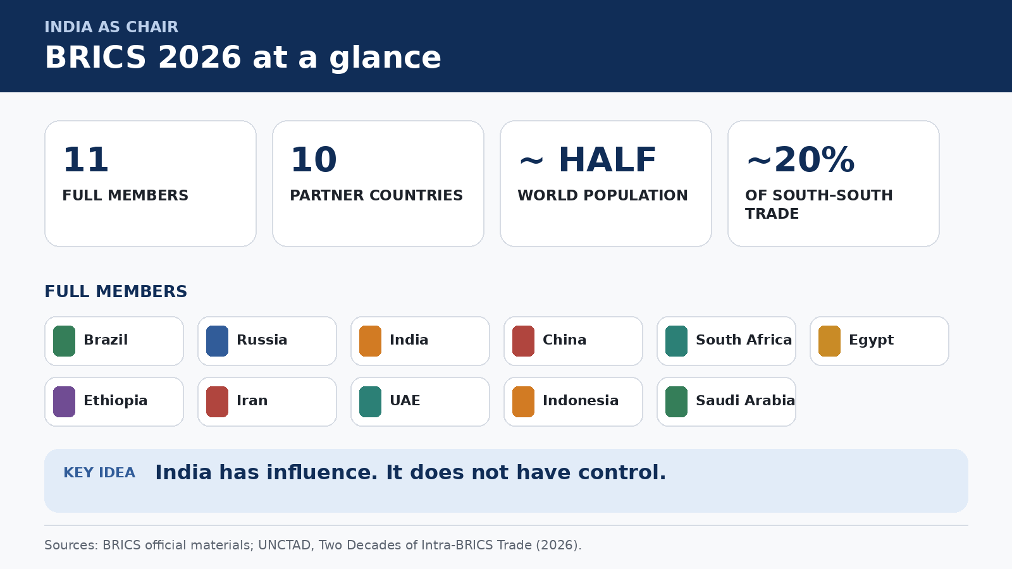
The grouping now has eleven full members — Brazil, Russia, India, China, South Africa, Egypt, Ethiopia, Iran, the United Arab Emirates, Indonesia and Saudi Arabia — alongside ten partner countries. Expansion has increased BRICS’ reach and representation. It has also made consensus more difficult.
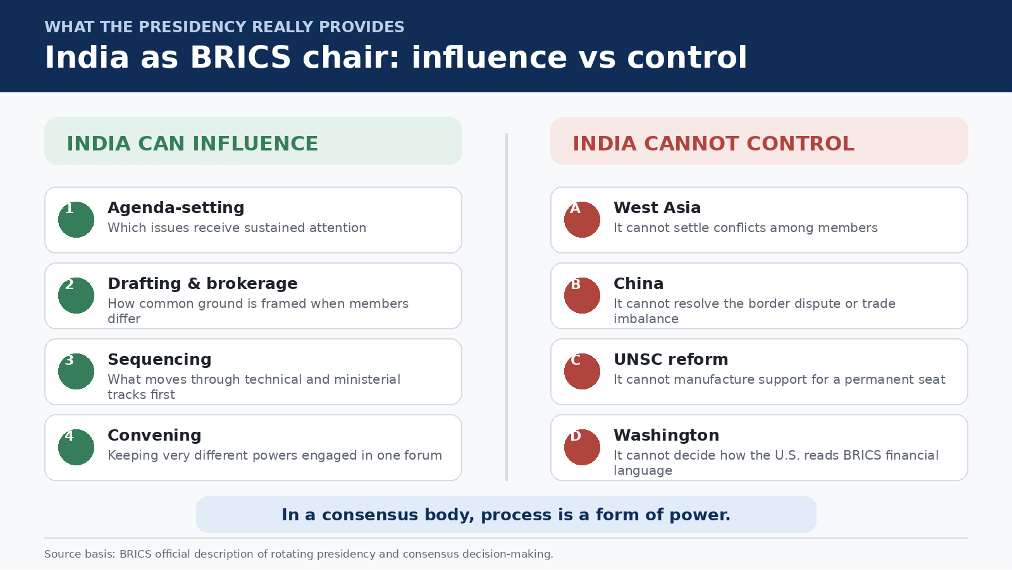
New Delhi cannot use the presidency to settle the war in West Asia, resolve its border dispute with China, determine the future of the international monetary system or secure a permanent UN Security Council seat. What it can do is set priorities, organize the process, broker language, sequence negotiations and identify the narrow ground on which eleven very different governments can still act together.
That may sound procedural. In a consensus-based body, however, procedure is often where influence resides.
A larger BRICS, but still a loosely integrated one
BRICS’ scale is impressive. The grouping represents close to half the world’s population and a major share of global output and trade. Yet those aggregate figures can overstate the degree of economic integration among its members.
UNCTAD estimates that BRICS countries account for more than two-thirds of Global South GDP, while intra-BRICS trade represents only about one-fifth of South–South trade. Intra-BRICS merchandise exports reached roughly $1.17 trillion in 2024 — substantial in absolute terms, but still modest relative to the economic weight of the group.
India-China trade illustrates the asymmetry. Indian government data show bilateral goods trade of about $151 billion in FY2025–26, with India running a merchandise deficit of roughly $112 billion. That deficit does not eclipse most intra-BRICS commerce, but it does show how BRICS can widen India’s diplomatic space while leaving important economic dependencies unresolved.
That tension helps explain India’s emphasis on supply-chain resilience, critical minerals, pharmaceuticals, technology, food security, digital public infrastructure and development finance. These are areas where practical cooperation may be possible without requiring agreement on the geopolitical order.
West Asia has exposed the limits of consensus
The difficulty became visible at the BRICS Foreign Ministers’ Meeting in New Delhi in May. The ministers did not issue a conventional joint declaration. India instead released a Chair’s Statement and Outcome Document that preserved areas of agreement while acknowledging differences over West Asia.
The enlarged BRICS now contains both Iran and the UAE as full members. Expansion has therefore brought regional rivalries directly into the grouping. This is one of the less discussed costs of enlargement: a more representative BRICS is also one in which members are more likely to disagree on wars, regional security and relations with the United States.
India could not eliminate those disagreements. What it could do was prevent them from overwhelming the entire agenda. That is a useful way to understand the chairmanship: the chair cannot manufacture consensus, but it can preserve cooperation where consensus still exists.
Hormuz makes the dispute directly relevant to India
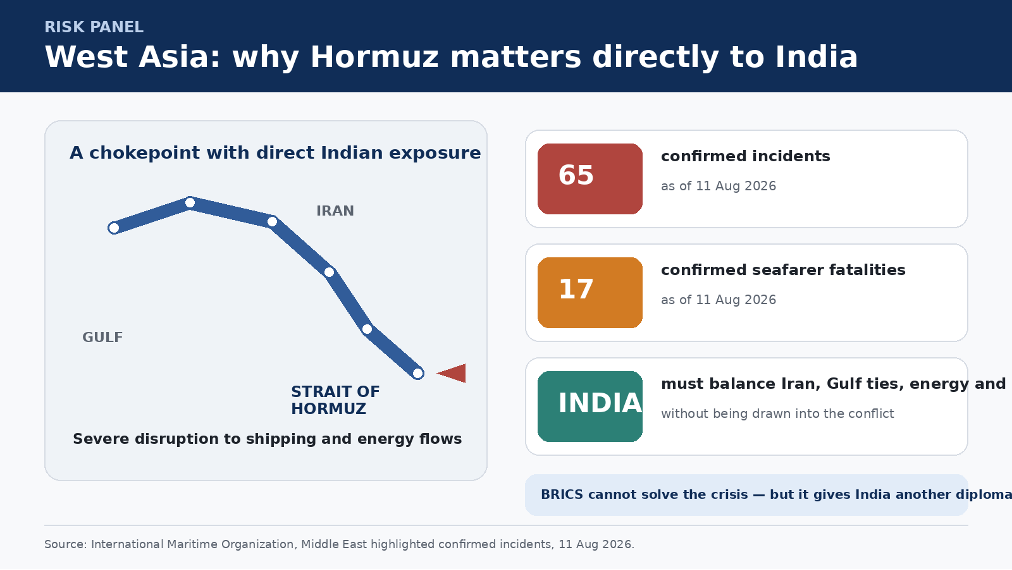
For India, instability in West Asia is not a distant diplomatic problem. Indian energy supplies, shipping, commercial interests and a large expatriate population are tied to the Gulf. Disruption around the Strait of Hormuz therefore carries direct economic and security consequences.
The International Maritime Organization had recorded 65 confirmed incidents and 17 confirmed seafarer fatalities in the current Middle East maritime crisis as of 11 August 2026. Traffic through the Strait has been severely disrupted, although describing Hormuz as completely “closed” would be too categorical while some shipping continues.
India’s objective is practical: protect energy flows, preserve maritime access, maintain workable relations with both Iran and the Gulf Arab states, and avoid direct entanglement in the conflict. BRICS cannot resolve that dilemma. It does, however, give India another diplomatic forum in which several relevant actors are already present.
Washington complicates the financial agenda
A second pressure comes from the United States. BRICS discussions about local-currency settlement, alternative payment mechanisms and financial architecture are often interpreted in Washington as evidence of a coordinated effort to weaken the dollar. India’s position is more cautious.
New Delhi has supported lower-cost cross-border settlement, greater use of national currencies where commercially viable, payment-system interoperability and reform of international financial institutions. That is not the same thing as supporting a common BRICS currency.
In February 2026, Washington and New Delhi announced a framework for an interim trade agreement that included an 18% U.S. reciprocal tariff rate on qualifying Indian goods, tariff reductions by India across a number of categories and an Indian intention to purchase $500 billion of specified U.S. goods over five years. The White House separately linked part of its tariff treatment to what it described as India’s commitment concerning Russian oil purchases.
The legal environment then shifted again. On 20 February, the U.S. Supreme Court ruled that the International Emergency Economic Powers Act did not authorize the challenged tariffs imposed under that statute. The decision did not eliminate presidential tariff authority generally; it narrowed one legal basis for exercising it.
For India, the diplomatic implication is straightforward. New Delhi has little incentive to allow a BRICS declaration to be portrayed as an anti-dollar manifesto while its own economic relationship with Washington remains legally and politically fluid. India can support diversification without embracing confrontation. For New Delhi, the useful word is interoperability — not replacement.
China remains the central contradiction
India’s relationship with China has stabilized from its most difficult period after the 2020 border crisis, but improved atmospherics should not be mistaken for strategic resolution. The boundary dispute remains unsettled, the trade imbalance remains large, and India is trying to reduce dependence in sectors where Chinese industrial capacity is difficult to replace.
This gives the BRICS presidency an awkward internal logic. India needs China if major BRICS initiatives are to succeed. At the same time, China is central to some of India’s largest strategic concerns.
The same contradiction is visible in UN Security Council reform. BRICS declarations have supported a greater role for India and Brazil in the United Nations, including the Security Council, but they have stopped short of collectively endorsing permanent membership for India. China has not provided the explicit endorsement New Delhi seeks. Yet it would be too strong to say Beijing alone blocks the bid: reform requires a wider UN process, including ratification by all five permanent members.
Pakistan and the politics of enlargement
Pakistan has expressed interest in joining BRICS. India does not possess a unique legal veto over Pakistan, but because BRICS takes decisions by consensus, India — like every other existing member — can withhold agreement.
The additional advantage of the chair lies in process. A presidency can emphasize membership criteria, institutional consolidation and sequencing. Difficult applications can be moved through technical discussion rather than turned immediately into public political confrontations.
That may suit New Delhi. India has an interest in preventing enlargement from moving faster than the institution can absorb new members. It also has obvious strategic concerns about Pakistan’s entry. The most effective use of the chair may therefore not be a dramatic public rejection, but shaping the conditions under which enlargement is considered.
What the chair actually gives India
Stripped of ceremony, India’s presidency offers four practical instruments: agenda-setting, drafting and brokerage, sequencing, and convening power.
Agenda-setting allows India to decide which issues receive sustained political attention. Drafting and brokerage matter when governments disagree and common language has to be salvaged. Sequencing allows difficult issues to move through technical and ministerial tracks before reaching leaders. Convening power matters because India occupies an unusual position: it is a Quad member, a major economic partner of the United States, a longstanding defence partner of Russia and a strategic competitor of China that continues to work with Beijing in multilateral forums.
That does not make India neutral. It makes India difficult to place neatly within either a Western or anti-Western camp. For New Delhi, that ambiguity is an asset.
The NDB and digital infrastructure: where practical BRICS may matter
The New Development Bank remains one of the clearest examples of BRICS cooperation becoming more tangible than a declaration. Its history is also a reminder not to overstate the role of any single presidency. BRICS leaders considered establishing a development bank in 2012, agreed on its feasibility in 2013, and signed the agreement establishing the NDB at the 2014 Fortaleza Summit. India played an important early role; it did not create the institution alone.
As of June 2026, the five founding members each held 18.72% of subscribed capital, while several newer shareholders held much smaller stakes. For India, the bank matters because it provides an additional development-finance channel in which the United States does not hold a governance vote. But it remains exposed to funding costs, credit ratings, sanctions risk, market access and its own lending policies.
India also has a practical proposition in digital public infrastructure. Aadhaar, UPI and DigiLocker allow New Delhi to point to systems operating at population scale. The credible opportunity for BRICS is not to assume other countries will copy Indian platforms wholesale, but to share standards, regulatory experience and approaches to interoperability.
Any cross-border payment or central-bank digital-currency initiative would still have to deal with anti-money-laundering rules, sanctions compliance, cybersecurity, privacy, capital controls and settlement arrangements. In that sense, the plumbing carries politics with it. Practical interoperability may therefore be easier for India to champion than a grand common-currency project.
Is BRICS being taken too seriously?
There is a legitimate counterargument. BRICS has no supranational political authority, no collective-defence system and no mechanism compelling members to adopt a common geopolitical position. Its members often disagree, and the May meeting showed how quickly consensus can break.
But the criticism should not be taken too far. The NDB exists because BRICS governments collectively created it, and the grouping has built a substantial network of financial, political, technical and sectoral cooperation. The more accurate criticism is narrower: BRICS has rarely demonstrated an ability to take binding collective action on major geopolitical disputes.
For India, that may not be the relevant standard. New Delhi does not need BRICS to become NATO or the European Union. It needs BRICS to remain useful — as a diplomatic forum, a development institution, a place to engage Russia and China, and an additional arena in which India can widen its strategic options.
Four things to watch in September
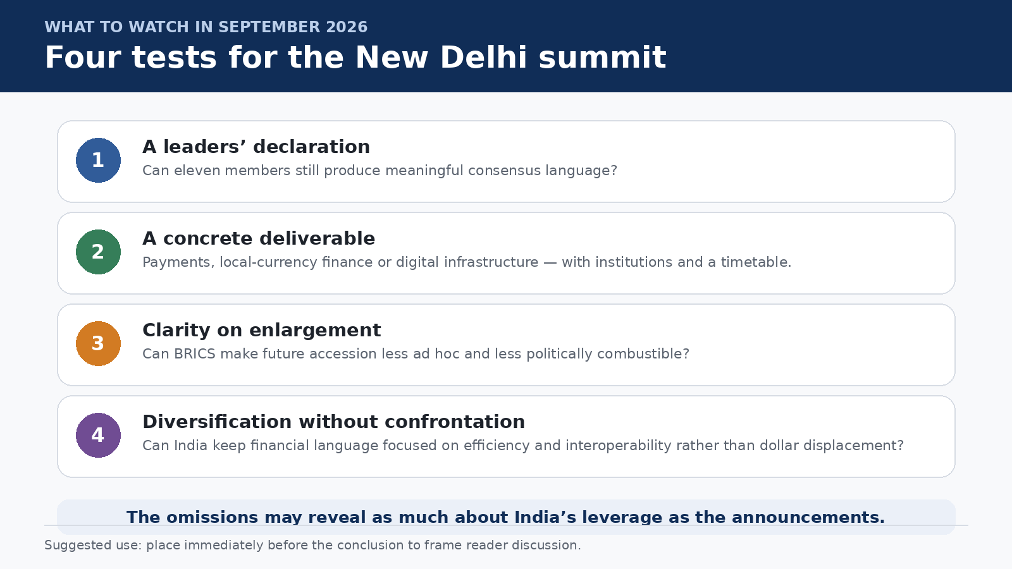
Rather than judge the New Delhi summit by choreography, four outcomes may tell us whether India’s presidency is working: whether the eleven members can agree on a leaders’ declaration; whether there is a concrete economic or technology deliverable; whether BRICS creates greater clarity around enlargement; and whether India can preserve the distinction between financial diversification and geopolitical confrontation.
Those tests matter because each can be observed. They turn a broad debate about BRICS into a set of outcomes against which India’s chairmanship can later be assessed.
The real test of India’s chairmanship
India’s foreign policy increasingly rests on a difficult proposition: relationships do not have to be exclusive. India can participate in the Quad and remain inside BRICS. It can deepen ties with the United States and Europe while maintaining a longstanding relationship with Russia. It can work with Iran while building close partnerships across the Gulf. It can compete with China and still negotiate with Beijing in multilateral forums.
In calmer times, that looks like strategic flexibility. In 2026, it looks more like a stress test. Several of those relationships are under pressure at the same time, and India happens to hold the BRICS chair while those pressures converge.
The real question is therefore not whether India can force eleven governments into a common worldview. It cannot. Nor is it whether BRICS is about to become a coherent geopolitical alliance. It is not.
The more interesting question is whether India can keep a divided institution useful: preventing conflict among members from overwhelming cooperation, producing enough practical value to justify the attention BRICS now attracts, managing enlargement without making consensus impossible, and preserving the strategic room for manoeuvre that makes the forum useful to India in the first place.
If New Delhi manages that, September may not produce a spectacular summit. The declaration may be cautious, the deliverables technical, and some disagreements simply parked. That may be precisely the point.
India’s real power as BRICS chair is not the power to make eleven governments think alike. It is the ability to keep eleven governments in the room when they do not; to identify the narrow territory on which agreement remains possible; and to prevent everything they disagree about from consuming everything they still have reason to do together.
That is influence without control — and in the BRICS of 2026, it may be the most meaningful form of leadership available.
| Discussion prompt: When the New Delhi summit concludes, the most revealing question may not be what BRICS announced, but what India managed to keep eleven very different governments agreeing on. |
References and source notes
- BRICS official overview — membership, presidency, consensus and partner-country structure. https://brics.br/en/about-the-brics
- BRICS — Vietnam joins as a Partner Country, 13 June 2025. https://brics.br/en/news/vietnam-joins-brics-as-a-partner-country/
- UNCTAD — Two Decades of Intra-BRICS Trade: Trends, Patterns and Policies. https://unctad.org/publication/two-decades-intra-brics-trade-trends-patterns-and-policies
- Embassy of India, Beijing — India-China Trade and Economic Relations. https://www.eoibeijing.gov.in/page/trade-and-economic-relation/
- Ministry of External Affairs, India — BRICS 2026 materials and Foreign Ministers’ Meeting documents. https://www.mea.gov.in/
- International Maritime Organization — Middle East: Highlighted (Confirmed) Incidents. https://www.imo.org/en/mediacentre/hottopics/pages/middle-east-highlighted-incidents.aspx
- White House — United States–India Joint Statement, February 2026. https://www.whitehouse.gov/briefings-statements/2026/02/united-states-india-joint-statement/
- White House — Fact Sheet: United States and India Announce Historic Trade Deal. https://www.whitehouse.gov/fact-sheets/2026/02/fact-sheet-the-united-states-and-india-announce-historic-trade-deal/
- U.S. Supreme Court — Learning Resources, Inc. v. Trump, February 2026. https://www.supremecourt.gov/opinions/25pdf/24-1287_4gcj.pdf
- BRICS — Rio de Janeiro Declaration, 2025. https://brics.br/en/documents/presidency-documents/250705-brics-leaders-declaration-en.pdf/@@download/file
- United Nations Charter — Article 108. https://www.un.org/en/about-us/un-charter/chapter-18
- New Development Bank — History. https://www.ndb.int/about-ndb/history/
- New Development Bank — Shareholding. https://www.ndb.int/about-ndb/shareholding/
- New Development Bank — Investor Presentation, June 2026. https://www.ndb.int/wp-content/uploads/2026/06/New-Development-Bank_Investor-Presentation_June_2026-1.pdf
- BRICS — Areas of Cooperation. https://brics.br/en/about-the-brics/areas-of-cooperation