Private Philanthropy and Nation Building: Lessons from the World and from India
In Brief
Private philanthropy has never matched government spending, but it has repeatedly shaped how nations develop. It has built lasting institutions, funded risky research and tested ideas that governments later scaled up, from America’s public libraries to India’s Green Revolution and its first great institutes of science.
- Global giving is at a record. Americans gave $617 billion in 2025, and the Gates Foundation plans to spend $200 billion before it closes in 2045.
- India’s roots run deep. The traditions of daan and Gandhi’s trusteeship, along with families such as the Tatas, Birlas and Sarabhais, built many of India’s leading institutions.
- Indian giving is booming. Private philanthropy reached about ₹1.43 lakh crore in FY25, and corporate social responsibility (CSR) spending hit a record ₹40,794 crore.
- It is still not enough. To stop India’s social sector funding gap from widening, private giving would need to grow by over 25 per cent a year. Today it grows by 9 to 11 per cent.
- The approaches that work are well known: build institutions, partner with government, take risks and fund for the long term. Givers also need to stay accountable and reach the regions in greatest need.
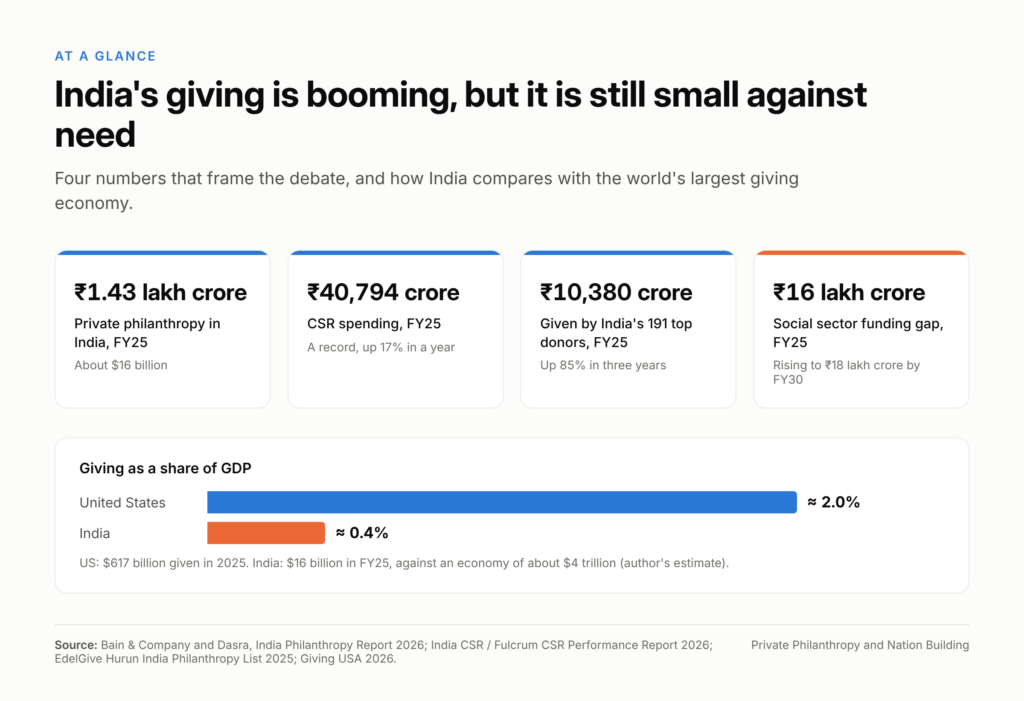
Figure 1. India’s giving at a glance
Why Private Giving Still Matters
Nations are built by governments, markets and citizens. But in almost every country that has made a leap in human development, a fourth force has quietly shaped the outcome: private philanthropy. It funded the universities that trained a nation’s scientists. It seeded the research that conquered diseases. It built libraries, hospitals and institutes that governments later scaled. And it took risks on ideas that no budget committee would approve.
Philanthropy is not a substitute for the state. Even in the United States, the world’s largest giving economy, charitable donations amount to only about two per cent of GDP. In India, public spending accounts for roughly 95 per cent of all social sector funding, according to the India Philanthropy Report 2026 by Bain & Company and Dasra. Private giving, then, is small in comparison. Its power lies elsewhere: in its freedom to experiment, its patience, and its ability to build institutions that outlast any single government.
The story has two strands. The first is global: how giving in America and Europe built the modern foundations that now operate across continents. The second is Indian: how an ancient culture of giving became a force for nation building, and how corporate law and new wealth are now reshaping it. Both strands lead to the same question. How can India’s fast-growing private wealth help build a developed nation, Viksit Bharat, by 2047?
Where It Began: Carnegie, Rockefeller and the Green Revolution
Modern institutional philanthropy took shape in the United States in the late nineteenth century. In 1889, the steel magnate Andrew Carnegie published his essay “The Gospel of Wealth”. He argued that the rich were trustees of their fortunes and that dying wealthy was a disgrace. Carnegie then funded more than 2,500 public libraries across the English-speaking world, along with universities, research institutions and peace foundations. The libraries alone opened knowledge to millions of working people who could never have bought books.
John D. Rockefeller went further by bringing a scientific approach to giving. The Rockefeller Foundation, set up in 1913, did not simply give relief. It attacked root causes. Rockefeller’s campaign against hookworm in the American South, the Foundation’s support for public health schools, and its funding of medical research helped create the field of modern public health. Later, together with the Ford Foundation, it backed the agricultural research of Norman Borlaug and the high-yield seed programmes that became the Green Revolution.
That Green Revolution is one of the clearest cases of private philanthropy shaping a nation’s destiny, and the nation was India. In the 1960s, foundation-funded research, seeds and expertise worked alongside the Indian government, agricultural universities and scientists such as M.S. Swaminathan. The result was a dramatic rise in wheat and rice yields. India moved from dependence on food aid towards food self-sufficiency within a decade. The Ford Foundation, which opened its India office in 1952, also supported community development, management education and many early research institutions.
These early givers set a pattern that still holds. Their greatest impact came when they built lasting institutions and worked alongside governments, not around them. A century later, the same pattern is playing out on a far larger scale.
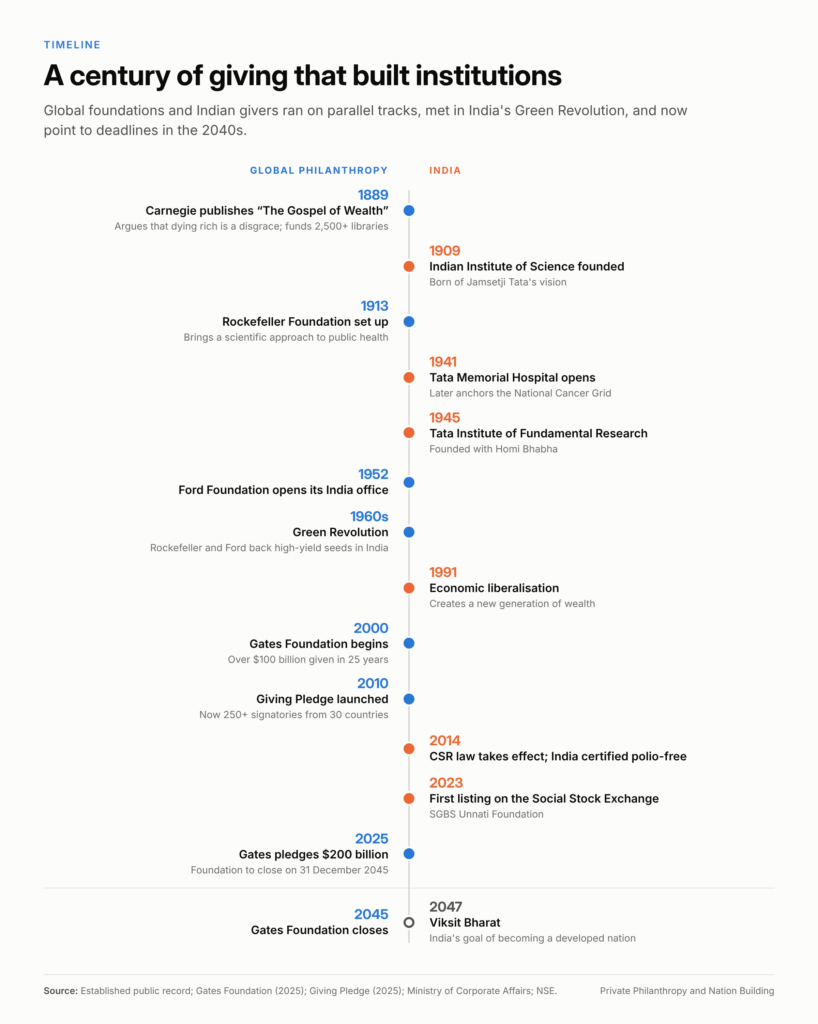
Figure 2. Milestones in private philanthropy, world and India, 1889 to 2047
The timeline above shows the two threads running side by side. Early global foundations helped shape India’s Green Revolution, and India’s own givers built its first great scientific institutions. Both now point towards deadlines in the 2040s.
The Age of Mega-Philanthropy
Global philanthropy is now larger and more ambitious than ever. American donors gave a record $617.2 billion in 2025, the first time annual giving crossed $600 billion, according to Giving USA 2026. Individuals gave about $394 billion of that, and foundations about $117 billion. Giving is also becoming more concentrated among the very rich, with a handful of mega-donors accounting for tens of billions.
The Gates Foundation is the defining institution of this era. Since 2000 it has spent over $100 billion, mainly on global health. Its work with partners such as Gavi, the vaccine alliance, and the Global Fund helped vaccinate hundreds of millions of children and push polio to the edge of eradication. In May 2025, Bill Gates announced that the foundation would spend around $200 billion over twenty years and close on 31 December 2045. The goals are to end preventable deaths of mothers and babies, eradicate polio and malaria, and lift millions out of poverty.
Other models matter too:
- Enterprise foundations. Denmark’s Novo Nordisk Foundation controls the Novo Nordisk pharmaceutical company. With an endowment of over $100 billion, it is one of the world’s wealthiest foundations, and profits from medicines fund science, health and sustainability research. The UK’s Wellcome Trust plays a similar role in biomedical research. India’s Tata Trusts, discussed below, are an older example of the same model.
- Collective pledges. The Giving Pledge, launched by Bill Gates, Melinda French Gates and Warren Buffett in 2010, now has over 250 signatories from 30 countries. Indian signatories include Azim Premji, Nandan and Rohini Nilekani, and Kiran Mazumdar-Shaw.
- Trust-based giving. MacKenzie Scott has given away billions in large, unrestricted grants to community organisations, with few reporting demands. Her approach has pushed the field to trust grantees more.
- Giving beyond the West. The Mastercard Foundation invests in jobs and education for young Africans. The Mo Ibrahim Foundation promotes good governance in Africa through its annual index. In Asia, the Li Ka Shing Foundation built Shantou University in China.
- Philanthropy for public goods. Foundations increasingly fund digital public infrastructure, climate solutions and AI for health, areas where markets underinvest.
This scale arrives at a delicate moment. Since 2025, the United States, the United Kingdom and several European donors have cut foreign aid sharply. Foundations are now being asked to fill gaps they were never designed to fill alone. For India, the shift raises a different question. India increasingly funds its own development rather than relying on aid, so can its own givers do for India what Carnegie and Rockefeller did for America? To answer that, we must start with India’s long tradition of giving.
From Daan to Trusteeship: India’s Giving Heritage
Giving is woven into Indian life. Hindu traditions speak of daan and seva, Islam of zakat, Sikhism of dasvandh and the langar, and Jainism and Buddhism of compassion and generosity. For centuries, merchant communities built temples, wells, dharamshalas, schools and water tanks. This giving was local and often religious. But it created a deep habit of private resources serving public needs.
In the late nineteenth and early twentieth centuries, Indian industrialists turned that habit into nation building. Jamsetji Tata believed India needed science and industry to be free and strong. His vision led to the Indian Institute of Science in Bengaluru, founded in 1909. The Tata Trusts later created the Tata Institute of Social Sciences, the Tata Memorial Hospital for cancer care, and, with Homi Bhabha, the Tata Institute of Fundamental Research in 1945, the cradle of India’s atomic energy programme. Because the Tata Trusts own the majority of Tata Sons, a large share of the group’s profits has flowed to public causes for over a century. Ratan Tata, who died in 2024, carried this ethic into modern times.
Other families followed. The Birlas founded BITS Pilani and many other colleges, and supported the freedom movement. Jamnalal Bajaj was a close ally of Mahatma Gandhi and funded constructive work in villages. In Ahmedabad, the Sarabhai and Lalbhai families helped establish the Physical Research Laboratory, the Indian Institute of Management Ahmedabad and textile research bodies. Vikram Sarabhai, from this tradition, went on to found India’s space programme.
Gandhi himself gave this giving a philosophy. His idea of trusteeship held that the wealthy should see themselves as trustees of their wealth for society. In many ways, it was India’s answer to Carnegie, rooted in Indian values. After independence, the state took the lead in development. Yet these private institutions remained the backbone of Indian science, education and health. Economic liberalisation in 1991 then created a new generation of wealth, and with it the conditions for today’s giving boom.
India’s Giving Boom: CSR, Billionaires and New Donors
Private philanthropy in India reached an estimated ₹1.43 lakh crore ($16 billion) in FY25, according to the India Philanthropy Report 2026 by Bain & Company and Dasra. Families are its backbone, contributing about 42 per cent of private giving through personal donations and the CSR of family-run businesses. Two forces drive this growth: a world-first CSR law, and a new class of wealthy Indians giving at scale.
Relative to the size of its economy, though, India still gives little. American giving equals about 2 per cent of US GDP. India’s $16 billion is roughly 0.4 per cent of an economy of about $4 trillion. Experts say the issue is not only how much money there is, but how it is organised. Bhavini Malhotra, a partner at Bain & Company, asks whether India’s philanthropic capital is “structured to solve at scale”.
The CSR Mandate: A World First
In 2013, India became the first major economy to make corporate giving a legal duty. Section 135 of the Companies Act requires larger profitable companies to spend at least 2 per cent of their average net profit on social causes. It applies to firms with a net worth of ₹500 crore or more, turnover of ₹1,000 crore or more, or net profit of ₹5 crore or more, and took effect in April 2014. Annual CSR spending reached a record ₹40,794 crore in FY 2024-25, a rise of 17 per cent in one year. Education received the largest share, ₹13,877 crore, followed by healthcare at ₹8,531 crore. Reliance Industries, HDFC Bank and Tata Consultancy Services were the top spenders. Cumulative CSR spending since the law began has crossed ₹2.6 lakh crore, a sum that has funded schools, hospitals, skilling centres, water projects and clean energy across the country.
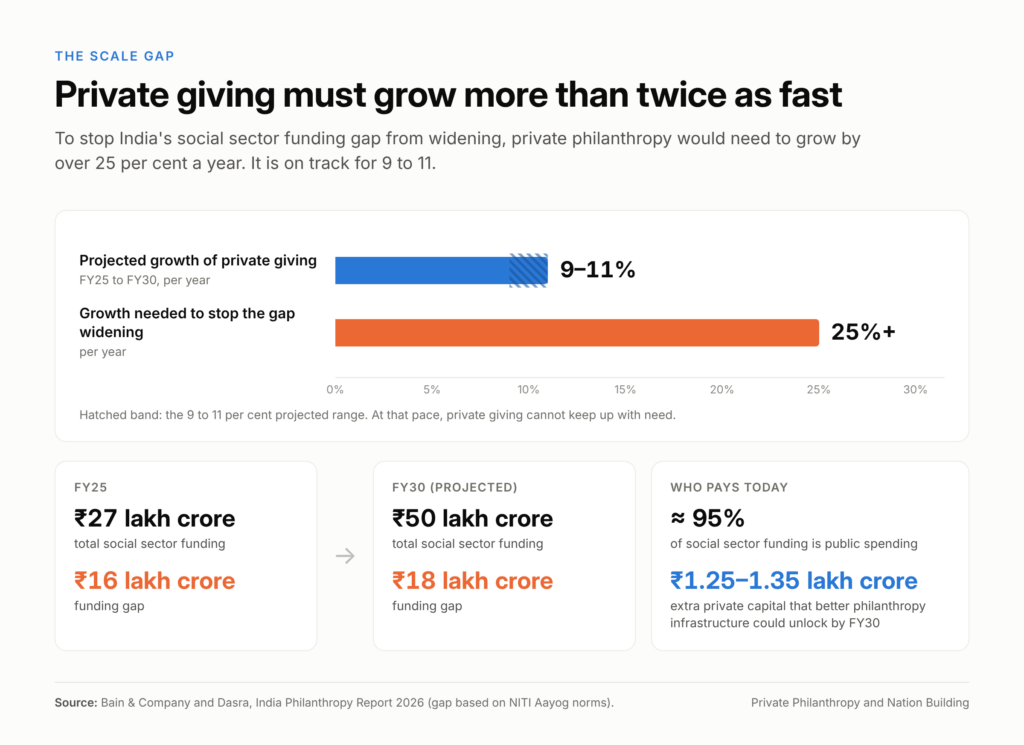
Figure 3. Where India’s CSR money goes, FY 2024-25
The Rise of Big Family Giving
Alongside CSR, personal giving by India’s wealthiest has grown fast. The EdelGive Hurun India Philanthropy List 2025found that 191 donors gave ₹10,380 crore in FY25, an 85 per cent rise over three years.
| Rank | Donor | Giving in FY25 (₹ crore) | Main focus |
| 1 | Shiv Nadar and family | 2,708 | Education, arts, rural schools |
| 2 | Mukesh Ambani and family | 626 | Health, education, rural development |
| 3 | Bajaj family | 446 | Skilling, education, rural livelihoods |
| 8 | Rohini Nilekani | 204 | Civil society, water, democracy |
The most striking commitment remains Azim Premji’s. Through successive gifts, he has dedicated most of his wealth, including about two-thirds of the economic ownership of Wipro, to the Azim Premji Foundation. In 2019 the endowment was valued at around $21 billion. The foundation works with state governments to improve public schools, trains teachers, and runs Azim Premji University in Bengaluru and Bhopal, and, since 2026, at a third campus near Ranchi.
New Donors, New Causes, New Tools
The donor base is widening. Young founders such as Nikhil and Nithin Kamath and Binny Bansal are giving early in life rather than late. Women lead philanthropic decisions in over 60 per cent of giving families, according to the Bain-Dasra report. Causes are also broadening beyond education and health to climate, gender equity, livelihoods, and arts and heritage.
Ordinary citizens matter too. Online platforms and crowdfunding have made small donations easy, and festivals such as Daan Utsav, the annual “Joy of Giving” week, encourage everyday generosity. Section 80G of the Income Tax Act gives donors a tax deduction for gifts to registered charities. India has also created a Social Stock Exchange. Market regulator SEBI set out its rules in 2022, and the first non-profit, SGBS Unnati Foundation, listed in December 2023. Non-profits can now raise money from the public through a regulated market, using special zero-coupon, zero-principal bonds. These tools are still young, but they could turn giving from an elite activity into a national habit.
Six Principles of Nation-Building Philanthropy
Across a century and three continents, the giving that has truly built nations shares six features.
- Build institutions, not just projects. As the Carnegie libraries and the Tata institutes show, institutions keep producing talent and ideas long after the first cheque is spent. A well-run university or research centre compounds its impact over generations.
- Partner with government to reach scale. The state has the reach, and philanthropy has the flexibility. India was certified polio-free in 2014 after a campaign that combined government muscle with funding and expertise from Rotary, the Gates Foundation and others. The Akshaya Patra Foundation runs kitchens for the government’s mid-day meal scheme and feeds millions of schoolchildren.
- Take risks that governments cannot. Private money can test new ideas, fail and try again, and successful pilots can then be adopted by the state. Aravind Eye Care’s low-cost cataract surgery model began this way. Pratham’s ASER surveys changed India’s education debate by measuring whether children actually learn, not just whether they enrol.
- Fund public goods and shared infrastructure. The EkStep Foundation, co-founded by Nandan and Rohini Nilekani, backed open digital tools for education whose work fed into the government’s DIKSHA platform. Funding data, research and open technology strengthens entire systems, not just single beneficiaries.
- Be patient and trust partners. Social change takes decades. Long-term, flexible grants that cover salaries and systems, not just project costs, let NGOs build strong teams and adapt to what they learn.
- Collaborate. Pooled funds let donors combine money and knowledge against problems too big for any one of them. Gavi, the vaccine alliance, brings governments and foundations together to buy vaccines at scale. In India, the Tata Trusts’ Collectives for Integrated Livelihood Initiatives and Dasra’s adolescent-focused collaborative bring multiple funders behind a single agenda.
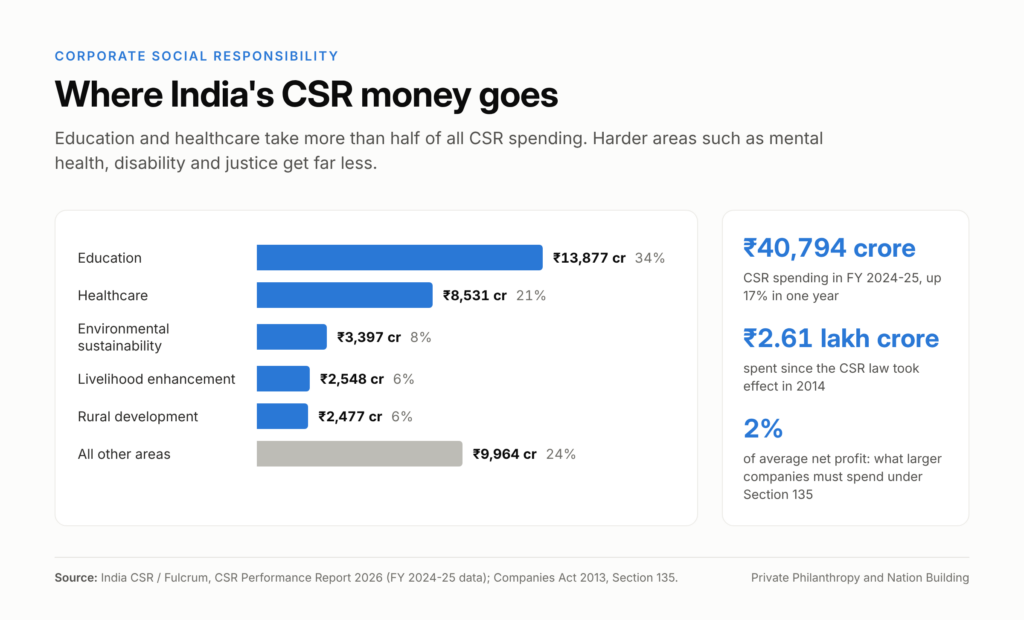
Figure 4. Six principles of nation-building philanthropy
Three Case Studies in Nation-Building Philanthropy
Three Indian stories show these principles at work: an institution that became national infrastructure, a public-private health campaign, and a long-term partnership with state schools.
Tata Memorial: from private hospital to national cancer network
The Sir Dorabji Tata Trust opened the Tata Memorial Hospital in Mumbai in 1941, when cancer care in India barely existed. In 1962 it came under the government’s Department of Atomic Energy, which shows a private institution growing into a public one. Today the Tata Memorial Centre anchors the National Cancer Grid, a network linking cancer centres across India to share treatment standards, training and research. A single philanthropic hospital became the backbone of a national system. Principles shown: build institutions; partner with government.
Polio: how partnership ended a disease
In the 1990s, India had more polio cases than any other country, and many experts doubted it could ever be eliminated there. The government’s Pulse Polio campaign ran national immunisation days that reached well over 100 million children at a time. Rotary International, the Gates Foundation, WHO and UNICEF provided funding, vaccines, surveillance and technical help. India recorded its last case in January 2011 and was certified polio-free in 2014. Principles shown: partner with government; collaborate.
Azim Premji Foundation: working inside the public system
Rather than building a parallel network of private schools, the Azim Premji Foundation chose to strengthen government schools, where most poor children study. It works alongside state education departments, trains teachers and runs district-level institutes. Its university in Bengaluru trains the educators and development professionals the sector needs. The foundation measures success in decades, not grant cycles. Principles shown: partner with government; be patient; build institutions.
The Limits of Private Giving
Philanthropy’s record is impressive, but it is not beyond question. A mature conversation on nation building must face its limits.
Power without accountability. Large foundations can shape public priorities, such as which diseases get attention or which school reforms are tried, without facing voters. Critics argue this gives a few rich individuals outsized influence over public policy. The Gates Foundation has long faced this debate in global health.
Pledges versus delivery. A 2025 report by the Institute for Policy Studies, The Giving Pledge at 15, found that many signatories had grown far wealthier since pledging, and that much giving flows into intermediaries such as donor-advised funds rather than to working charities. Pledges are moral promises, not binding contracts.
Uneven geography. In India, money does not always go where need is greatest. A recent Sattva Consulting analysis found that Maharashtra receives nearly 19 times more CSR funding per person than Bihar, partly because companies favour areas near their headquarters and plants. In FY25, Maharashtra alone received ₹8,631 crore, more than a fifth of all CSR spending, while Delhi and Tamil Nadu each received about ₹2,750 crore. Bihar’s multidimensional poverty is nearly five times Maharashtra’s. High-need districts remain underfunded.
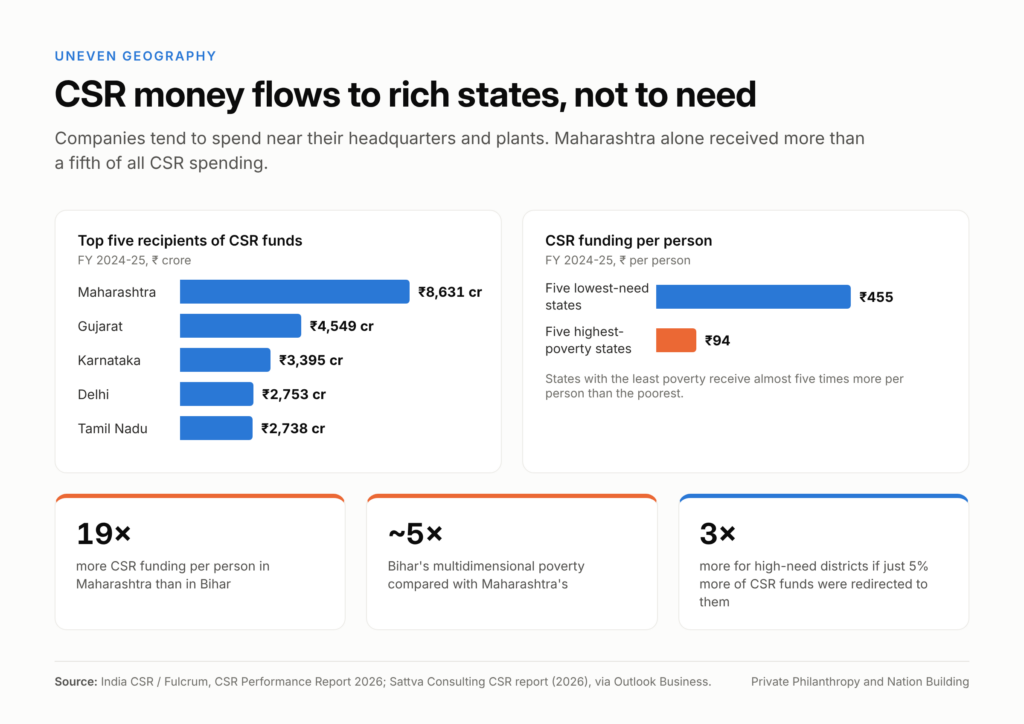
Figure 5. CSR funding by state and need, FY 2024-25
Compliance over impact. Some companies treat CSR as a box to tick. Funds go to safe, visible projects, while harder work, such as mental health, disability, justice or tribal welfare, is neglected. Unspent CSR balances and weak impact measurement remain concerns.
A fragile civil society. NGOs need stable funding to retain talent. Short grants that cover only project costs, not salaries or systems, keep many organisations weak. Amendments in 2020 to the Foreign Contribution (Regulation) Act tightened rules on overseas funding and squeezed some Indian non-profits, which makes domestic giving even more important.
The scale gap. Above all, private giving remains small against need. Bain and Dasra estimate India’s social sector funding gap at about ₹16 lakh crore in FY25. Private philanthropy is growing at 9 to 11 per cent a year but would need to grow at over 25 per cent a year to stop that gap widening.
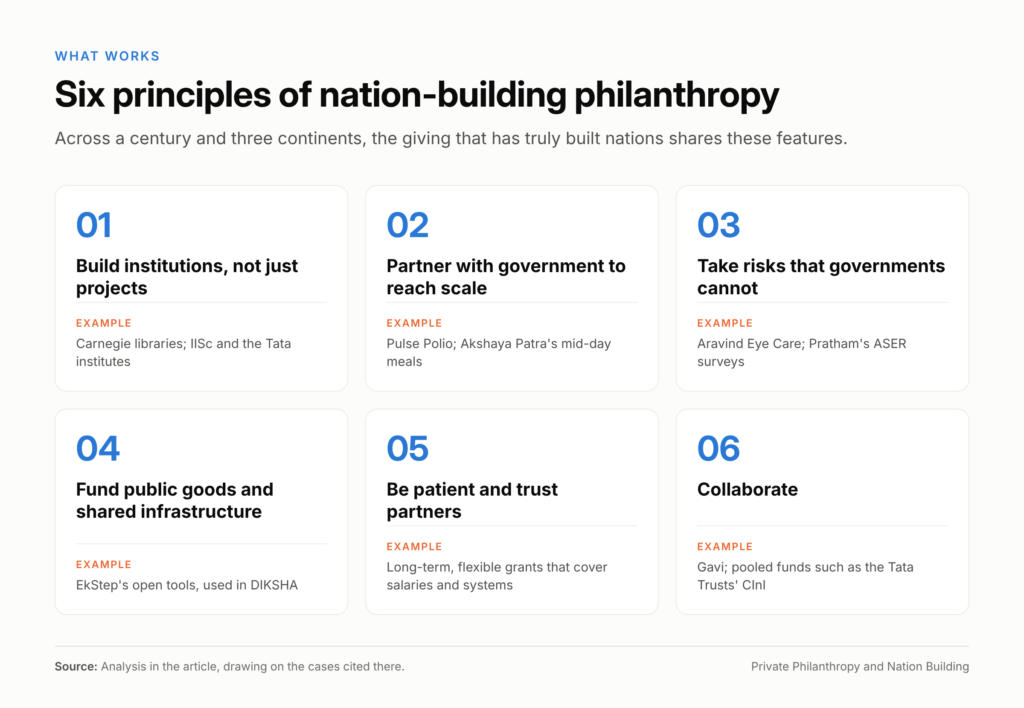
Figure 6. The scale gap: growth needed versus growth projected
What Government Can Do to Unlock More Giving
Philanthropy grows fastest where public policy makes giving easy, trusted and rewarding. Several practical steps, many of them already debated in India’s policy circles, would help:
- Steer CSR towards need. The government could offer incentives for CSR spent in aspirational districts and low-income states. Sattva Consulting estimates that redirecting just 5 per cent of FY25 CSR funds to high-need districts would triple what they receive.
- Strengthen tax incentives for individuals. Simpler and more generous deductions under Section 80G, and quicker digital receipts, would encourage the growing middle class to give regularly.
- Make the Social Stock Exchange work at scale. Tax benefits for donors who buy social bonds, lower listing costs and simpler disclosure would help it grow beyond a few dozen listings.
- Simplify compliance for non-profits. Clear, predictable rules on registration, audits and foreign contributions would let good NGOs spend more time on their work and less on paperwork.
- Publish better data. Open, district-level data on CSR and philanthropy, linked to development indicators, would help donors see where gaps lie and measure what works.
- Match private money with public funds. Government matching schemes, as some countries use for research and endowments, could multiply private gifts to universities, hospitals and research.
Trustees of the Future: Philanthropy and Viksit Bharat 2047
India stands at a turning point. It is now one of the world’s largest economies and creates new wealth at a remarkable pace. That wealth brings an opportunity that the Tatas, Birlas and Sarabhais seized a century ago: to put private resources behind the nation’s long-term future.
Five shifts would let Indian philanthropy rise to that moment:
- Grow faster. Newly wealthy families, and ordinary citizens through everyday and digital giving, must close the gap between today’s 9 to 11 per cent growth and the 25 per cent that is needed.
- Go where need is greatest. That means poorer states, neglected causes, and the strength of NGOs themselves.
- Partner with the state. Philanthropy should use its freedom to test ideas that government can then scale.
- Invest in the ecosystem. Bain and Dasra estimate that investing in philanthropy’s own infrastructure, such as intermediaries, data, talent and giving platforms, could unlock ₹1.25 to 1.35 lakh crore more in philanthropic capital by FY30.
- Stay transparent and humble. Givers should measure results honestly and listen to the communities they serve.
Around the world, the Gates Foundation’s decision to spend its fortune within twenty years signals a new urgency. India’s moment calls for the same urgency, rooted in its own values. A century ago, Gandhi asked the wealthy to see themselves as trustees of their fortunes for society. If today’s givers take up that call, private philanthropy can become a true partner in building a developed, just and inclusive India by 2047.
Sources
- India Philanthropy Report 2026, Bain & Company and Dasra
- India’s private philanthropy can reach up to Rs 1.43 lakh crore in FY25, ThePrint
- EdelGive Hurun India Philanthropy List 2025, Business Today
- India’s CSR spending rises 17% to Rs 40,794 crore in FY 2024-25, India CSR
- CSR spending: top 10 companies, state-wise figures, India CSR
- Sattva Consulting report on CSR distribution, Outlook Business
- Poor states receive lowest CSR funds, Deccan Chronicle
- Social Stock Exchange sees first listing with Unnati Foundation, Business Standard
- Social Stock Exchange in India, IMPRI
- Giving USA 2026: charitable giving rose to $617.20 billion in 2025
- Charitable donations hit record $617 billion (giving as share of US GDP), Moneywise
- The Gates Foundation announces plans to shutter in 2045, Chronicle of Philanthropy
- The Giving Pledge at 15, Giving Pledge
- The Giving Pledge at 15, Institute for Policy Studies
- Azim Premji Foundation
- Novo Nordisk Foundation, Wikipedia
- Mandatory corporate social responsibility legislation around the world, Oxford Business Law Blog
- Azim Premji University to set up 150-acre campus in Ranchi, ThePrint
Note: India’s giving as a share of GDP is the author’s estimate from the figures above. Historical facts on Carnegie, Rockefeller, the Tata institutions, polio eradication and the Mastercard, Mo Ibrahim and Li Ka Shing foundations are drawn from the established public record.
