How to Keep Deliveries on Time in India
Updated Original Blog 75
A practical guide to dispatch, stock and shipment alerts for businesses that move goods or depend on them.
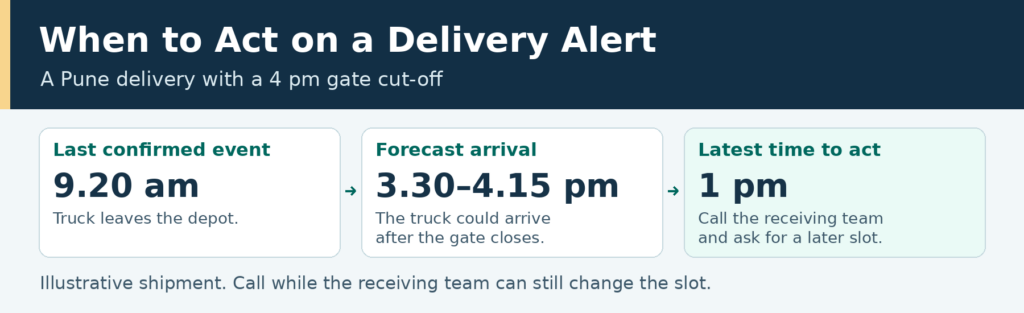
At ten in the morning, a supplier tells you the truck is on its way. Your warehouse stops accepting deliveries at four. The information you need is whether the driver can reach the right gate in time, and when you should free the unloading slot for another vehicle. That is a question you can answer with a phone call and a shared sheet. On a busy route, a good forecast can give you the answer earlier.
Whether you run a small factory, buy for a retail outlet or manage a warehouse, you can start with the shipments due today. Check where the goods were last confirmed, what deadline they are working to and who can intervene. Once you do this regularly, you will know which delays software could help prevent and which require a change in the way you dispatch or receive goods.
Before the truck leaves
Agree the receiving window and the latest time the vehicle can report at the gate. Confirm the delivery address and PIN code, the gate or loading bay, the receiving contact and any vehicle restrictions. For repeat customers, save the gate location and instructions against the customer record. Ask the transporter for a shipment reference and a contact who can act if the plan changes.
Check that the order, invoice or delivery challan, vehicle details and any required e-way bill match the movement. Agree who will handle any required update if the vehicle changes. The official GST e-way bill FAQ explains when a bill is required, its validity and how vehicle details are updated. [1]
What to check during the day
Use one shared sheet, or a view in the system you already have, with one row per shipment. Start with these fields. For a busy shift, put the next decision time in its own column so you can sort by it.
| What to record | Example | What it helps you do |
| Shipment reference and deadline | Order 2874 · Pune gate closes at 4 pm | Confirm which delivery is at risk |
| Last confirmed event and time | Left depot at 9.20 am | See how fresh the information is |
| Expected arrival and next decision time | 3.30–4.15 pm · call by 1 pm | Ask for a later slot while one is available |
| Owner and next action | Dispatch lead to call receiving team | Give one person responsibility for closing the loop |
When a delivery is at risk
If the arrival window overlaps the cut-off, check whether the receiving team can hold or move the slot. If a carrier update is overdue, label it “awaiting confirmation” and call the dispatcher. For a customer waiting on urgent stock, send a revised window, say what you have arranged and give a time for the next update. Keep the original confirmed deadline in your records so you can see how often promises had to move.
At delivery, record when the goods arrived and what the receiver accepted. Note shortages or damage on the delivery record and save the signed or digital proof of delivery with the shipment reference. That gives the accounts team something to work with if the invoice is disputed.
Use the tracker that fits the shipment
For parcels, enter the tracking number on the courier’s own site. If a parcel is marked undelivered, ask for the reason, confirm the address and receiving hours, and agree the next attempt. For a full truck, ask the transporter for the last confirmed event, its time and the expected arrival window. For an import or export container, enter the container number in India’s Logistics Data Bank. Ask the forwarder, terminal or shipping line to confirm the cut-off or booking you are working to. [2]
If your software provider offers a connection to the Unified Logistics Interface Platform (ULIP), ask them to show the exact event you need on a route you use, along with its timestamp and typical update lag. ULIP is a channel for integrating logistics data into software. A small shipper can get started with the carrier’s tracking page and a shared sheet. [3]
Order stock before you need an emergency delivery
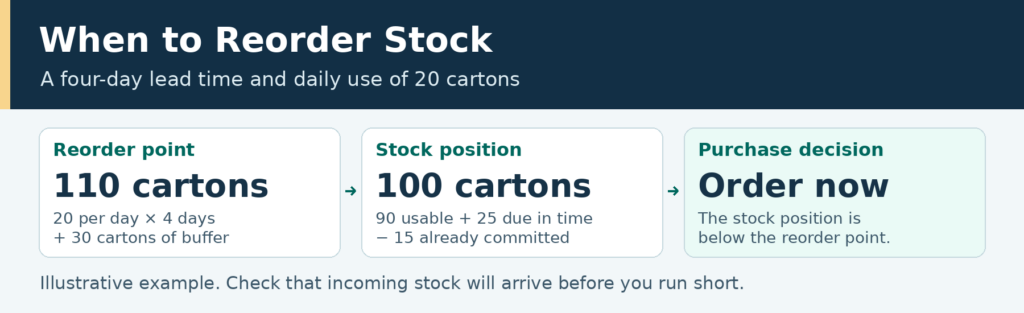
Start with an item that regularly runs out and check how many units you typically use each day. Measure the time from placing the purchase order until the goods are available to use. Include time spent waiting for unloading or inspection. Multiply daily use by that lead time and add a buffer for variation. This gives you a starting reorder point. [4]
Suppose you use 20 cartons a day, replenishment takes four days and you hold a 30-carton buffer. Your starting reorder point is 110 cartons. If 90 cartons are usable, 25 are confirmed to arrive in time and 15 are already committed, your effective stock position is 100 cartons. Place the next order. If an incoming load is due after the day you expect to run short, plan for the gap now. A transfer from another depot may cover it.
Before a festival or promotion, ask sales what is being promoted and the supplier what it can deliver. Review fast-moving items first. For perishable goods, check whether extra stock will sell within its shelf life before increasing the buffer. If an item regularly runs out despite a buffer, check whether demand has risen, whether orders are being placed late or whether the supplier is taking longer.
Compare freight quotes on the same terms
Put the rates for the same route and service window side by side. Ask what each quote includes for pickup, delivery, tolls, fuel, waiting and repeat attempts, as applicable. If a quote is for a parcel, check whether the carrier will charge by actual weight or by a weight calculated from the carton’s dimensions. Look at a few recent invoices for similar shipments and check what you paid after extra charges.
Suppose one transporter quotes ₹8,000 and charges ₹1,500 for a repeat delivery. A second quotes ₹8,300 and charges ₹1,000. If each needs a repeat trip once in five jobs, the expected cost is ₹8,300 versus ₹8,500 per shipment, using those assumptions. If the second has a better on-time record, the extra ₹200 may be worth paying when a customer faces a stockout or a production stoppage. Use your own invoices and delivery records to make that call.
When a forecast is worth paying for
An AI forecast can use recent journey times, past delays and live updates to estimate when a truck will arrive. Start with one busy route and one decision you can still change after dispatch. For instance, ask a provider to flag trucks likely to miss a receiving slot while the warehouse can still move it. Compare the forecasts with your current process, such as a dispatcher’s call or a carrier’s estimated arrival. Use comparable shipments in the same period where possible. Keep a record of the alert time, the action taken and the outcome. A month is a sensible starting point on a busy route. Extend the trial if too few shipments or disruptions occur to draw a conclusion.
| Measure | How to count it |
| On-time delivery | Deliveries within the original agreed window divided by shipments due. Include overdue shipments that are still open. |
| Alerts early enough to use | Among the alerts, count those that arrived before the deadline for changing the plan. Also count missed cut-offs with no alert and alerts cleared after a check showed there was no risk. |
| Cost per completed delivery | Add freight, waiting, repeat attempts and the software and staff costs of running the process. Divide by completed deliveries for the shipment group being compared. |
Before paying for a tool, ask to see it work with your own records. Check how it handles a missing update, whether staff can override a bad estimate and whether you can export your shipment history. Then look at what the trial saved in repeat trips, waiting or emergency freight and what it cost to run. If most problems begin with a wrong address or a warehouse that has already closed, fix that first. Where the next handover is genuinely hard to predict, a timely estimate can save a booking, a second trip or a call from a customer asking where the goods are.
Where businesses are using AI
Delhivery checks Indian addresses. Its AI-assisted maps use past delivery and location data to turn a written address into a map location. Delhivery says the maps went live across its internal operations. A shipper can test the value by comparing first-attempt delivery rates and address-related repeat trips. [5]
Urban Ladder plans furniture deliveries. A case study published by India’s electronics and IT ministry describes how Locus used order data to suggest vehicles and routes based on delivery requirements and customer time preferences. A distributor can track kilometres per completed stop and on-time arrivals to judge a similar system. [6]
An Indian grocery retailer forecasts stock by location. Technology supplier LTM describes a machine-learning project that forecasts demand separately for distribution centres and local fulfilment stores. It reports less waste and fewer stockouts at an unnamed retailer. Those are supplier-reported outcomes. [7]
How AI saves money on a delivery route
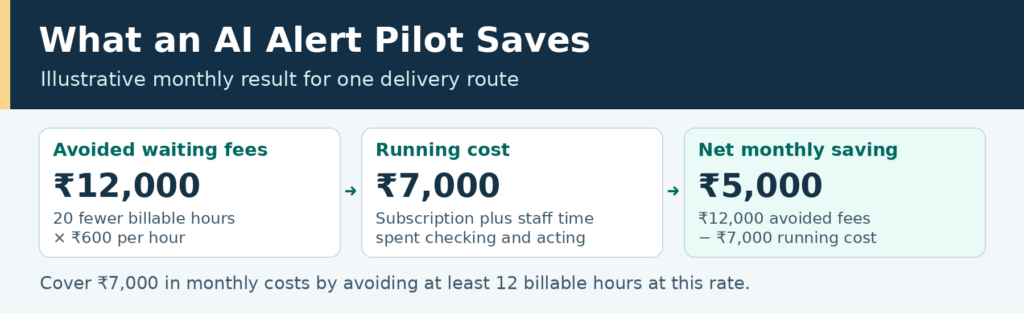
An early arrival forecast gives the warehouse time to move an unloading slot and the dispatcher time to tell the driver. If that prevents billable waiting, the saving appears on a freight invoice. A better address can avoid a repeat trip. A better stock forecast can reduce write-offs or the need for emergency freight.
Suppose comparable deliveries incur 20 fewer billable hours in a month at ₹600 an hour. That is ₹12,000 in avoided fees. If the subscription and staff time cost ₹7,000 a month, the net saving is ₹5,000 before any one-off setup cost. Track on-time delivery alongside costs to see whether the change also works for the customer.
Links for readers
[1] GST E-Way Bill System. Official FAQ on applicability, validity and vehicle updates
[2] Logistics Data Bank. Container tracking portal
[3] Unified Logistics Interface Platform. Portal and information on data integration
[4] Oracle Inventory. Reorder-point planning and safety stock
[5] Delhivery. Q3 FY26 shareholder letter on internal deployment of AI-assisted maps
[6] Ministry of Electronics and Information Technology. Urban Ladder and Locus case study on pages 67–68
