The Engineers Who Fixed the World Before They Fixed Home
For three decades, India built a world-class technology export industry around other countries’ demands. What changed when home finally became a market worth building for?
UPDATED AUGUST 2026
India’s software export story is rightly celebrated. It earned foreign exchange, created millions of careers and established the country as a trusted technology partner. Yet it also left a difficult question: if Indian engineers could modernise banks, airlines and supply chains across the world, why did so many systems closest to ordinary Indians remain paper-heavy, fragmented or unreliable for so long? The answer is not a failure of patriotism or ability. It is a story about customers, incentives, risk and buildability – and about what happened when those conditions finally began to change at home.
For most of three decades, the face of Indian technology ambition was a young engineer with a laptop, a passport and an onsite assignment. They flew to New Jersey to tend a bank’s mainframe, to London to untangle an insurer’s claims system, and to Frankfurt, Singapore or Sydney to keep the back offices of global companies running. They were good at it – exceptionally good.
The industry they helped build became one of independent India’s most consequential economic achievements. NASSCOM expected the broader technology sector to cross US$315 billion in revenue in FY2025-26 and direct employment to approach six million. In the preceding year, roughly four-fifths of industry revenue came from exports. The Reserve Bank’s narrower survey of software and IT-enabled services recorded US$204.7 billion of exports in 2024-25, before adding sales delivered through overseas commercial presence.[1,2]
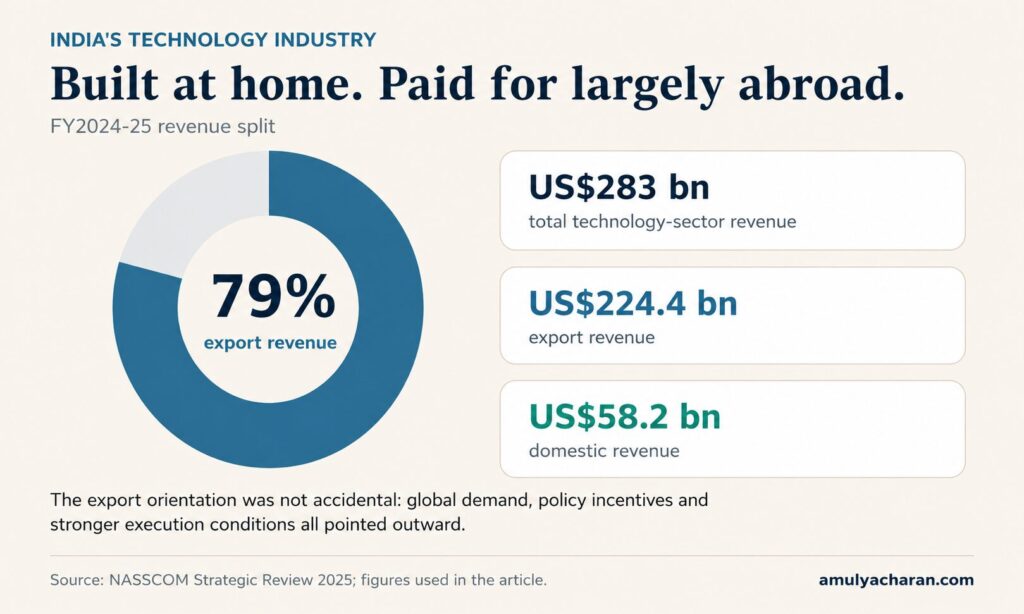
Figure 1. India’s technology industry remained overwhelmingly export-oriented in FY2024-25.
That success leaves an uncomfortable question. If Indian engineers could modernise the plumbing of American banks and European airlines, why did many systems nearer home – land records, municipal services, district hospitals, court registries and welfare offices – remain difficult to use, poorly integrated or dependent on paper? Why did so much of India’s best technical effort accumulate around other countries’ problems before it accumulated around its own?
The easy moral answers do not survive contact with the evidence. It was not a shortage of patriotism, and it was certainly not a shortage of talent. The more durable explanation is less dramatic: talent is not disloyal; it is responsive. It moves toward customers who can pay, institutions that can decide, projects that can be completed and careers that appear to lead somewhere. For a long time, most of those signals pointed outward.
The best-paying customer was usually abroad
Every business goes where the paying customer is. In the India of the 1990s, the customer with a large technology problem, a serious budget and a willingness to outsource was far more likely to be overseas than next door.
The industry did not begin with Y2K, but Y2K became a decisive inflection point. Western companies discovered that date fields buried in ageing code could disrupt critical systems at the turn of the millennium. They needed large numbers of programmers quickly. Indian firms already had a growing pool of engineers, English-language capability, experience with international clients and an emerging reputation for process discipline. A temporary emergency became a commercial bridge: once global firms had learned that complex work could be delivered from India, offshoring expanded well beyond the original problem.[3]
Then came the broader outsourcing wave. An engineer in Chennai or Bengaluru cost a fraction of an equivalent employee in the United States or Europe, while time-zone differences supported round-the-clock workflows. The gap between a rupee cost base and a dollar invoice created an unusually powerful business model. Selling comparable work to an Indian customer did not create the same currency spread, the same contract size or, in many cases, the same room for reinvestment.
Domestic demand was never literally absent. Indian banks, railways, telecom companies, exchanges, public enterprises and government departments did buy technology. But the market was smaller and more uneven. Many private firms were modest in scale and cautious about discretionary software spending. Public projects could involve dispersed authority, uncertain data, long procurement cycles and delayed payments. The overseas contract was often clearer, larger and easier to repeat. In a payroll-heavy business, choosing it was not simply greed. It was a rational route to survival and growth.
A machine built to earn dollars
If global demand pulled the industry outward, public policy gave it an additional push. That policy made sense in its historical setting. India emerged from the 1991 balance-of-payments crisis with an urgent need for foreign exchange, and software offered something unusually valuable: an export that required little imported raw material and could scale with human capital.
Software Technology Parks improved access to communications and export infrastructure. Sections 10A and 10B of the Income-tax Act, and later Section 10AA and the Special Economic Zone framework, provided tax incentives to qualifying units or undertakings that earned profits from software exports, subject to statutory conditions and time limits. These were not blanket exemptions for every software company, but they materially improved the economics of eligible export operations.[4]
The message to founders and finance chiefs was nevertheless clear: policy placed a heavy thumb on the export side of the scale. The foreign customer brought revenue, foreign exchange and, for qualifying operations, tax advantages. A domestic contract brought none of those benefits in the same combination.
The physical shape of the industry reflected the same logic. Technology campuses in Bengaluru, Hyderabad, Chennai, Pune and Gurugram were often built as self-contained islands, with reliable power, dedicated connectivity, security, food services and fleets of buses. This was a sensible response to weak urban infrastructure and the service promises made to overseas clients. But the insulation had a second effect: an engineer could spend years solving sophisticated problems for a bank in Boston while the paper-heavy public office a few kilometres away remained outside the commercial field of vision.
Services first, products later
The distinction between services and products is often drawn too sharply. Indian services firms have long performed consulting, architecture, research, engineering, design, integration and other high-value work. They did not merely follow instructions. Even so, the dominant commercial model rewarded a particular set of strengths: client service, process quality, large-team coordination, reliability and delivery against objectives substantially defined by somebody else.
A product company bears a different kind of risk. It must decide what to build, identify users who may not yet know what they need, finance development before revenue is certain, create distribution and absorb the loss when the bet is wrong. A conventional time-and-material or managed-services contract transfers less of that product-market risk to the provider and can scale with utilisation and headcount.
The imbalance remains visible in the export data. In the Reserve Bank’s 2024-25 survey, IT services accounted for US$131.3 billion of exports and business-process outsourcing for US$55.8 billion, while the category labelled software product development accounted for US$6.8 billion. These categories do not capture every Indian product company, but they show how heavily the export engine remained weighted toward services.[2]
The expertise followed the invoice. India became world-class at solving the problems the world was prepared to buy.
Over time, that meant deep expertise in global banking, retail logistics, enterprise software, telecommunications and insurance. There was much less commercial demand for companies to build comparable institutional knowledge around a district health system, a municipal water network, agricultural extension or a lower court. This did not leave Indian engineers incapable of product thinking; it meant that the market paid them far more consistently to apply that thinking elsewhere.
The opportunity cost should not be exaggerated into a single-cause theory. Weak public systems also reflected fragmented authority, poor records, limited budgets, political choices, procurement design and shortages of domain capacity. The software export industry did not create those problems. But its orientation meant that relatively few institutions were prepared to pay sustained, top-tier technical talent to master them.
Home was the harder system
Money and policy were only part of the story. Building for India was – and often remains – a harder systems problem. Much of that difficulty sits outside the code.
Rich-country enterprise systems were never as clean or modern as nostalgia suggests; Y2K itself was proof of their legacy debt. But a typical global corporate client was more likely to offer reliable electricity and connectivity, digitised records, a standard working language, a defined budget, experienced project ownership and an enforceable commercial framework. The rails might be old, but they were usually visible.
In India in the early 2000s, a public-facing system could require the builder to lay the rails as well as run the train. Records might exist only on paper, in multiple scripts, with incomplete or inconsistent fields. Identity documents existed, but they were fragmented and often difficult to verify digitally across institutions. Electronic payment mechanisms were developing, yet there was no ubiquitous, interoperable mobile retail-payments layer comparable to UPI. Bandwidth was limited, devices were expensive, digital literacy was uneven, and the eventual user might speak or read one of India’s 22 scheduled languages – or one of many other languages and dialects.[5]
Government procurement added another layer. Its procedures are designed, properly, to protect public money, maintain competition and survive audit. Formal procurement frameworks have never required every consultancy or technology contract to be awarded on price alone; quality-and-cost methods are available. In practice, however, procedural defensibility and evaluated cost could be easier to reward than iterative design, user research, maintainability or long-term outcomes. A file moving slowly through multiple authorities could turn a technically manageable project into a commercial hazard for a small vendor.[5]
The foreign work was therefore not only richer. It was often more buildable: the customer could define the problem, provide the data, approve the change and pay the invoice. That difference in buildability may have mattered as much as the difference in salary.
The dream came with a visa
Institutions shaped the industry, but so did personal aspiration. For an individual engineer, an onsite posting could mean a higher income, global exposure, professional status and the possibility of a longer life abroad. In many families, it became a visible sign that education had paid off.
The legal path was more complicated than popular memory sometimes suggests. An H-1B is a temporary non-immigrant employment classification; it does not automatically turn into a green card. But an H-1B job could provide a foothold from which an employee and employer later pursued a separate permanent-residence process. For many young professionals, that possibility mattered.[6]
Large numbers of graduates from leading engineering institutions built careers in the United States and elsewhere. Some stayed permanently; some returned; many moved back and forth, founded companies, mentored teams, invested in India or connected Indian firms to global markets. The story was never a one-way evacuation of talent. Yet the prestige attached to overseas work was real, and the domestic alternative often offered lower pay, slower institutions and less certainty that a difficult project would ever be allowed to succeed.
That was not betrayal. It was a rational response to the opportunity set. A country cannot ask its young people to choose its hardest problems on sentiment alone; it has to make those problems credible careers.
The exceptions that showed what was possible
India did build important systems for itself during the export era, and the exceptions reveal what the wider market lacked. Indian Railways created large-scale online reservation services. Banks computerised despite substantial labour concerns and resistance. The National Stock Exchange commenced electronic, screen-based trading in 1994, while dematerialised trading and settlement expanded in stages from the mid-1990s. C-DAC was established in 1988 in the context of the United States denying India the import of an advanced supercomputer, and went on to build the PARAM family. Space, defence and scientific institutions developed complex software throughout.[7]
These successes did not all follow one formula, and not every public technology project succeeded. Still, most had a powerful institutional sponsor, a clear national mandate, the authority to set standards and a large, assured user base. They did not have to discover whether a market existed; the institution commissioning the system was also in a position to create the market around it.
That combination – authority, budget, data, standards, risk-bearing capacity and users – is close to a practical definition of buildability. Where it existed, Indian engineers demonstrated that the constraint was not technical ability.
Coming home – and what actually changed
The turn toward India over the past fifteen years was real, but it should not be romanticised as a sudden return of patriotism. The homecoming was institutional more than literal. Not every builder came back from abroad. Rather, capabilities developed across export firms, global capability centres, government, banks, universities and startups increasingly found domestic problems that could attract capital, authority and users.
Several conditions changed at once. Smartphones and inexpensive mobile data became vastly more widespread, although not universal. Indian consumers and businesses came online at scale. Venture capital and a domestic startup ecosystem made product risk financeable. Regulators and public institutions developed greater technology capacity. Most importantly, digital public infrastructure began to provide common rails on which many different services could be built.
Aadhaar created a portable, digitally verifiable identity credential for well over a billion residents. That was a major administrative capability, but its legal meaning must remain precise: Aadhaar is proof of identity and address for a resident; it does not confer citizenship or domicile, and it does not by itself prove eligibility for every benefit or the truth of every underlying record.[8]
UPI created an interoperable, real-time retail-payments layer that connected banks, apps, consumers and merchants. In May 2026, it processed about 23.2 billion transactions. By transaction volume, India had become the world’s leading real-time retail-payments market; that statement should not be confused with leadership by total transaction value, because UPI is especially strong in frequent, relatively low-value payments.[9]
India Stack is not one platform but a name for a collection of technology products, open APIs, standards and policy frameworks maintained by different institutions. GSTN provides common and shared technology infrastructure for the Union, states, taxpayers and other stakeholders. CoWIN served as the digital backbone for registration, appointment management, monitoring and certification during a vaccination programme that administered more than 2.2 billion doses; healthcare workers and the health system, not the software, delivered those vaccinations.[10,11]
These were Indian-led systems, but not the work of a single agency or a closed national team. They emerged from multi-institutional ecosystems involving government departments, regulators, banks, public bodies, private vendors, technologists, nonprofits and, in some cases, development partners. Their achievement lies not in having excluded every outsider, but in having organised Indian institutions around Indian-scale needs.
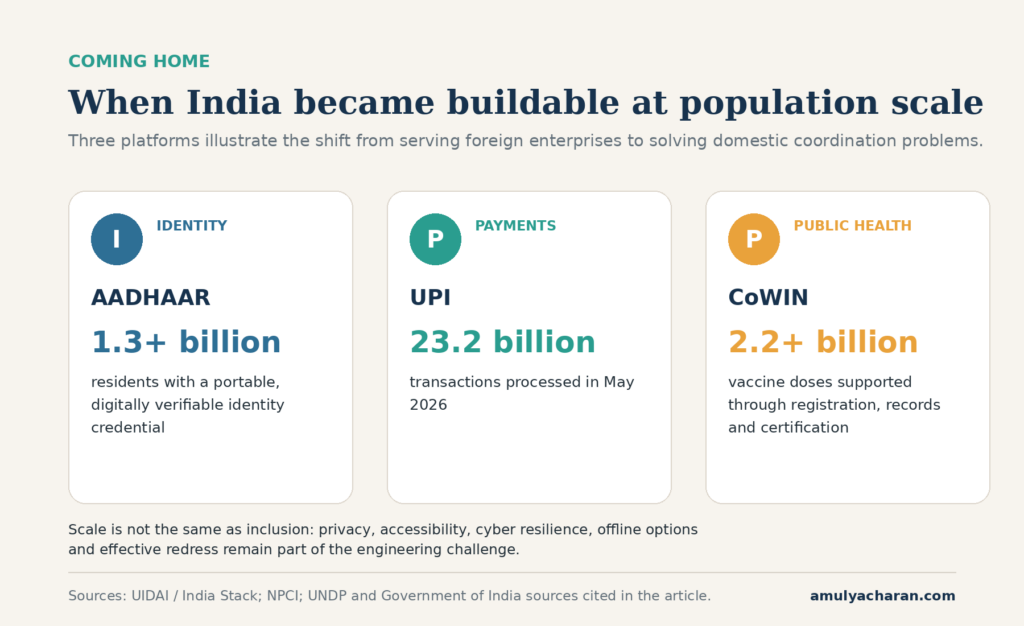
Figure 2. Population-scale digital public infrastructure helped make domestic problems more buildable.
Around those public rails, a genuine product economy took shape in commerce, finance, logistics, mobility, education, healthcare and business software. The domestic customer had not merely appeared; it had become large enough, connected enough and willing enough to pay for products designed around Indian conditions.
Scale is not the same as inclusion
The new story also needs guardrails. A system can be technically impressive and still fail an individual user. At population scale, a small error rate can affect a very large number of people. Digital identity can simplify access, but authentication failure, inaccurate records or the absence of an alternative channel can also exclude. Fast payments can reduce friction, but fraud, social engineering, outages and weak grievance handling can quickly erode trust.
Privacy, consent, cyber resilience, accessibility, multilingual design, offline options and effective redress are therefore not decorative policy concerns. They are part of the engineering specification. The Reserve Bank’s work on digital payments repeatedly stresses integrity, inclusion, security and consumer protection, while also documenting risks such as phishing, vishing, malware and misuse of payment requests.[12]
Nor can software substitute for institutions. CoWIN could schedule and record a vaccination, but it could not manufacture a dose or replace a nurse. A court platform can organise filings, but it cannot by itself create judges, improve legal reasoning or guarantee due process. A school application can distribute content, but it cannot substitute for teaching. Technology becomes transformative when it strengthens an accountable service, not when it is mistaken for the service itself.
The definition of buildability must therefore evolve. A system is not truly buildable merely because the code can be written. It must also be lawful, secure, maintainable, financially sustainable, accessible to the weakest user and capable of being challenged when it gets something wrong.
What the export era cost – and what it made possible
Two truths can be held at once. The export era was not a betrayal. It brought in foreign exchange, expanded India’s urban professional middle class, created direct and indirect employment, built global trust and trained a vast base of technical and managerial talent. Much of what India can now do at home was made possible by capabilities accumulated while serving clients abroad.
There was also an opportunity cost. For a long period, the best-paying and most executable work sat outside the country, while many domestic public problems attracted too little sustained technical investment. That does not mean Indian engineers caused public systems to remain weak. It means the incentives around those systems were rarely strong enough to compete for the same talent, attention and institutional discipline.
The lesson is not guilt. It is mechanics. Talent generally moves toward reward, professional growth and a reasonable chance of completion. A nation that wants its best people working on its hardest problems has to make those problems payable, governable and buildable. It must fund outcomes rather than ceremonial launches, reward quality rather than only the cheapest compliant bid, create interoperable standards, protect data, involve domain experts and allow teams to learn through iteration without abandoning public accountability.
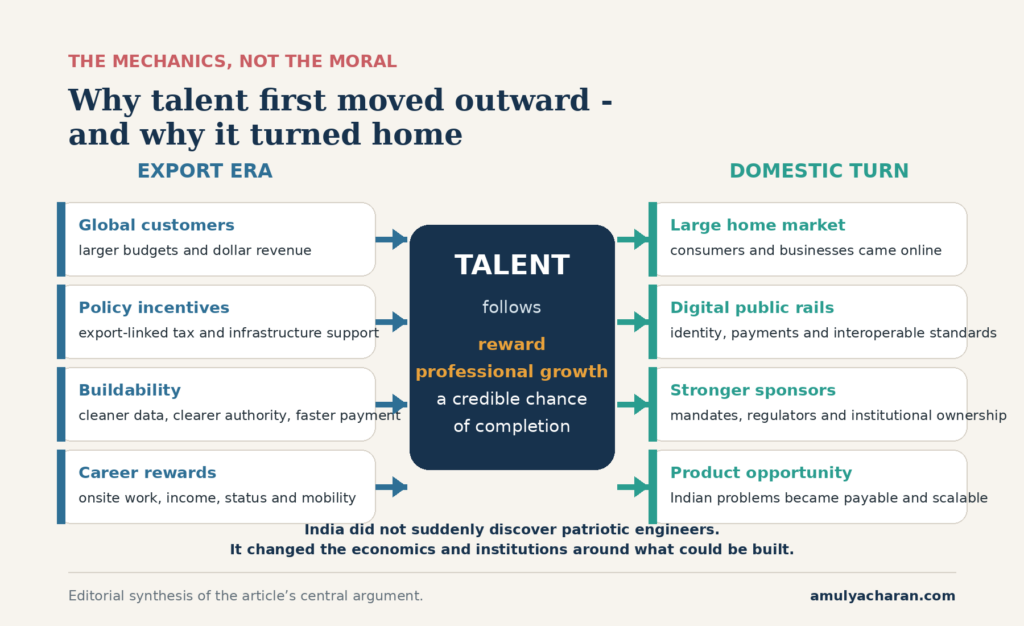
Figure 3. Talent followed the combination of reward, professional growth and a credible chance of completion.
The next homecoming
India has shown that it can create population-scale digital identity and payment infrastructure. The next frontier is more difficult because health, justice, education and local government cannot be reduced to a single transaction layer. Their data are more sensitive, their outcomes are harder to measure and their failures can cause deeper harm.
That makes the institutional work even more important. Health systems need longitudinal records, consent and clinical responsibility. Courts need reliable digital case management without compromising open justice or due process. Schools need tools that serve teachers and students across languages and levels of connectivity. Panchayats and municipalities need systems simple enough to use, resilient enough to survive poor networks and transparent enough to strengthen local accountability.
The engineers are ready. They were always ready. What changed was not their affection for the country but the country’s capacity to turn difficult needs into credible projects. The challenge now is to extend that capacity beyond identity and money – and to do it without confusing scale with success, software with service, or digitisation with reform.
For thirty years, India became indispensable by fixing the world’s systems. Its next achievement will be measured by how well it builds institutions that make the hardest problems at home worth a clever person’s best years.
Sources and notes
The numbered notes support the principal quantitative, historical and regulatory claims. They are provided as editable hyperlinks rather than as exhaustive academic citations. Accessed 1 August 2026.
1. NASSCOM, Technology Sector in India: Strategic Review 2026; NASSCOM, Technology Sector in India: Strategic Review 2025 The 2026 review projected sector revenue above US$315 billion and direct employment of about six million; the 2025 review reported the export-domestic revenue split for FY2024-25.
2. Reserve Bank of India, Survey on Computer Software and Information Technology Enabled Services Exports: 2024-25 The survey reported software-services exports of US$204.7 billion and provides the export-category figures used in the article.
3. Devashish Mitra and Priya Ranjan, Y2K and Offshoring: The Role of External Economies and Firm Heterogeneity, NBER Working Paper 11718; Ashish Arora and Surendra K. Bagde, Human Capital and the Indian Software Industry, NBER Working Paper 16167 These papers support the treatment of Y2K as an accelerator with persistent effects and the importance of India’s engineering talent base.
4. Central Board of Direct Taxes, Clarification on direct tax benefits relating to export of computer software The clarification describes incentives under Sections 10A, 10AA and 10B as applying to qualifying units or undertakings subject to prescribed conditions.
5. Department of Official Language, Languages Included in the Eighth Schedule of the Indian Constitution; Reserve Bank of India, Report on Currency and Finance 2023-24; Department of Expenditure, Government of India, Procurement Manuals These sources support the terminology “22 scheduled languages”, the historical development of digital payments and the existence of procurement methods that combine quality and cost.
6. US Citizenship and Immigration Services, H-1B Specialty Occupations; US Citizenship and Immigration Services, Permanent Workers H-1B classification is temporary non-immigrant status; lawful permanent residence is obtained through a separate immigrant process.
7. National Stock Exchange of India, History and Milestones; National Stock Exchange of India, Depositories; Reserve Bank of India, Banking computerisation and technology history; C-DAC, About C-DAC and the PARAM programme The transition to electronic trading and dematerialised settlement occurred in stages; C-DAC was established in the context of US denial of supercomputer imports.
8. Unique Identification Authority of India, What is Aadhaar?; India Stack, Identity UIDAI describes Aadhaar as proof of identity for residents and expressly states that it does not confer citizenship or domicile.
9. National Payments Corporation of India, UPI Product Statistics; Press Information Bureau, Ten Years of UPI; Reserve Bank of India, Annual Report 2023-24: Payment and Settlement Systems and Information Technology NPCI reported 23,201.93 million UPI transactions in May 2026. Official sources describe UPI as the largest retail fast-payment system by transaction volume.
10. India Stack, Frequently Asked Questions; Goods and Services Tax Network, About GSTN; Goods and Services Tax Network, GST System India Stack is a collection of products and frameworks owned or maintained by different institutions; GSTN provides common and shared technology infrastructure for multiple public and private stakeholders.
11. United Nations Development Programme India, Winning Over COVID (CoWIN); UNDP India, Equitable access to healthcare services through digital health platforms CoWIN supported registration, appointments, monitoring and certificates for a vaccination programme that administered more than 2.2 billion doses.
12. Reserve Bank of India, Report on Currency and Finance 2023-24, Chapter III: Digitalisation and Payment Revolution in India; Reserve Bank of India, Master Directions on Cyber Resilience and Digital Payment Security Controls for non-bank Payment System Operators, 2024 These sources discuss digital-access constraints, fraud typologies, consumer protection and cyber-resilience requirements.
————————————————————————————————————————————
Amulya Charan writes on energy systems, infrastructure economics, and development policy at amulyacharan.com.
Critical factors in the next frontier would be delivery of Justice; Judicial Reforms to speed up the process and thereby improve the accountability along with Police Reforms.
In the field of Education, I believe we are better off comparatively, though the same cannot be said of Public Health.
An excellent analysis, as always. I take this opportunity to recollect my own personal experience of building from scratch, an India based offshore Engineering Services organisation with global customers. One attractive point was that major customers in the US paid on time. I tried my best to provide design services for Indian customers, large companies, however our payment was usually extended to 90 days, even 120 days. We had to keep chasing customers’ Finance department to release payment. Another factor was that Indian customers constantly increased the scope of project and also tried to rush the timelines, at the same time they did not compensate for the increased efforts and resources put on the project, this reduced margins substantially. On the other hand, overseas companies in the US were more disciplined in terms of following the signed agreement/ Scope of Work. Net result, our customer mix finally became 97% overseas customers and only 3% domestic. Not our fault. We tried.
Coming to Indian product development, as a country, we are nowhere close to being the Top5 in software and AI , the very same companies where Indians are CEO’s / CTO’s. This is a problem to be addressed
We are also not among the Big 5 global Consulting Companies (where again Indians are in leadership positions) . Again this is a problem of our own making and needs to be addressed
India is the Top3 Automotive market in the world. Here, Indian owned desi manufacturer is No. 1 in scooters. But in cars as well as Trucks, Indian owned manufacturers are nowhere among the Top10 worldwide . Again this is a problem of our own making, and needs to be addressed.
in Mobile phones, India has emerged as a destination to make them. But no Indian owned desi company can be counted among the world’s Top 10. Same for Battery packs, Laptops, Washing machines, and many other products.
Coming to Commercial Aircrafts, we are highly dependent on the US and Europe. We have nothing domestically.
All these need to be analysed, debated and solutions found so that the next 20 years brings about a sea change and miracle in India’s Product journey.